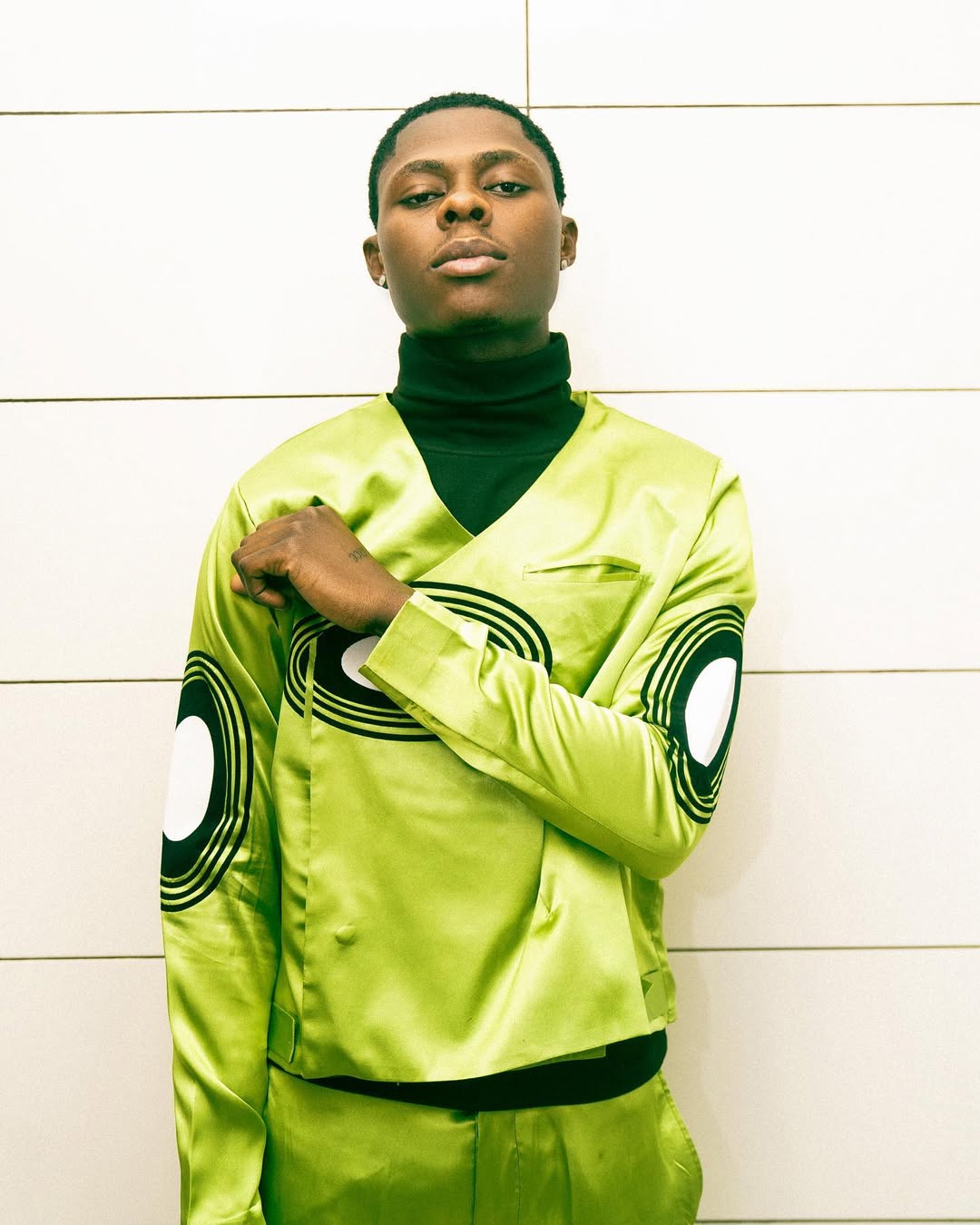
There are artists who make hits. Then there are artists who make moments. Mohbad was the latter. His sound felt like a Friday night in Lagos — loud, unpredictable, full of emotion. One minute he’s singing about survival with grit and gravel in his voice, the next he’s riding a beat that could light up an entire room.
Mohbad’s work lingers. It’s not just the rhythm, it’s also the honesty. His lyrics echo real-life Lagos: the resilience, the hustle, the small joys. Whether it’s a slow groove or rapid-fire delivery, there’s always a sense of purpose. Each verse came across as personal, made for the listener who needed to feel seen, even in the middle of a packed dancefloor.
And the reach was wide too. From house parties in Surulere to playlists in London, his sound travelled far, touching people wherever it played.
These five songs have been on loop since the day we heard them, and we’re not hitting pause anytime soon.
And then there’s the more recent collab that stole our hearts, “Egwu” with Chike. A rich mix of soul and rhythm that had us dancing, and still keeps us grooving like it’s brand new.
In celebration of its 10th anniversary, Apple Music has unveiled its list of the 500 most-streamed songs of the decade, with Ed Sheeran’s global hit Shape of You taking the top spot.
The British singer-songwriter’s 2017 track has outperformed every other song on the platform in the past 10 years, beating The Weeknd’s Blinding Lights and Drake’s God’s Plan, which landed in second and third place respectively.
Upon its release, Shape of You shattered Apple Music’s record for the highest number of first-day streams and went on to dominate the Billboard Hot 100 for 12 consecutive weeks. The track later earned Ed Sheeran a Grammy Award for Best Pop Solo Performance in 2018.
The remainder of the top 10 features a mix of pop and hip-hop heavyweights. Post Malone makes two appearances with Sunflower alongside Swae Lee at No. 4 and Rockstar featuring 21 Savage at No. 5. Other chart-toppers include Drake’s One Dance featuring Wizkid and Kyla, Travis Scott’s Sicko Mode, Sheeran’s Perfect, Chris Brown’s No Guidance, and Billie Eilish’s Bad Guy.
Drake holds the title for the most entries on the list, with 27 songs making the cut. Taylor Swift follows with 14, while Mariah Carey secures a notable spot as the only artist with a holiday track in the upper rankings, her classic All I Want for Christmas Is You lands at No. 100.
To mark the milestone, Apple Music released a special playlist featuring the full 500-song lineup and shared an exclusive interview with Ed Sheeran. Reflecting on the enduring success of Shape of You, Sheeran told Zane Lowe, “No one can take away the song. I’ll be able to play it forever… I’m just grateful to have songs like that, where anywhere in the world, you can pick up a guitar and make someone happy.”
The full list of all most-streamed songs and playlist are now available for streaming on Apple Music.
JUST IN:
Ed Sheeran's "Shape of You" is officially the #1 Most Streamed Song in Apple Music History pic.twitter.com/11gMqLGVxv
As OkayAfrica marks our 15th anniversary, we're taking a look back at 15 defining African moments of the past 15 years that deserve to be remembered, and the impact they've had. Here's Moment No. 11.
For his first cover as the Editor-in-Chief of British Vogue, Edward Enninful refused to play it safe. Photographed, in a stunning close-up shot with spare but striking make-up, was British-Ghanaian model Adwoa Aboah. And next to Aboah was a list of names of people from diverse disciplines, including politics, music, literature, acting, and of course, fashion. It was revolutionary and striking with its perspective. Like Aboah, Enninful is also of Ghanaian heritage, and as the first African and Black man to ever lead British Vogue, Enninful wanted to make a statement.
Throughout his illustrious and vibrant time as editor-in-chief, that is exactly what he did. Where other major magazines shied away from conversations around diversity or representation, Enninful unabashedly took it on. During his tenure, the covers and pages of British Vogue illustrated the diverse and colorful world in which Enininful lived and wanted to see reflected. Enninful took up the most powerful position at British Vogue when the magazine struggled to find an identity that accurately captured the times. With that in mind, he gave the magazine a vibrant, urban slant and made it culturally aware, even ahead of the zeitgeist.
Enninful's time coincided with the rise of a new generation of boundary-pushing fashion creatives from Africa or of African descent in the global scene. From trailblazing designers like Thebe Magugu, Kenneth Ize, and Virgil Abloh, to models like Mayowa Nicholas, Adut Akech, and Anok Yai, to photographers like Campbell Addy, Trevor Stuurman, and Stephen Tayo, and editors like IB Kamara and Chioma Nnadi, these creatives found their feet and carved their paths in their various careers within the fashion industry. Their work enlivened an industry that desperately needed a fresh sensibility.
Reclaiming our narrative
Within the last decade and half, African creatives have played a central role in some of the most culturally significant fashion moments — from editorials, to campaigns, runway shows, among others. One high-profile example is Beyoncé’s Black Is King visual album which enlisted a constellation of African talent including Daniel Obasi, Conrad Egyir, Sarah Diouf, Emmanuel Adjei, Joshua Kissi, and Loza Malèombho, to reimagine the Lion King mythology through an unapologetically African lens.
Together, they ushered in a shift in the industry, one that went beyond tokenism to real presence and power. Africa has always had a voice in the world of fashion, but it wasn’t always pronounced, and it certainly wasn’t a voice with much agency.
“From an editorial lens, it’s no longer just about spotlighting ‘African prints’ or singular aesthetics — it’s about capturing a dynamic, multifaceted fashion narrative that reflects modern Africa’s cultural complexity,” fashion editor and producer Ekow Barnes tells OkayAfrica.
From Barnes’ perspective, there is also a growing respect for authenticity and unparalleled individuality, which is affirming the place that African creatives occupy. “Publications are realizing that telling African fashion stories requires more than just exotic visuals — it demands context, credit, and collaboration with creatives who understand the cultures behind the clothes,” Barnes says. “We’re seeing more African writers, editors, and photographers being given platforms to speak for themselves, rather than being spoken about.”
The modeling success story
In modelling, the status quo has also seen considerable change in the last decade and half. In the past, a model from the continent would occasionally be discovered and end up being the only African on runways for years, thus limiting the ideas of beauty and the ideal bodies on which clothing can be made. There were, and in some ways, still, issues of exotification that are being addressed. Nonetheless, the 2010s brought a radical change to the treatment of, and the place of African models in the global fashion industry.
This shift prompted Enninful and British Vogue to celebrate the rise of the African model with its February issue in 2022. “The nine models gracing the cover are representative of an ongoing seismic shift that became more pronounced on the SS22 runways; awash with dark-skinned models whose African heritage stretched from Senegal to Rwanda to South Sudan to Nigeria to Ethiopia,” the magazine wrote on Instagram about the cover.
And for Enninful, the rise of the African model on the global scene is more than symbolism or beauty standards. “It is about the elevation of a continent. It is about economics, access, culture, perspective, difference and wonder. And it is here to stay,” he wrote in his editor’s note.
Frontrunners like Nicholas helped democratize the industry for emerging African models, says Dolapo Habeeb, the founder of the modelling agency Inline. Nicholas was discovered in Nigeria by Elite Model Look scouts while on her way to a hair salon in 2013. She went on to win the Nigeria competition the following year. She later became the first Nigerian to star in campaigns for Dolce & Gabbana, Saint Laurent, and Calvin Klein.
Yai, who is from South Sudan, became a viral sensation following a photo of her at Howard University’s homecoming in 2017, leading to her runway debut in 2018 where she became the second Black woman to open for Prada, after Naomi Campbell.
Habeeb also cites the success of Eniola Abioro, who transitioned from teaching to modeling, and walked for Prada, and Ama Okolo, who trained in human anatomy, and is forging a new path entirely.
“These are not just modeling success stories, they're examples of how diverse, intelligent, and multidimensional African talent is,” Habeeb tells OkayAfrica.
Trailblazing designers and ecosystem builders
The world of fashion and garment-making has also fared well. Couture brands like Orange Culture, Thebe Magugu, Maki Oh, Kenneth Ize, Lagos Space Programme, Diarra Blu, and many others have broken through hallowed institutions. Their works have been nominated for some of the world’s biggest prizes, and their pieces worn by the world’s biggest stars and dignitaries and featured at major fashion events like, more recently, the 2025 Met Gala, where African designers earned significant red carpet attention.
“Designers are embracing sustainability, heritage, and innovation, while digital platforms are helping local talent reach global audiences,” says Barnes.
But behind the runway moments and international acclaim is the often quieter, steady work of ecosystem builders — those laying the groundwork so this wave of African talent could thrive. Since 2011, Omoyemi Akerele has run the renowned Lagos Fashion Week, a multi-day affair where many of the continent’s biggest fashion brands first found their footing.
Other ecosystems like the Dakar Fashion Week, GTCO Fashion Weekend and Arise Fashion Week have also been instrumental in providing fashion talents with spaces to show their creativity. And pushing the needle even further, streetwear, alt-culture spaces like Street Souk, which hosts streetwear brands from across the globe, are providing dynamic means of expression.
Meanwhile, agencies like Beth Model Management, established in 2004, have played a crucial role in discovering and developing modeling talent. Founded by Elizabeth Elohor Isiorho, the agency runs the Elite Model Look competition in Nigeria. It has helped launch the careers of models like Nicholas, bridging the gap between local promise and international opportunity.
Keeping the momentum going
Still, as the industry levels up, the challenges that African creatives face remain stubbornly present, say Habeeb and Barnes. Visa restrictions, limited access to funding, and the lack of creative infrastructure continue to slow progress. “There’s still a need to deepen the infrastructure that supports creative careers on the continent,” Barnes says.
In response, many creatives are taking matters into their own hands — using social media platforms to reach global audiences, build their own communities, and monetize their work directly, says Habeeb. “Social media played a role, Diversity, Equity and Inclusion conversations put pressure on brands, and more importantly, African-led agencies and managers started taking control of their narratives,” Habeeb adds.
“We are now making sure that our models understand their value from the beginning. We don’t just scout, we equip them with knowledge, strategy, and support systems that allow them to sustain their careers.”
Ultimately, the future looks good for African fashion creatives. The continent has been heralded as the next frontier for the next stage of global fashion — a completely justifiable prediction. But to keep the momentum going, the industry needs to scale investment and education, and push beyond the limits of major urban centers, says Barnes. “Finally, fashion education and media literacy should be scaled so that emerging creatives are equipped not just with skills, but with the tools to own their narratives.”

 Connexion
 JUST IN:

 (@AlbumTalksHQ)


