❌

Vue normale

Reçu avant avant-hier
  • ✇Afrocritik
  • Where Are Nigeria’s Established Bestseller Lists?
    Publishers need to invest in education and literacy initiatives. The idea is that such an investment creates tomorrow’s readers—the customers who will buy books when the contemporary readers are no longer there. By Chimezie Chika One of the long-running omissions of Nigeria’s publishing industry is the absence of regular weekly bestseller lists. We know on occasion—usually by hearsay—what books are movin
     

Where Are Nigeria’s Established Bestseller Lists?

3 septembre 2026 à 05:50

Publishers need to invest in education and literacy initiatives. The idea is that such an investment creates tomorrow’s readers—the customers who will buy books when the contemporary readers are no longer there.

By Chimezie Chika

One of the long-running omissions of Nigeria’s publishing industry is the absence of regular weekly bestseller lists. We know on occasion—usually by hearsay—what books are moving numbers, but no official list in this country collates bestselling books weekly and ranks them by sales. 

One drawback of this absence is that, in an industry as large as ours, no one has concrete information on the numbers around our bestsellers. When all is considered—the industry’s infrastructural deficits notwithstanding—one must conclude that we seem to be operating in an industry that thrives on withholding information. Perhaps thrive is the wrong word here, for withholding information as far as sales go has never helped anybody in publishing. 

But bestseller lists have changed the industry considerably in terms of circulating valuable business information on sales data and creating further demand. Putting aside the sales engineering that this is hinting at, bestseller lists are immensely beneficial for publishers and authors alike. For the former, they are marketing tools and provide signals about where the market is leaning; for the latter, they create visibility, credibility, and the ability to command higher future advances. 

One example is what the phrase “The New York Times Bestseller” pasted on the front cover does for a book published in the United States or what The Sunday Times version of that phrase does for a book published in the UK. Can we not create something that would make it possible to put a similar phrase on books published in Nigeria? Something along the lines of “No. 1 on The Vanguard’s Bestseller List” or “No 2 on Open Country Mag Bestseller List” or “No. 3 on Afrocritik’s Bestseller List”. 

Bestseller
Credit: The All Nigerian Girl

The idea of becoming a bestseller gives a social—and even psychological—weight to a book. This is purely on the basis of publishing and marketing rather than the quality of the writing. While it is hard to determine what kind of books readers will like and buy, collecting data on reader preference goes a long way in providing leverage for stakeholders within the publishing industry. 

Some people may begin to point to Open Country Mag/RovingHeights Bestseller List as an example of one such initiative in this country. Need I remind them that the Open Country list is an annual one (though a remarkable one in the desired direction). 

The kind of list I am pitching for here is weekly or monthly lists which, over time, are collated to give a more comprehensive picture of sales figures within the industry, usually at the end of the year. By these indices, almost anybody can reasonably estimate how many copies a book sold by simply going through bestseller lists—week by week or month by month—during the given year. 

Transparency and Bestseller Lists

For all intents and purposes, Nigeria is not a transparent state, has proven not to be so, particularly in much of its public affairs. This is why a bestseller list in Nigeria will return paradoxical results, if not managed well. On one hand, bestseller lists are an exercise in transparency in that all stakeholders in the industry—publishers, bookstores, authors, the National Archives—are willing to give sales information to make this possible. 

Imagine what would happen if each of these stakeholders willingly gave data on sales? I wager we would have relatively comprehensive and credible bestseller lists. Conversely, when any or all of these stakeholders withhold such information, the bestseller list becomes a partial representation of actual sales in the country or, worse, completely nonexistent. 

I have already given an example of a part-representation bestseller list: The Open Country Mag/RovingHeights List. This list is strictly restricted to sales data from Nigeria’s largest bookstore, RovingHeights, yet the data shows that in the year 2025, the bestselling book in Nigeria from the bookstore, billionaire Femi Otedola’s memoir Making it Big: Lessons from a Life in Business, sold over 8,000 copies (the biggest for a single book since the list was launched), followed in second place by Chimamanda Ngozi Adichie’s novel Dream Count, which sold more than 4,000 copies. 

Dream Count
Dream Count

Musing on these data, Open Country Mag would go on to note: “The only bigger winner is the publisher of those two books: Narrative Landscape Press, the first press to claim the Top 2 spots.” They also noted the limitations of using only one bookstore’s data as a yardstick. According to them, Nigerian publishers tend to sell more copies of their books than bookstores. 

They referenced Narrative Landscape again, “which also released and primarily sold another bestseller in Chude Jideonwo’s How Depression Saved My Life.” This makes sense for a book like Adichie’s Dream Count, her first in 12 years, which would have—judging from speculations—been the number 1 on a comprehensive bestseller list. Speculations online earlier this year were that the book would probably have sold over 15 thousand copies, with some putting the figures at over 25 thousand. 

Speculations like this are only possible because the country—and more specifically, the entire publishing ecosystem—is not transparent enough with sales data. In the same vein, Fatima Bala appears to dominate fiction sales this year. We will see what the 2026 Open Country Mag/RovingHeights list would reveal. 

On the other hand, transparency can be doctored, gamed, or twisted to serve the interests of those concerned. One of the most controversial subjects of bestseller lists has been how easily they can be tailored to suit a publisher’s agenda. Some sales data can be skewed to favour certain books or genres. It is well known that Amazon bestseller lists can be easily doctored simply by choosing less-popular categories (meaning fewer sales push the book into bestseller spots), or by engineering the preorders. This is perhaps why authors hustle so desperately for preorders these days. 

Historically, this was not how bestsellers happened. This happened organically. A book is released (touted, marketed), and its sales pick up as demand rises with ads, reviews, and word-of-mouth, building up to a buzz (to be fair, these still play a part in the making of bestsellers). In fact, one of the major bestsellers of this year in the US is an initially self-published book by an American retiree, whose sales were first boosted by word-of-mouth. The book in question, Theo of Golden, has now sold more than 3.5 million copies. 

Bestseller
Theo of Golden

Official bestseller lists, as an editorial product, were first created by The Bookman, an American literary magazine, in 1895. Afterwards, Publishers Weekly began its list in 1912, while the famous The New York Times list was first published in 1931. All collated their lists by tracking sales across bookstores nationally. A major question to ask in the bestseller discourse is what exact numbers make a book a bestseller? 

It will immediately become clear that this is dependent on the country or the book demand within a location. There are countries where selling 10 thousand copies doesn’t make you a bestseller, but there are countries where a mere 5000 copies makes you an absolute chart topper. It has always amused me that books that sold a thousand or two thousand copies in Nigeria are considered bestsellers (though, again, this makes sense as data from one bookstore). But is it not a mark on our publishing, literacy, or education infrastructure?

Poor Infrastructure or a Lack of Will

I have always argued that the publishing industry should synergise and grow its own market. This is the innovation publishers must commit to in a country like Nigeria, where government is failing to invest in literacy and fight piracy. While we must continue to hold government accountable, publishers must be willing to go the extra mile. 

Publishers need to invest in education and literacy initiatives. The idea is that such an investment creates tomorrow’s readers—the customers who will buy books when the contemporary readers are no longer there. 

Lateral collaboration between publishers, and between publishers and serious-minded publications, and between publishers and educational institutions should be unquestionable. Publishers should be willing to provide relevant sales data wherever they are needed. 

We know that this country is severely limited by governmental dysfunctions, poor infrastructure, and dire economic conditions. This is why all stakeholders must be willing to be innovative with ideas. At the moment, a bestseller list and a continuous investment in literacy will do no small work. 

Chimezie Chika is a staff writer at Afrocritik. His short stories and essays have appeared in or forthcoming from, amongst other places, The Iowa Review, Dappled Things, Channel Magazine, Terrain.org, Lolwe, Isele Magazine, Efiko Magazine. He is the fiction editor of Ngiga Review. His interests range from culture, history, to art, literature, and the environment. You can find him on X @chimeziechika1.

Cover photo credit: Pulse NG

The post Where Are Nigeria’s Established Bestseller Lists? first appeared on Afrocritik.

  • ✇Afrocritik
  • Filmmaking Within the Frame of Neglect
    Infrastructure in Nigeria does not merely fail; it asserts itself as a constant condition, a baseline against which life is measured. Electricity, water, transport, and access to safe streets are all provisional, temporary, and negotiable only in the most practical terms. By Taiwo Egunjobi Cinema serves many masters.  It can persuade, entertain, provoke, indict, memorialise, and mobilise.  In the Nigerian context, where I live and work, the demand to entertain is often
     

Filmmaking Within the Frame of Neglect

1 septembre 2026 à 10:19

Infrastructure in Nigeria does not merely fail; it asserts itself as a constant condition, a baseline against which life is measured. Electricity, water, transport, and access to safe streets are all provisional, temporary, and negotiable only in the most practical terms.

By Taiwo Egunjobi

Cinema serves many masters. 

It can persuade, entertain, provoke, indict, memorialise, and mobilise. 

In the Nigerian context, where I live and work, the demand to entertain is often treated as the primary, most legitimate function. My own early education in film mirrored this tension; while studying a diverse canon, I gravitated towards works that married persuasion with pleasure, and often found myself impatient with European or African art films that seemed to disdain entertainment. Yet, many of those films held something vital: an unflinching gaze at the environments shaped by systemic neglect. The danger, I learned, was in turning that gaze into dogma, in presenting restraint or deprivation as the only “correct” cinematic mode. It has become a thematic preoccupation of festival programmers and critics of African cinema to reinforce this dogma, and there are no signs of this abating anytime soon. 

For me, the real goal is not a predetermined style, but an honesty of relation between form and condition. This honesty becomes imperative when the subject is infrastructural failure that is permanent rather than exceptional, bureaucratic rather than violent, and normalised rather than shocking. 

In such a context, spectacle often lies. Not morally, but structurally. It distorts the lived experience of neglect by presenting it as an event or a dramatic interruption, rather than the very air a society breathes. The question for a filmmaker, then, is not “Should cinema avoid spectacle?” but “What kind of form does this reality demand if I am not to distort it?”

Sometimes the honest form is quiet. Sometimes it isn’t. The trap is in making poverty porn for the international festival circuit, a commodity of despair that is legible to outsiders but alien to those who live within the reality it claims to depict. Some truths about neglect collapse when aestheticised. In response, restraint becomes less an aesthetic choice than an ethical refusal to misrepresent. 

Filmmaking

My filmmaking practice has been shaped by this refusal. In Nigeria, infrastructure does not fail episodically; it fails continuously. This continuity alters not only how films are made, but what kind of films can be made. Electricity is the cardinal example. On set, power failure is not a crisis, but the chief premise. The generator’s constant hum is our baseline, reshaping soundscapes, dictating schedules, and rewriting dialogue. This is not dramatic. It is routine. And because it is routine, it quietly determines form: it dictates where scenes can be staged, how long they can run, and what kind of auditory silence is achievable. 

This pressure extends into writing. I stopped imagining stories that could only be realised through production heroics. Instead, I began writing for contexts I knew intimately: university campuses, zoological gardens, junkyards in familiar neighbourhoods, spaces whose rhythms and constraints I could predict. This was not so much a creative limitation as it was an adaptive logic: if neglect structures the world, then narrative must be designed to survive inside it. Constraint became a tool to be acknowledged, not romanticised. 

Infrastructure in Nigeria does not merely fail; it asserts itself as a constant condition, a baseline against which life is measured. Electricity, water, transport, and access to safe streets are all provisional, temporary, and negotiable only in the most practical terms.

Power cannot be relied on permanently, and this uncertainty seeps into every aspect of production, every choice of location, every moment of planning. Filming exteriors in many urban centres is a hazardous negotiation: crews are confronted with extortion, thugs demanding payment, and the ever-present threat of violence. On one prominent set, several crew members were stabbed after refusing to settle a new gang of thugs. Injuries, fear, and improvisation become part of the production. Fuel crises compound the instability: kegs of petrol have been seized by authorities and never returned, forcing productions to continue with smaller generators and improvised energy sources. These are not exceptional crises; they are ordinary pressures, shaping both how stories are told and what stories can survive the day. 

The slow violence of neglect extends beyond electricity and roads into the very rhythm of urban life. Public roads, estate streets, and city infrastructure become both stage and character, subtly dictating where and how action can unfold. The filmmaker must budget for power, assume the impossibility of social infrastructure, and anticipate the interruptions imposed by spatial decay. 

Filmmaking

Waiting becomes a civic condition: students endure terminal university strikes, markets operate on the whims of fuel availability, commuters navigate streets that offer no guarantee of safety. Lives are navigated in suspended time, negotiating around absence, scarcity, and delayed provision. Such rhythms are not incidental—they shape aspiration, social connection, and hope itself. Filmmaking that attempts to ignore these rhythms risks distortion; the camera must learn to breathe with them, to acknowledge absence without fetishising it. 

Audience recognition introduces a further tension. Local audiences, accustomed to the realities of infrastructural failure, often recognise the truth quietly embedded in a film: the generator hum in the background, the awkward improvisation of a scene, the improvised detours through broken streets. Yet, there is also a persistent desire for entertainment above all else, a demand that stories provide pleasure or distraction. 

International festival circuits add another layer: films that aestheticise neglect and failure often receive attention precisely because they conform to a dogma of African cinema, a spectacle of deprivation legible to outsiders. Filmmakers are left in a delicate bind: how to tell the real story without transforming endurance into performance, or suffering into spectacle? The tension between domestic recognition and festival reward becomes a structural pressure, shaping choices in framing, narrative pacing, and even casting. 

Cinema, then, is ultimately an archival act. Beyond immediate aesthetic or narrative concerns, films bear witness to the texture of the era: the music that pulses in streets and markets, the clothing that marks generational change, the language and dialects that punctuate daily life. They become living photographs of a time and place, recording not just absence or failure, but presence, the strategies of survival, the improvisations of ordinary people, the small assertions of dignity that persist in conditions of structural neglect. 

This documentation matters because it allows the future to understand who we were and where we were. By capturing the rhythms of daily life, films create a historical ledger that statistics and policy papers cannot; they register the lived experience of citizens navigating an infrastructural landscape of instability. In doing so, cinema becomes a form of memory, offering a reference point for reflection, critique, and perhaps, eventual improvement. 

Visually, this translates to a preference for compositional stillness. While often interpreted as a stylistic signature, for which I often reference Yasujuro Ozu, its roots are practical and ethical. The environments I film are often visually chaotic or compromised. A restless camera would risk turning that backdrop into a spectacle, forcing the audience to see deprivation as a series of striking images. A still frame, by contrast, allows attention to settle on the characters. It becomes a form of refusal: the refusal to insist that every broken thing be seen, the refusal to make deprivation perform. My characters exist within materially constrained worlds, but the camera does not linger on peeling paint or empty cupboards as if collecting evidence. Deprivation is the given, not the subject. The goal is not to show that things are “bad,” but to show how lives, gestures, and hopes are rearranged around that “badness.” It is not about the bridge that collapsed, but about the path people take to walk around it. 

This approach demands a specific discipline: the discipline of patience. It means making fewer films. It involves long periods of development, writing with specific collaborators and locations in mind, building productions that can absorb sudden, predictable collapses. On almost all my projects, from In Ibadan (2020) to All Na Vibes (2021), A Green Fever (2024), and The Fire and the Moth (2025), locations have fallen through repeatedly due to sudden situations. Scenes have been reworked overnight, interiors converted to exteriors, and narrative emphases shifted not for creative flair but for survival. This filmmaking trains a particular kind of patience, not as a virtue, but as a necessary, embodied response to a world where nothing is promised, and continuity cannot be assumed. 

The Fire and the Moth

Ultimately, this practice advocates for cinema as a historical witness, a record of neglect that operates on the level of form. It is a cinema that allows broken systems to shape its aesthetics quietly and its ethics firmly. It refuses to turn neglect into either pity or poetry. 

By accepting the slow, repetitive, and incomplete rhythms imposed by infrastructural failure, such filmmaking creates a durable record of ordinary life within abandonment. It captures not the spectacle of crisis, but the texture of endurance, offering a testament to how authority, legitimacy, and daily existence are contested and shaped within the quiet, continuous crisis of the everyday: how a poor Ibadan farmer deals with heartbreak, how terminal University strikes can damage waiting students, how a smuggler and a struggling student try to make off with a great artefact. This is the record we make from within the frame of neglect, not a cinema of complaint, but a cinema of witness.

*This essay, among other cultural essays, is published in The Afrocritik Report 2025. Download the report here.

Taiwo Egunjobi is a Nigerian film director, screenwriter, and cultural commentator based in Lagos. A graduate of Psychology from the University of Ibadan, he began making short films as a student, driven by a deep interest in how stories shape human experience and identity. His films have screened at international festivals, including the NOW Festival Paris, the African Film Festival in Argentina, and AFRIFF. His works are available globally, with All Na Vibes on Netflix, and A Green Fever and The Fire and The Moth on Amazon Prime Video. Beyond filmmaking, Taiwo serves as the Editor-in-Chief of Filmkaku, where he contributes to critical discourse on African cinema, and regularly shares insights on other platforms. He has taught sessions on storytelling and leadership at YP Lagos, and has served as a juror for the Africa Magic Viewers’ Choice Awards (AMVCA), the Fountain International Film Festival, and the Ibadan Indie Film Awards.

Cover photo credit: The Guardian News Nigeria

The post Filmmaking Within the Frame of Neglect first appeared on Afrocritik.

  • ✇Afrocritik
  • Immigration is the Trafficking of Souls: A Review of Jide Salawu’s “Contraband Bodies”
    Contraband Bodies challenges us to think about exile: that there is not much dignity in it, either within the places of origin or in exile itself. By Chimezie Chika In Jide Salawu’s splendidly titled debut collection of poems, Contraband Bodies, you might catch yourself forcefully imagining hordes of bodies moving in one clouded mass (“a cartographer talk say his country na sufferhead and maps the sea as an alternative bridge”), the destin
     

Immigration is the Trafficking of Souls: A Review of Jide Salawu’s “Contraband Bodies”

29 août 2026 à 11:12

Contraband Bodies challenges us to think about exile: that there is not much dignity in it, either within the places of origin or in exile itself.

By Chimezie Chika

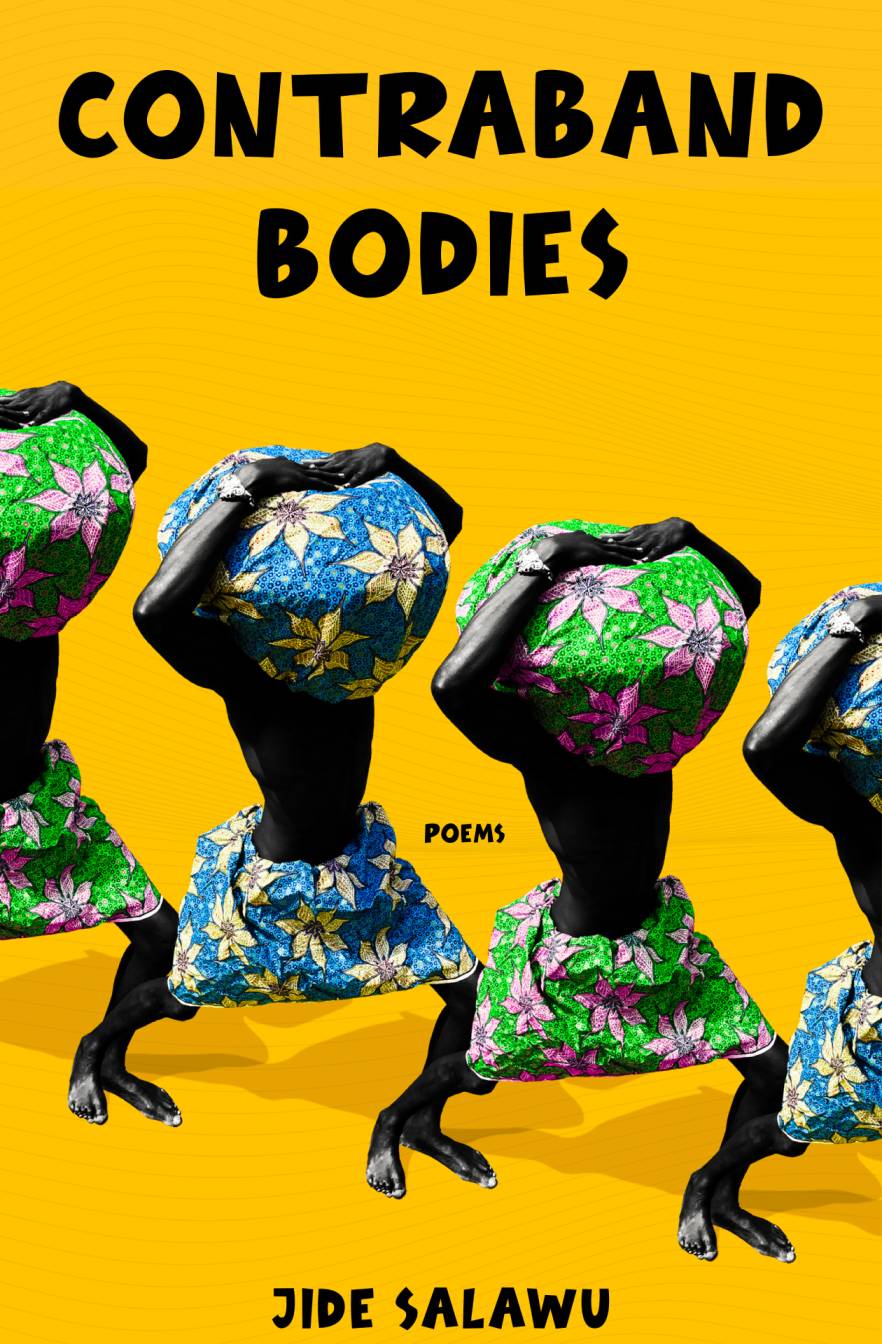
In Jide Salawu’s splendidly titled debut collection of poems, Contraband Bodies, you might catch yourself forcefully imagining hordes of bodies moving in one clouded mass (“a cartographer talk say his country na sufferhead and maps the sea as an alternative bridge”), the destination being anywhere other than their places of origin, across the Atlantic from Africa. 

Although these migrations are not limited to echoes of the transatlantic or trans-Saharan human trafficking (“Newark is the harbour of Atlantic dreams/where boats of the past dock with the present”), we are aware that they are no less devastating. It is this devastation—of what could be but cannot be, of entire fugitive lives “made of running”—that Salawu attempts to inscribe. 

Contraband Bodies
Contraband Bodies

In Contraband Bodies, Salawu makes us see clearly that the poetry of bodies is the poetry of exile. As has become evident in contemporary poetry of exile, traces of the reasoning that even the journey to exile is itself a kind of condemnation are everywhere. Salawu offers it up well in the last line of the poem, “A Cartographer Maps His Way out of His Country”: “exile is also a famished road even when you survive sea”.

If this reasoning functions as colonial gutting, this is what the poet writes in “48 Nightmares Later”:

In the beginning was the sea,

and the bandits of empire arriving at the shores

Before Lagos was called to bow

for the crown under a sky of smog.

If the reasoning is contemporary “Sea Stories”, we will find a lot of it flammable:

… hundreds are wading 

through the butane eye of the Mediterranean 

flailing in the brine.

…

rushing out of a country’s flame.

And of course the idea is that the journey is so arduous, insufferable, coming with so many baggages, that surviving the journey becomes another exile of its own kind. 

Jide Salawu
Jide Salawu

Choice can be read in many of these lines. The poet suggests a kind of consciousness in which “choice” as a valid reason for the journey of exile is ever-evolving. While the slave trades of the past were choiceless for the African victims, today this choice thing is more complicated. If there is even some agency with that choice, many have arrived at it from being hounded by hardship and dysfunctional or war-torn homes. The poem, “Sufferhead”, exemplifies this pattern in the collection, framed as a prayer:

God, do not make me a beast of burden 

for this land, its broken door, 

and fractured fiber of its roads.

…

I leave home with my anger

on my back like a hunch

…

On every road I have drifted,

I hear the voices of the dead

and contraband bodies waiting for dawn.

Home here is a metaphor sitting either in plain view or just between the interstices of the poet’s melancholia. One prose-poem, “The Family House”, in this vein jumps out. Here the poet revisits and reimagines his natal home. What could have gone wrong with his memories of the place? He tells us: “Standing at the front of the house, I smell like a loss.” Loss here is many things: it is family, dreams, an undivided nationality, a non-dislocated identity. We are feeling emotions we have been searching for all over with the poet. 

Considering all these, the African exile understands that exile is a kind of permanent condition. Many homes these days may function for, and as a result of, exile. “I am in the story,” Salawu muses in the end, “where my father says all gratitude belongs to the road”. Some of this last consideration is also in a poem like “Memorandum of Understanding for the Travelling African”. 

Contraband Bodies is not limited by geography. In these poems, we move across the Americas, across Africa and parts of Europe. And in these places, we are given the understanding, sometimes vaguely, that Africans are the contrabands. Every African understands the horrors of visa applications and other related immigration blues. The African immigrants can be many things: unwelcome bodies, bodies that feel strange, bodies that feel lost, bodies that are longing, bodies that do not belong, bodies of ennui—they are all contraband bodies. 

Contraband Bodies
Jide Salawu with his book, Contraband Bodies

The best poems here, often familial or autobiographical, encapsulate something about the tragedy of moving bodies, either those leaving in life or leaving in death. Like in a “Lament of Leaving” where moving away from family is a devastating exercise in the loss of love (“Every morning, I sacrificed to the worms/because I speak no language of the grave.”). Or like in “The Uplanders” (“what makes the sea salty is the migrant’s sweat”)

But is Nigerian literature new to the poetry of bodies? Of course not. And while we do not expect poetry on this theme to end anytime soon, we want poets to bring singular insight, a certain strange new wisdom, to the subject. 

If one looks at poets who have done this successfully as a yardstick, this collection does not, on the whole, give us the consistent emotional pull of an Adeoba or the narrative poignancy of an Oriogun. It does, however, offer what one may call individuated clarities, and that resides wholly in experience. The best poems conflate the symbols of memory, home, and the sea; some of the others contain execrable lines.

Perhaps the culprit is that Salawu may have spread some of his thoughts a little too thin. As a result, some of the earlier poems in the collection feel superfluous. Or perhaps it is the lack of rhythm, the sense of a running inner song, that gives this sense that something is missing.

Yet, these will not detract from what Contraband Bodies challenges us to think about exile: that there is not much dignity in it, either within the places of origin or in exile itself. This is as much a poetry of bodies as it is a poetry of the sea, of lands, and of nameless faces striving for survival in those places. 

Chimezie Chika is a staff writer at Afrocritik. His short stories and essays have appeared in or forthcoming from, amongst other places, The Iowa Review, Dappled Things, Channel Magazine, Terrain.org, Lolwe, Isele Magazine, Efiko Magazine. He is the fiction editor of Ngiga Review. His interests range from culture, history, to art, literature, and the environment. You can find him on X @chimeziechika1

The post Immigration is the Trafficking of Souls: A Review of Jide Salawu’s “Contraband Bodies” first appeared on Afrocritik.

  • ✇Afrocritik
  • Silicon Valley African Film Festival (SVAFF) Returns for 17th Edition
    The festival programme includes projects in different formats, including narrative features and shorts, documentary features and shorts, and animation, from 21 African countries. By Adedamola Jones Adedayo  The Silicon Valley African Film Festival (SVAFF) has unveiled a lineup of 76 films from 33 countries for its 17th edition, acknowledging stories from across the African continent and diaspora—with the festival scheduled to run from 8th to 11th October, 2026 in
     

Silicon Valley African Film Festival (SVAFF) Returns for 17th Edition

29 août 2026 à 10:52

The festival programme includes projects in different formats, including narrative features and shorts, documentary features and shorts, and animation, from 21 African countries.

By Adedamola Jones Adedayo 

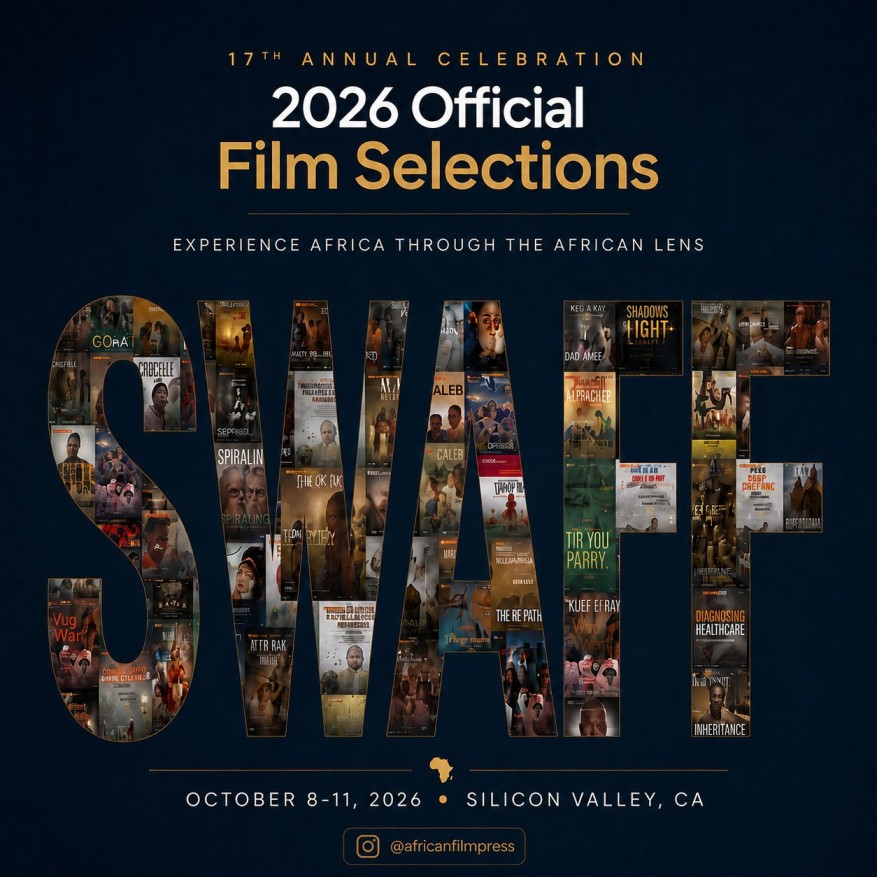
The Silicon Valley African Film Festival (SVAFF) has unveiled a lineup of 76 films from 33 countries for its 17th edition, acknowledging stories from across the African continent and diaspora—with the festival scheduled to run from 8th to 11th October, 2026 in California, USA.

The festival programme includes projects in different formats, including narrative features and shorts, documentary features and shorts, and animation, from 21 African countries. Selected countries include Angola, Benin, Burkina Faso, Côte d’Ivoire, Egypt, Gabon, Ghana, Kenya, Madagascar, Mauritania, Morocco, Namibia, Nigeria, Rwanda, Senegal, South Africa, Tanzania, Togo, Tunisia, Uganda and Zimbabwe.

Narrative feature projects include  Namibian filmmaker Elisabeth Tonata Hamukwaya’s Mwananga, Gabonese filmmaker David Mboussou’s AFROTŌPIA, Ugandan filmmaker Maureen Jolly Nankya’s SLUM BOMBER, South African filmmaker Lwazi Duma’s Thulebona, and Beneath The Tides, directed by Kenyan filmmakers Mbithi Masya, Millan Tarus, Mark Wambui, Barbara Minishi, Samuel Tebandeke.

Silicon Valley African Film Festival

In the narrative short category, projects include Mauritanian filmmaker Boubecrine Ibrahim El Mamy’s Anima, Senegalese filmmaker Zeyna Seyni Diop’s Burden of Silence, Nigerian filmmaker Ola “Naked” Jegede’s Convictions, Moroccan filmmaker Taha Aziz’s Donkey Skin, Angolan filmmaker Paulo Idalécio’s Do You Know Who I Am?, and Tanzanian filmmaker Kelvin Kagambo’s Embe Dodo.

Part of the documentary lineup are shorts such as Ugandan filmmaker Denis Israel’s The Blind Family, Kenyan filmmaker Robert Mutahi Macharia’s What Shall I Wear To My Funeral?, South African filmmaker Felicia Mokgara’s Living Under Water, Nigerian filmmaker David Akwara’s 40 Years of Crafting AFRICA; and features such as Togolese filmmaker Joel M’Maka Tchedre’s CENT DOUZE, Tunisian filmmaker Anis Lassoued’s Our Seed, Kenyan directors Robert Asimba and Ras Mutabaruka’s Fight For Life, and Nigerian filmmaker Daro Umaigba’s SUYA – A Spicy Piece of Home.

From the animation selections are Moroccan filmmaker Marwan Chiguer’s INVESTIGATION, Ugandan filmmaker Arnold Abayo’s Queen Kitami, and Congo-Côte d’Ivoire co-production My little stories_The gardener’s tears, directed by Manuelly Lashika N’Landou-Tchibindat, among others.

The festival programme also highlights projects linked to African diaspora communities across Brazil, Canada, Cuba, Guadeloupe, Jamaica, Réunion, Switzerland, the United Kingdom and the United States.

The full list of all 76 selections is available on the official website of SVAFF.

The post Silicon Valley African Film Festival (SVAFF) Returns for 17th Edition first appeared on Afrocritik.

  • ✇Afrocritik
  • Afrocritik Music Spotlight: Storytelling Songwriting
    Afrocritik Music Spotlight: Storytelling Songwriting By Yinoluwa Olowofoyeku Hey everyone, and welcome back to another edition of the Afrocritik Music Spotlight! How are we doing? We’re already well into Q3, and we hope the year has been treating you kindly so far. How’s everything going on your end? We hope you’re staying positive, making the most of your time, and finding little reasons to keep moving, whether that’s th
     

Afrocritik Music Spotlight: Storytelling Songwriting

28 août 2026 à 09:49

Afrocritik Music Spotlight: Storytelling Songwriting

By Yinoluwa Olowofoyeku

Hey everyone, and welcome back to another edition of the Afrocritik Music Spotlight!

How are we doing? We’re already well into Q3, and we hope the year has been treating you kindly so far. How’s everything going on your end? We hope you’re staying positive, making the most of your time, and finding little reasons to keep moving, whether that’s through work, love, creating, resting, or simply taking things one day at a time.

And of course, if you’ve been making music, don’t keep it from us. We’ve been discovering so much amazing music lately, and we’d love to hear what you’ve been working on. Send your latest releases our way at yinoluu@afrocritik.com for a chance to be featured in a future edition of our Music Spotlight.

Addressing the elephant in the room, unfortunately, technical difficulties kept us from bringing you our delectable selection two weeks ago. Thankfully, they have been resolved, and now you get to enjoy a stacked, long, and moving curation. You know I don’t like being away from you guys for too long, so consider this a soft apology from me.

This batch was particularly special to discover because the storytellers really came out to play. From beautiful songs carrying deeply personal narratives to records built around vivid themes, heartfelt reflections, and lyrics that stay with you long after the music stops, this edition is all about Storytelling Songwriting. These are songs that give your mind something to chew on and your heart something to feel, while still getting your feet moving.

So settle in, turn the volume up, and let’s get into this week’s discoveries in the form of…

SOUL & BALLADS

Some artists let the music speak softly, leaning into soulful melodies, vulnerable performances, and stories that linger long after the song ends. This selection brings together some of the week’s most heartfelt offerings, where rhythm meets reflection and emotion takes centre stage.

Somi explores different shades of emotion across What Does It Take to Bloom?, with “Throw Something”, “Aiwah”, and “Sugar” showcasing her melodic versatility and expressive songwriting. Ṣẹ̀wà expands Detox (Deluxe) with “Àlàké”, “Cautionary Tale”, and “I.p.b.y.h”, adding new perspectives to an already deeply personal body of work. Odeal brings his smooth, intimate approach to For A Good Time…, where “Bluey Vitton”, “Coming Home”, “After The Club”, and “Trying Things” pair polished production with reflective songwriting. 95ANTNY looks inward on IN-HINDSIGHT, with “SLiDE”, “BROWN EYES”, and “DEEP SH*T” featuring Azekel exploring different shades of contemporary Alternative expression.

The singles continue that soulful thread, with Libianca’s “I Know” featuring ZeeBoy, Lusanda’s “By The Time I Wake Up”, Nasty C and Tellaman’s “Natural”, and Marcus Harvey’s “Waters” each offering their own take on intimacy, vulnerability, and emotional expression.

NARRATIVE FUSIONS

Some artistes find their stories in the spaces between genres, folding different rhythms, textures, and influences into songs that remain deeply personal. This selection brings together a broad spectrum of Afro-fusions, where movement and melody work alongside storytelling, emotion, and distinctive artistic voices.

Moelogo leans into identity, heritage, and emotional expression on Yorùbá Healer, with “Broke and Mighty”, “Eledùà”, “For Us”, and “You Know” forming a deeply personal collection. Lodù explores intimacy and atmosphere on Wine & Honey, where “lolufé”, “follow”, and “ífémí”, featuring DOTTi The Deity, form a warm and melodic collection. Kemuel embraces his roots on Borokiri Boy, delivering “FINI”, “Seki” with DJ Tunez, and “YOLO”, a melodic project that blends personal expression with contemporary Afro-Pop. ru. explores a range of moods on SILK, bringing together “Entertainer”, “Colours”, and “Falling” in a concise project built around smooth melodies and expressive songwriting. 

Valee YVE introduces the LITBOY WAVE v1 aesthetic through “Purple hibiscus”, “Sb boys!”, and “Vacay!”, blending youthful energy with an unmistakably modern sound, while Llona takes listeners through the highs and lows of the journey on On The Road, where “Monster or Not”, “Cry” featuring Black Sherif, “Masculine Love”, and “Look At Me” pair introspective songwriting with emotionally charged performances.

That same blend of rhythm and narrative continues through ginius’ “Love Me Softly”, Ms Gideon and Not3s’ “All My Luv”, Darkoo and Asake’s “THAT GIRL!”, and YKB’s “BOOBO”, each bringing a different energy and perspective to the playlist.

STORIED ENERGY

Some stories do not have to slow the music down. There is plenty of room for emotion and narrative when the beat is thumping, the rhythm is infectious, and the energy demands movement. This selection finds that balance, pairing strong songwriting with grooves built to get the body moving.

Zhus Jdo brings a playful, contemporary energy to Wahala Pikin, with “Kai Cenat”, “Opium Amapiano”, and “USDT” offering three distinct flavours across the project. Zen Universe taps into a hazier headspace on #flowstate, with “#toomuchswag”, “margiela baby”, and “2am in Elegushi” capturing its laidback, atmospheric character. MOLIY captures a playful, vibrant energy on BADDIES <3 MOLIY, where “TOMETO”, “PARTYGYAL”, and “ACCRA GIRLS” bring together catchy melodies and lively collaborative chemistry. Anabel Rose reflects on love, growth, and emotional complexity across How Do The Flowers Bloom?, with “Peace of Mind”, “How I Want It Too”, and “Monsters” showcasing her intimate songwriting.

The momentum carries through Phina’s “Ambulance”, HEVI’s “Dance”, and Liquideep’s “For The Night”, bringing more movement and rhythmic energy without losing sight of the stories and emotions at the heart of the music.

ELECTROPULSE

The final stretch takes us into the electronic heart of South Africa, where rhythm, atmosphere, and texture can carry a story just as vividly as words. These projects turn pulse into their own language, building immersive worlds through layered production, emotive melodies, and grooves that keep the narrative moving.

Royal Music brings together “iThemba”, “Umoya” featuring Q Bonke, and “Drain My Energy” for SZEID, a collaborative project steeped in contemporary African sounds and emotive vocal performances. Chronical Deep delivers another atmospheric electronic statement on H.O.P.E, with “Hope”, “Zizwe”, “Pulse”, and “Aura” building a cohesive, immersive listening experience. De Mthuda turns up the energy on Noise, bringing together “Sasingengjena”, “High Hills”, and “Baleka” featuring Nobuhle and Notkzin for a vibrant Amapiano-driven experience. 

ShaunMusiq explores soulful Amapiano textures on MISSING PIECE, with “Magama” featuring Thatohatsi, “Maseko” featuring Rory DiamonDz, and “Imizamo Yami” featuring Mashudu. MÖRDA expands his sonic world on Asante IV, bringing together “Nightlife Scats” featuring Napelion, “We Are Samba” featuring Meguel, and “Craving Corners” featuring 2Me10 for a richly textured electronic-leaning experience, while DJ Zinhle keeps the momentum moving on ZINHLE, pairing “Uthando”, “Njengemali”, and “Bestie” with energetic production and collaborative vocal performances.

As ever, what we’ve featured here is only a small part of everything waiting for you across this week’s playlist. There are plenty more gems tucked between these selections, so keep exploring beyond the tracks we’ve highlighted. Revisit the projects that caught your attention, follow the threads that lead you somewhere new, and you might find an artist or song that becomes a lasting favourite.

That remains at the heart of Music Spotlight. Every edition gives us another chance to celebrate the incredible range of African music, from established artists continuing to evolve to emerging voices finding new ways to express themselves. We’re committed to digging through the noise, finding the records that might have slipped past you, and bringing them into the conversation.

And we’d love to know what you’ve been listening to as well. Tell us which releases have been on repeat, what you’ve discovered recently, and which artists or projects you think deserve a little more attention. If you’re an artiste with new music to share, send your work to yinoluu@afrocritik.com for a chance to be featured in a future edition of the Music Spotlight. And keep up with Afrocritik across our social platforms for more reviews, interviews, playlists, and cultural conversations.

As we proceed into September, we hope the month brings you fresh inspiration, meaningful progress, good moments with the people you love, and plenty of music to soundtrack it all. Take care of yourself, keep looking out for those around you, and make the most of whatever the new month has in store.

And there’s more on the way. The next edition will also be a really big one, so please stay tuned for that! We’re always so excited to keep you up to date with the music we’ve been discovering across the continent. Until then, keep your ears open, keep supporting the artists shaping African music, and never be afraid to follow a new sound down the rabbit hole. We’ll be back in two weeks with another collection of brilliant discoveries. Happy listening.

Yinoluwa ”Yinoluu” Olowofoyeku is a multi-disciplinary artist and creative who finds expression in various media. His music can be found across all platforms, and he welcomes interaction on his social media @Yinoluu.

https://music.apple.com/ng/playlist/afrocritik-music-spotlight/pl.u-LdbqE75I21vAkDK

The post Afrocritik Music Spotlight: Storytelling Songwriting first appeared on Afrocritik.

  • ✇Afrocritik
  • What the Headies Awards Keep Getting Wrong: A Cursory Look at the 18th Edition Nominees List
    If a category can be reopened and reshuffled hours after publication, what confidence does anyone have that it won’t happen again? By Emmanuel “Waziri” Okoro There is a particular kind of fatigue that comes with covering the Headies Awards year after year. It is the fatigue of watching an institution that positions itself as “Africa’s biggest and most prestigious music award show” fumbl
     

What the Headies Awards Keep Getting Wrong: A Cursory Look at the 18th Edition Nominees List

27 août 2026 à 07:28

If a category can be reopened and reshuffled hours after publication, what confidence does anyone have that it won’t happen again?

By Emmanuel “Waziri” Okoro

There is a particular kind of fatigue that comes with covering the Headies Awards year after year. It is the fatigue of watching an institution that positions itself as “Africa’s biggest and most prestigious music award show” fumble the basics with a consistency that would be almost impressive if it weren’t so exhausting. To be honest, this writer is frankly tired.

The 18th edition nominees list, released a couple of days ago, is the latest instalment in that fumble, a list that is already rife with shortcomings. Noted, every year comes with a fresh round of excitement, parsing of category lists, arguments over snubs, and maybe the quiet pride of seeing an artiste’s name where it belongs. And every year, somewhere underneath that excitement, sits the same set of structural problems the Headies has never quite bothered to fix.

This piece is an attempt to name them plainly, one more time, in the hope that naming them enough times eventually forces a correction.

A Year Under Review That Refuses to Be a Year

Let us start with the arithmetic, because the Headies never quite can. One of the most persistent and least interrogated problems with the awards over the last decade is its handling of the “year under review”, the eligibility window meant to determine which songs and projects qualify for a given edition. In theory, this should be a 12-month stretch. In practice, it has never once landed there.

The pattern, once you lay it out, tells its own story. At the 2018 Headies, the review period ran from July 2016 to December 2017 (seventeen months). There was no ceremony at all in 2019. The 2020 edition then stretched the window to a startling eighteen months: January 2018 to June 2019. The years that followed offered little correction: fourteen months at the 2021 Headies, fourteen again in 2022, and fourteen once more in 2023. The 2024 edition held the line at fourteen months too, despite promising two ceremonies that year and delivering only one.

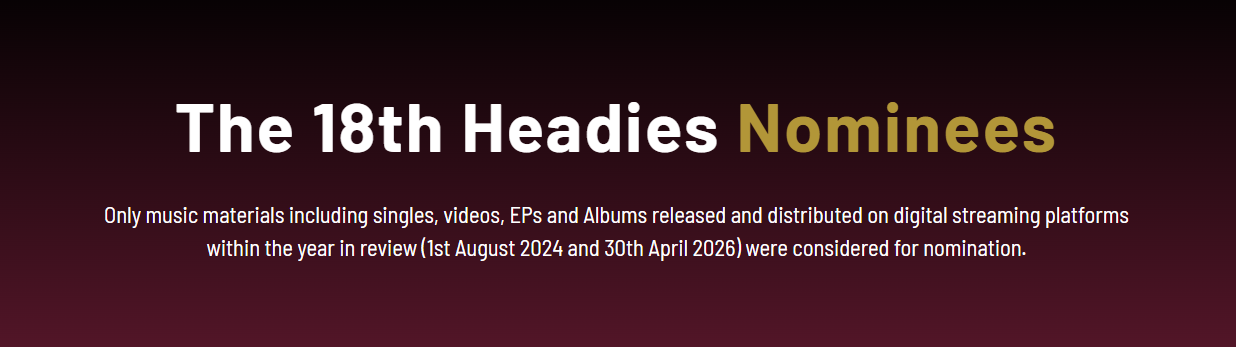
Last year, nothing happened at all; Nigerian music went uncelebrated by the show meant to celebrate it. Now, at the 18th edition, the submission window spans from the 1st of August 2024 to the 30th of April 2026, twenty-one months, the widest gap in the award’s twenty-year history.

Headies
The year under review of the 18th Headies Awards

When a review period balloons past a year, it stops functioning as a snapshot of a single creative season and starts functioning as a grab bag, throwing projects from different years into direct competition with each other regardless of when they were actually released or how the conversation around them has already moved on. 

An album that dropped in the first month of the window and one that dropped in the last are, for all practical purposes, being asked to answer the same question, even though they were made for entirely different moments, competing against entirely different fields, and received by an audience whose tastes had shifted in the interim. 

That is not a fair contest. The consequences of this are not hypothetical; the Headies have lived them before. At the 2021 edition, both of Burna Boy’s African Giant (2019) and Twice As Tall (2020) were in contention, with their songs featuring in some of the categories, even as the two albums had already been assessed separately by the Grammys, with Twice As Tall going on to win Best Global Music Album at its own, distinctly bounded, edition.

It is worth pausing on that comparison, because it is instructive. The Grammys, BET Awards, Brit Awards all operate on eligibility windows that critics can argue over at the margins, but that never balloon to seventeen or twenty-one months. A defined year under review is not a bureaucratic nicety but the mechanism by which an award show tells a coherent story about a specific period in an industry’s life. 

Strip that mechanism away, and what you’re left with isn’t an award show so much as a periodic, loosely organised catalogue of whoever happened to release music since the last time anyone checked. If the Headies wants to be taken seriously as an arbiter of a given year in African music, it has to start behaving like one. That begins with committing, without exception, to a genuine twelve-month window, and holding itself to it the way every other major award show in the world manages to.

Home Is Always the Best Address

Then, there is also the matter of geography. The Headies has announced that its 18th edition, tagged “Africa to the World”, will be staged in Canada, a decision that, whatever the stated rationale, is bound to reopen a wound this publication and others have flagged before. Hosting an award show built around celebrating Nigerian and African music somewhere outside Nigeria or Africa is not a convention observed anywhere else. National and continental award shows tend to stay rooted in the places whose culture they claim to honour.

The 15th and 16th editions were held at the Cobb Energy Performing Arts Centre in Atlanta, and the complaints then were the same complaints now: what does it say about an industry when its most prestigious award show goes shopping for venues abroad rather than investing in the infrastructure to host its own moment at home?

Headies Awards
Headies Awards

The 17th edition, fittingly tagged “Back to Base”, returned to the Landmark Event Centre in Victoria Island, Lagos, a gesture that suggested the organisers understood the problem. That understanding appears to have been temporary. Some stakeholders will point to investment and collaboration opportunities as justification for the move to Canada, and those opportunities may well be real. Diaspora audiences matter, international visibility matters, and there is nothing wrong in principle with an African award show wanting a global stage.

But an award show’s first obligation is to the industry and audience it claims to represent, and there is no partnership abroad valuable enough to substitute for the simple act of celebrating African music on African soil. 

Every edition staged outside the continent is, whether intended or not, a small signal to the artistes, the fans, and the industry at home that the real audience worth impressing sits elsewhere. That signal accumulates. It shapes how seriously the show is taken by the very ecosystem it claims to serve, and it is a cost the Headies keeps paying without ever quite reckoning with it.

A Next Rated Category That Doesn’t Add Up

The unusually wide review window has also scrambled some of the individual categories, and nowhere is this more visible than in Next Rated, the award meant to spotlight the most promising emerging artiste “poised for superstardom”.

This year’s nominees include Mavo, Llona, FOLA, Shoday, and Fido, and even a cursory look at the list reveals an obvious mismatch: FOLA is not in the same tier as his fellow nominees.

His trajectory over the review period has already outpaced what “emerging” implies. He enters the 18th edition as its most nominated artiste, with ten nods in total, including placements in major categories like Album of the Year, Best Male Artiste, Best Recording of the Year, Best R&B Album, and Song Writer of the Year. An artiste with that breadth of recognition across the marquee categories has, by definition, “already arrived”. He does not belong in a category built for those still on their way. The same argument can also be made for Mavo, who is not only the go-to for collaborations, but has carved a niche for himself in the industry. 

FOLA
FOLA

The irony is that this dilutes the category rather than elevating it. Next Rated is supposed to function as a signal to the industry, a marker that says: watch this one, they are about to break through. 

When a nominee has already broken through several times over in the same awards cycle, the category stops doing that work. It becomes redundant, a formality attached to a name that has already collected its due recognition elsewhere on the ballot, at the expense of artistes for whom the nod might have actually meant something.

Editing After Releasing A Nominees List Is An Eyesore

Perhaps the most damning item on this list, though, is the least defensible: a few hours after the Headies published its nominees list across its website and social platforms, the organisers quietly began editing it. Davido has since been added to the Best Male Artiste category; and Olamide’s “99”, featuring Young Jonn, Asake, Seyi Vibez, and Daecolm, has been added to the Song of the Year lineup.

Headies
Davido was included in the Best Male Artiste category shortly after a list that didn’t feature his name

There is a broader culture of “anyhowness” that Nigerian institutions have normalised across public life, a tolerance for process that bends after the fact rather than holding before it, and the Headies has not been spared from it.

Headies
Olamide’s “99” has been included in the Song of the Year category.

A nominations list is not a rough draft but the output of a process that is supposed to have already happened, a committee that deliberated and finalised its categories before making anything public. To publish and then quietly revise raises real questions about how that process actually worked, and whether “finalised” means anything at the Headies at all. Calling it borderline criminal is not hyperbole so much as an accurate description of what it does to the credibility of the exercise.

It also raises an uncomfortable question about everyone who was already on the list before the edits. If a category can be reopened and reshuffled hours after publication, what confidence does anyone have that it won’t happen again, quietly, before the ceremony itself? The artistes who made the cut on merit deserve a process solid enough that their nomination isn’t contingent on who gets added, or removed, in the days that follow.

There is more that could be said, and more that probably will need to be said again after the award has been organised. But after seventeen editions, the question worth sitting with is not what else is wrong this time. It is what it says about the future of the Headies that, after all this time, we are still here.

Emmanuel “Waziri” Okoro is a Nigerian writer and journo with an insatiable knack for music and pop culture, with bylines on Afrocritik, PM News, Tribune, The Sun, ThisDay, Vanguard, and The Guardian. When he’s not writing, you will find him arguing why Arsenal FC is the best football club in the multiverse. Connect with him on Twitter, Instagram, and Threads: @BughiLorde.

The post What the Headies Awards Keep Getting Wrong: A Cursory Look at the 18th Edition Nominees List first appeared on Afrocritik.

Merit Gogo-fyneface’s “Deliverance” Studies the Familiar Traumas of Misrepresenting Christian Exorcism

27 août 2026 à 06:22

At its core, “Deliverance” studies the misrepresentations of Christian exorcism and the toll it takes on the victims.

By Chimezie Chika

Merit Gogo-fyneface’s Christian-oriented story, “Deliverance”, begins with a scene of corporal punishment. The narrator is being flogged by a man called Baba. At this point, we do not know who the narrator is or what they might have done. We are not even clear as to the justness of this punishment. What the narrative tells us at this point is the details of the beating going on. The onomatopoeic weight of the cane—“Viam. Viam.”—and the force and single-mindedness with which the man is flogging the narrator: “It [the cane] came down on my back – the first, the second, the third until I could no longer count.” 

Of course, a crucial word—time—is missing from that counting, but we get the drift of the narrative. In the next sentence, the narrator tells us that their screaming did nothing to stop Baba. “If anything, the strokes began to match the velocity of my wails.” And whenever the narrator tries to move away from Baba, he draws the narrator back into proximity so that the cane can continue its journey.

And thus we are let into the world of Bright, a boy whom the rest of the people around him see as a being “possessed”. But why is such heavy punishment being visited on Bright? What has he done? Apparently, nothing untoward. His father—whom he calls “Papa” in the story—took him to that ministry to be exorcised. In short, he is being flogged as a form of deliverance. Such extreme measures are not an anomaly in Nigeria, especially when the subject of the beating has been identified as “possessed”. 

The commonality of the idea of possession labelling within the Christian subculture in Nigeria conjures images of evil or satanic alliances which, as the religious devout would have it, can only be solved by church deliverances. But the idea of possession in Nigeria’s religious landscape goes much further. A child who is not walking exactly in the expected ways, a person who is behaving outside of society’s stipulated boundaries, is no less seen as possessed. Behavioural defects that may simply be a result of teenage exuberance are also added into the equation. Indeed, there is no end to the things Nigerians can label as possession. 

Deliverance
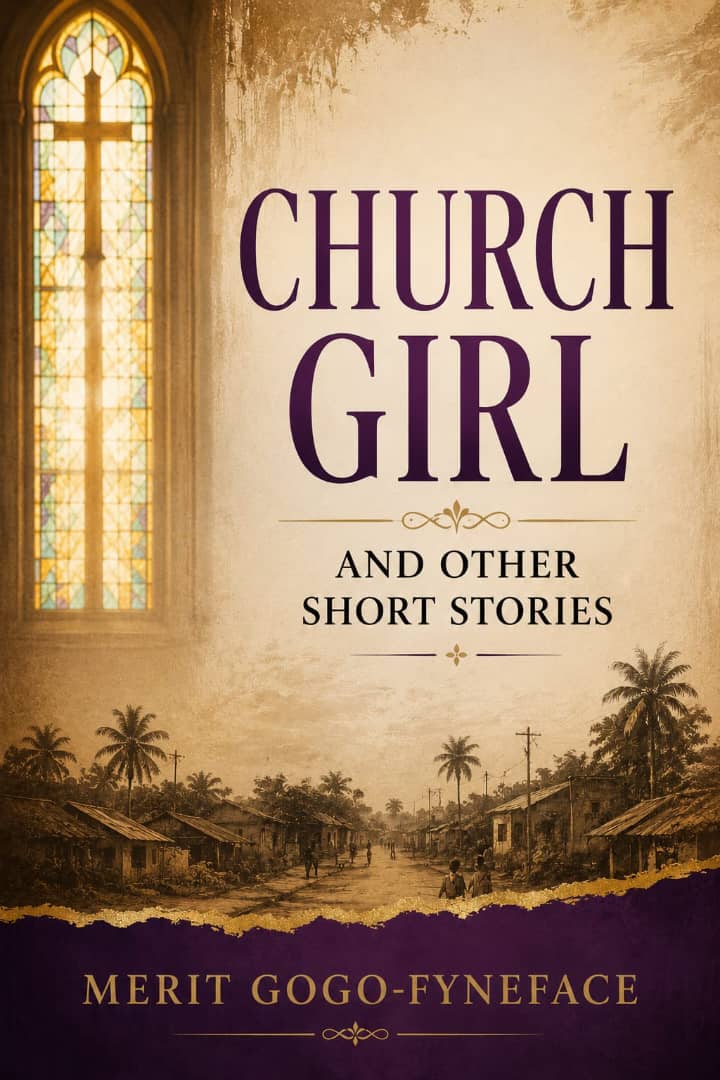
“Deliverance” is included in Merit Gogo-fyneface’s Church Girl and Other Stories collection

An unhealthy dependence on religious panacea as the only solution to physical or behavioural defects prevails in Nigeria. It is more disturbing that the route such deliverance sessions take is ferocious, with the belief that the possessing spirit can be forced out by putting the body through physical pain. Gogo-fyneface exposes that hypocrisy in this story. 

In truth, Bright’s problems do not appear to be spiritual. He is a child who does poorly at school. But is he less attentive in class? This is what he tells us: “I listened in class. I tried. I listened when our teacher came in wearing the same shoes all week, the same faded blouse, still speaking about education and telling us it was the key, a key that had locked her inside this village. Still, they said I was not trying enough.”

Now if a person tries this hard, as Bright narrates, is it possible for us to think they might not be a talented student? Certain kinds of people, like Bright’s father, do not understand the idea of nurturing talent, which is why he would miss the one crucial interest his son has, and insist on orthodoxy: “I saw Papa work hard, selling farm products that filled our soup pot and bought me books at school. My kind of hard was football – movement that made sense in my body. Papa did not understand me, no one did. He said I would grow up and I would be a Medical Doctor.”

At its core, “Deliverance” studies the misrepresentations of Christian exorcism and the toll it takes on the victims; it also highlights defects of character as a problem that demands a different solution. One cannot begin to imagine the mental toll of being misjudged as spiritually possessed by one’s own family, when parental care and love are all a child needs. In one of the author’s clever set-pieces, we learn that his father uses money meant for food to pay the prophet who does the exorcism or deliverance, as Pentecostal Christianity calls it. Bright describes the prophet as “a very old man in long white garments who said he would travel with it to see Jesus Christ”.

But while even Bright could see the disparity between the “Jesus Christ” the prophet speaks of and the one he had been taught to believe in, his father seems unable to detect the underlying subterfuge. To this end, Bright says something that proves he is far from the mentally challenged boy his father appears to think he is. 

In fact, he flips the script on him. And this time his father thanks the prophet. “I remember thinking: Papa might also need deliverance, because what kind of man thanks another human being for beating his child for thirty minutes?”

The author does well to show us the psyche of the character we are dealing with here. Bright narrates that his father is frustrated, waiting for his mind to catch up to the meaning of his name. He also says this: “There was nothing bright about me. Not my skin or the way I felt inside”. Without telling us these details in a bland, matter-of-fact way. The author makes us see that Bright is a dark-skinned, disturbed boy grossly misjudged by the people around him. 

Merit Gogo-fyneface
Merit Gogo-fyneface

It is perhaps to the author’s credit that she does not endow Bright with any Christian-centred redemption. The character is shown until the end to have the same issues he has always had, even after being bundled off to live with his aunty. The author leaves the story open-ended.

“Deliverance” is written as a first-person narrative. We encounter Bright through his own eyes. While his unstable mental state—which might be a result of his family’s treatment—may be why the narrative rambles, his voice is also disproportionately mature for a 10-year-old. 

The author’s tackling of the psychology of deliverance in the Nigerian imagination needs to be reiterated. Bright is stigmatised, not from an actual diagnosis, but from socio-cultural assumptions. Of course, the relevance of such a subject cannot be overstated. 

But also this is a story whose principles are extra-literary. The author could’ve stretched the narrative, taken it to its end, with characters acquiring a more nuanced portrayal by virtue of space to develop. 

This story assumes the tenor of the vast majority of the home-grown literature emerging today in Nigeria, in its tendency towards a range of social concerns. To its credit, its prose is simple; but the structural devices from which it operates remain vastly under construction. 

A time will come when we will look at the kind of provocative Christian fiction Gogo-fyneface writes and see our lives or that of our neighbours. Here, in this time, we can understand this is an instalment in the work of an author hewing their way through a much-trodden path. 

Chimezie Chika is a staff writer at Afrocritik. His short stories and essays have appeared in or forthcoming from, amongst other places, The Iowa Review, Dappled Things, Channel Magazine, Terrain.org, Lolwe, Isele Magazine, Efiko Magazine. He is the fiction editor of Ngiga Review. His interests range from culture, history, to art, literature, and the environment. You can find him on X @chimeziechika1.

The post Merit Gogo-fyneface’s “Deliverance” Studies the Familiar Traumas of Misrepresenting Christian Exorcism first appeared on Afrocritik.

  • ✇Afrocritik
  • Matt B: The Water Remembered Him First
    “When they found my living ancestral line, I said that it’s not enough for me to just know that information. I physically have to go there, and I have to meet them” – Matt B. By Emmanuel “Waziri” Okoro There is a peculiar kind of vertigo that comes with discovering you have been homesick for a place you have never been. I think of this often when I consider the millions of descendants o
     

Matt B: The Water Remembered Him First

26 août 2026 à 07:13

“When they found my living ancestral line, I said that it’s not enough for me to just know that information. I physically have to go there, and I have to meet them” – Matt B.

By Emmanuel “Waziri” Okoro

There is a peculiar kind of vertigo that comes with discovering you have been homesick for a place you have never been. I think of this often when I consider the millions of descendants of displacement scattered across the Americas, each carrying a blank space where a country’s name should be. For Matt B, that blank space had a shape long before it had a name. It just took a DNA kit, a Grammy, and a plane ticket to Owerri, Imo State, Nigeria, to fill it in.

I met Matt B – virtually, a few days before the release of his most personal work yet. But it didn’t feel like meeting a stranger. It felt like joining a man mid-sentence, in a story that started six years earlier and, as far as he’s concerned, has not ended. There’s an easy excitement in his voice when he says, “I’m excited for it to drop. I’m excited to see what people think about it. It’s all just so surreal”. 

We are there to talk about ALKEBULAN III: The Water Remembers, the closing chapter of a trilogy that began as curiosity and has become, over three albums, a pilgrimage. Over the course of the interview, we explore, among other things, the circumstances that led to his new project, how he makes music, what he looks for when selecting collaborators, and much more.

I: Where Do We Come From?

Matt B, born Matthew David Benson in Chicago, grew up singing alongside his two older brothers in church. The three of them later formed a family group called TriEnd in his teenage years. Over the past two decades, he has built a career that’s hard to categorise. He built an early audience in Asia with his 2014 album, Love & War, watched “Colour Blind” go viral in China, and found his way onto Billboard’s charts with the Trap-Soul-inflected 2021 project, Eden. But underneath the catalogue sat a question he had carried for longer than he’d been making music.

“I always wondered who I am and where I’ve come from”, he tells me, describing himself in the language he uses deliberately: not just African-American, but Freedman, Foundational Black American — a man aware that his identity had been interrupted somewhere along a coastline centuries ago. 

In 2019, he took an AncestryDNA test to try to answer it. The test told him he was majority Nigerian. It was, he says plainly, “not enough for me”. So he went looking for the answer the way he does best: inside a song. The search became his 2023 project, ALKEBULAN, then ALKEBULAN II released a year later. That second record won him a Grammy for Best Global Music Album in 2025, and handed the Royal Philharmonic Orchestra, founded 79 years ago, its first-ever Grammy in the process.

He is still, a year later, visibly stunned by that win. “To be recognised by my peers, and to be recognised as having the best album for that year, I’m lost for words every time I think about it. When they called my name, I was like, did they make a mistake? I had to pinch myself”.

It was in the wake of that win that AncestryDNA came back to him with something sharper than a percentage: a living bloodline, traced through records and genetic markers to the Igbo people of Owerri, Imo State. A certificate wasn’t going to cut it this time either. It wasn’t enough for him to just have that information. He knew he had to physically go there and reconnect with his people.

Thus, ALKEBULAN III: The Water Remembers did not begin as an album. It began as a documentary crew following Matt B and his wife, producer and manager, Angela V. Benson, through Ghana before they ever set foot in Nigeria. At Elmina Castle (a trading fortress built by the Portuguese in 1482, before evolving into a major hub for the Transatlantic slave trade), he stood before the Door of No Return. This was the passage through which captive Africans were marched onto ships bound for the Americas. At the Assin Manso Slave River — where, historical accounts hold, the enslaved were force-marched over fifty miles to the coast and bathed for the final time before that crossing — he took part in a traditional blessing ceremony.

Matt B
Matt B (photograph by Cecile Boko)

“Something very powerful was said to me”, he recalls, “that my walking through the Door of No Return was not my door of no return. It actually was my door of return. And that my going to the Assin Manso River, that was not my last bath, that was my first bath”. This was his re-introduction, as he puts it, to the continent, an act of honour paid to ancestral ties that had never technically been severed, only obscured.

II: Ikechukwu, Ahamefula, Nwanne Di na Mba

By the time Matt B landed in Owerri, Nigeria, the emotional register had already shifted from research to reunion. Looking out into the distance, he turned to his wife and told her it felt like he’d been there before, a feeling he still struggles to put into words, except to say that it felt like home. What followed were two elaborate homecoming ceremonies, staged by two separate kingdoms, each treating him as a son who has returned. 

He was received with a 12-gun salute he hadn’t anticipated, tribal drums, dancing and fanfare. “To be received in that way as a family member, as a brother, and welcomed back into the tribe, it just was heartwarming for me, because it felt like a sense of belonging that I just longed for, for such a long period of time”.

Then came a name. His Royal Majesty Eze Engr Chidume Okoro of  Amano, Obohia, Ahiazu Mbaise, conferred on him the Igbo name Ikechukwu (God’s Power) along with the chieftaincy title Ahamefula (May my name not be forgotten). A second monarch, His Royal Highness Eze Leo Nwokocha, Chairman of Mbaise Council of Traditional Rulers, later bestowed the title Nwanne Di na Mba (A brother in a foreign land). He admits none of it was expected. “I was like, what is going on right now? This is crazy”.

Matt B

Matt B named his entire trilogy after Alkebulan, which, according to some historical records, translates to “Mother of Mankind”. Being handed his own name back, in the region his ancestors were taken from, carries an obvious symmetry, and he draws the line himself. “There’s so much history, and there’s so much value in a name. It gives you your identity back”. He was taught, too, the etiquette of the kola nut, how it must be addressed in Igbo, because, as he was told, it does not speak English. A portion is carried home afterwards, proof to one’s own people that one was received and respected. 

III: Telling the Stories No One Else Will

Ask Matt B how he writes, and the answer changes depending on the assignment. Melody, he insists, usually comes first; a necessity, he says, when you’re singing in languages much of your audience won’t understand, because the emotion has to survive the translation gap through sound alone. But for this record, he reversed his own process. “I went into more of a historical dive before I started writing”, he explains, treating research as the foundation.

Two songs anchor the record’s emotional core, and both began as history before they became melody. “My Mother’s Song”, featuring the Malian vocalist, Fatoumata Diawara, is built around the true story of a nine-or-ten-year-old girl kidnapped from Sierra Leone in the 1700s who carried a song her mother had taught her across the Middle Passage. More than three centuries later, her descendants used the surviving lyrics and melody to trace their way back to their tribe. “When they made it back to their tribe, the lyrics and the melodies were almost the same”, he said, still visibly moved by it. “That is so powerful;  it just goes to show the importance of why those traditions matter”.

“Overboard”, an interlude built with the Kabusa Oriental Choir, draws from an account of a slave-ship rebellion in which captives who seized the vessel chose to jump overboard with their captors rather than live in bondage. “That was such a powerful story for me, so I put that into my lyrics, and that’s what I wrote around”. The choice to route this history through music rather than plain narration is deliberate. “If we aren’t telling the stories, then who will tell those stories? When you share it musically, then it could be digested a little easier” than it might in prose, where the same history risks landing as pure discomfort.

Across the album’s ten tracks, the Kabusa Oriental Choir functions as a structural device as much as a musical one, bookending the record and threading through its middle on songs like “At the End of the Door”, “Fertile Ground”, “Overboard”, and the title track. He confirms the placement was fully intentional. “They were a physical representation of the ancestors, the ancestral voice guiding me through that journey”. He walks me through the arc song by song. “At the End of the Door” doubles as both the record’s beginning and its end, an audible rendering of the Door of No Return itself. “Fertile Ground” is scored to footage of a plantation, where, despite the circumstances, there is a visible unity in people working the field together. “Overboard” carries the rebellion. And “The Water Remembers”, the closing track, is what he calls one of the most powerful interludes on the entire project.

ALKEBULAN III: The Water Remembers

The featured artistes on The Water Remembers: Diawara, Skales, Goya Menor, Boy Spyce, Camidoh, alongside the Kabusa Oriental Choir and an orchestral recording with the Royal Philharmonic at Abbey Road, were like archetypes assembled to complete a portrait. “It was important for me to work with West Africans for this project, because that’s where I descend from”. He notes that all of them “speak to the culture”, people who understand the music is not just about what is hot right now, but about creating longevity and something meaningful.

Assembling those voices around one project, largely without label infrastructure, came with its own friction, though perhaps not the kind one would expect. “As far as creative differences, I didn’t really experience that with anyone, honestly, from this project”, he said. “People were actually just very warm, very open-minded”. The real difficulty was technical: there was no blueprint to work from. “Even though this is my third time making a project like this, I have no blueprint”, he says, describing the search for a sound that could hold Afrobeats, Afrobeat, orchestral arrangement, and R&B together without flattening any of them. 

He worried, too, about singing convincingly in languages he doesn’t speak natively: Igbo, Yoruba, Swahili, and, on earlier records, Luganda and Zulu. And thus, he leaned on co-writers for diction and pronunciation, treating linguistic accuracy as inseparable from the respect the project was trying to pay.

That the whole thing was self-funded, without a major label, was, in his telling, not a limitation but a condition of the story surviving intact. “Some stories that are meant to be told, and they have to be told a certain way”, he says. “When you bring in too many powers that be, they want to control that narrative, which can water it down. It was really important, not only for me but my team, to ensure that we had the creative control of that narrative”. No expense, he was careful to note, was spared regardless; Abbey Road, The Royal Philharmonic Orchestra, Red cameras (some owned outright, others loaned in partnership) for the documentary and short film. Independence, for Matt B, was a creative firewall, not a budget cut.

IV: Homeward, Now for Others

Six albums and one Grammy win into a career that started in a college dorm room, Matt B’s hardest-won lesson isn’t about sound but trust. “Trusting yourself, trusting your process, knowing that you are unique, that you are creative, and that there’s no one else on this earth like you”, he says, before pivoting, characteristically, to the unglamorous mechanics behind the art. “Business is also really important. 90% of this industry is business, the other 10% is music”. He also notes that the people who eventually join an artiste’s momentum will rarely be the ones who built it. “They won’t necessarily do that journey for you. If you don’t put in that work yourself, why should anyone else trust what you’re doing?”

Matt B
Matt B

That philosophy extends, unsurprisingly, to who he still wants to work with. Careful not to pigeonhole himself, he rattles off a list that spans generations and geographies: Angélique Kidjo, whose voice he calls simply amazing; Nomcebo Zikode, a friend he has yet to collaborate with formally; and the Tanzanian star, Harmonise. Then come the Burna Boys, Davidos, and Temses of the industry. “I just love to create, and I love to make music. Anyone, big or small. If I love their sound and love what they represent, that’s a collaboration I want to do”.

As our conversation winds toward its close, I ask what advice he’d offer other African Americans chasing the same unanswered question he’d carried for years. He doesn’t hesitate. “I hope that I’m the blueprint for that”, he says, “That it isn’t as scary as what you think it’s going to be, that you will be well received when coming back to the continent, that you guys love us and that you want us to come home, and that the diaspora is stronger for it”.

There’s a particular irony in a man who once sang in languages he didn’t speak now being the one teaching others how to find their way home. But that, in the end, is what Matt B seems most at peace with; the fact that the question he carried for most of his life no longer belongs only to him. 

Somewhere in a lineage he didn’t know existed six years ago, there are cousins who now know his face. And somewhere, listening to The Water Remembers for the first time, there will be another Matt B — someone who has never set foot on the continent but has always, somehow, been homesick for it — hearing, in the choir’s opening notes, an invitation they didn’t know they’d been waiting for.

Emmanuel “Waziri” Okoro is a Nigerian writer and journo with an insatiable knack for music and pop culture, with bylines on Afrocritik, PM News, Tribune, The Sun, ThisDay, Vanguard, and The Guardian. When he’s not writing, you will find him arguing why Arsenal FC is the best football club in the multiverse. Connect with him on Twitter, Instagram, and Threads: @BughiLorde.

The post Matt B: The Water Remembered Him First first appeared on Afrocritik.

  • ✇Afrocritik
  • Davido, Wizkid, FOLA Lead 2026 Headies Awards Nominations + Full Nominees List
    The 18th Headies Awards will be staged in Canada, marking another international staging of one of Nigeria’s most prominent music award shows. By Emmanuel “Waziri” Okoro Nigerian music heavyweights Davido, Wizkid and Burna Boy are among the leading nominees for the 18th Headies Awards, following the unveiling of the 2026 nominations on Tuesday. The ceremony is set to take place in Canada, marking another international staging of one of Nige
     

Davido, Wizkid, FOLA Lead 2026 Headies Awards Nominations + Full Nominees List

25 août 2026 à 14:24

The 18th Headies Awards will be staged in Canada, marking another international staging of one of Nigeria’s most prominent music award shows.

By Emmanuel “Waziri” Okoro

Nigerian music heavyweights Davido, Wizkid and Burna Boy are among the leading nominees for the 18th Headies Awards, following the unveiling of the 2026 nominations on Tuesday. The ceremony is set to take place in Canada, marking another international staging of one of Nigeria’s most prominent music award shows.  The year under review for this edition is from August 1st 2024 to April 30th 2026. 

Davido, Wizkid and Burna Boy feature across several of the ceremony’s major categories, including Afrobeats Album of the Year, Best Male Artiste, Song of the Year, Afrobeats Single of the Year and Best Headies Collaboration.

Davido earned multiple nominations for his collaboration with Omah Lay, “With You”. The song is in contention for Song of the Year, Afrobeats Single of the Year, Best Recording of the Year, Best Headies Collaboration, and Viewers’ Choice. Wizkid also secured a strong showing. His collaborations with Asake: “MMS” and “Jogodo”, earned nominations in major song categories, while his album, Morayo, is nominated for Afrobeats Album of the Year. The singer is additionally nominated for Digital Artiste of the Year, Best Male Artiste, and Viewers’ Choice.

Headies Awards
Headies Awards

Burna Boy’s “Bundle by Bundle” received an Afrobeats Single of the Year nomination and is also recognised in the Music Video of the Year category. His album, No Sign of Weakness, is nominated for Afrobeats Album of the Year, while the singer is in contention for Best Male Artiste. The Next Rated category reflects a growing crop of Nigerian artistes, with Fido, FOLA, Llona, Mavo, and Shoday receiving nominations.

Check out the full nominees list below:

Song of the Year

  • “Arike” — Kunmie
  • “Hey Jago” — Poco Lee, Shoday & Rahman Jago
  • “Hot Body” — Ayra Starr
  • “Joy Is Coming” — Fido
  • “MMS” — Asake & Wizkid
  • “With You” — Davido & Omah Lay

Afrobeats Single of the Year

  • “Fun” — Rema
  • “Jogodo” — Asake & Wizkid
  • “Laho” — Shallipopi
  • “Joy Is Coming” — Fido
  • “With You” — Davido & Omah Lay
  • “You” — FOLA
  • “Bundle by Bundle” — Burna Boy

Best Performer (Live)

  • Adekunle Gold — Live at the National Theatre, Lagos
  • Asake — Red Bull Symphonic
  • Ayra Starr — Global Citizen Festival NYC 2025
  • Johnny Drille — Johnny’s Room Live 6
  • Ruger — Live at Indigo at The O2, London (2025)

Best R&B Album

Best Recording of the Year

  • “Arike” — Kunmie
  • “How Do You?” — Amaeya
  • “Baby (Is It a Crime)” — Rema
  • “Coping Mechanism” — Omah Lay & Elmah
  • “With You” — Davido & Omah Lay
  • “You” — FOLA

Best Alternative Album

  • Afrika Magik — SDC
  • Detox — Sewa
  • Duplicity — BOJ
  • Healers Chapel — Wizard Chan
  • Olorin Pack — Scottyolorin
  • then 1t g0t crazy — Zaylevelten

Digital Artiste of the Year

  • Asake
  • Ayra Starr
  • BNXN
  • Chella
  • FOLA
  • Mavo
  • Seyi Vibez
  • Wizkid

Next Rated

  • Fido
  • FOLA
  • Llona
  • Mavo
  • Shoday

Afrobeats Album of the Year

Music Video of the Year

  • Director Pink — “10 Kilo” — Davido
  • Dammy Twitch — “With You” — Davido
  • TG Omori — “Afroculture” — Flavour ft Baaba Maal
  • Jyde Ajala — “Kai” — Olamide ft Wizkid
  • DK — “Bundle by Bundle” — Burna Boy
  • Meji Alabi — “Who’s Dat Girl” – Ayra Starr ft Rema

Best Female Artiste

  • Ayra Starr
  • Qing Madi
  • Sewa
  • Tems
  • Teni
  • Tiwa Savage

Best Male Artiste

  • Adekunle Gold
  • Asake
  • FOLA
  • Mavo
  • Rema
  • Wizkid
  • Burna Boy
  • Davido

Rookie of the Year

  • Amma
  • Danpapa Gta
  • Firstklaz
  • Kidd Carder
  • No11
  • Priesst
  • OG Abbah

Best Inspirational Single

  • “Amioluwa” — Sunmisola Agbebi ft Yinka Okeleye
  • “Favour” — Lawrence Oyor
  • “Idinma (You Are Good)” — Sinach
  • “Korin Iyin (I Will Praise You)” — EmmaOMG
  • “No Turning Back II” — Gaise Baba ft Lawrence Oyor
  • “We Move” — Mercy Chinwo

Best Vocal Performance (Male)

  • Adekunle Gold — “I’m Not Done”
  • Flavour — “Orente”
  • Magixx — “Winter & Summer”
  • Odeal — “Patience”
  • Syemca — “Love Egbugomo”
  • Odeal — “Patience”
  • Tay Iwar — “Bad Belle”

Best Vocal Performance (Female)

  • Layefa — “6:35”
  • Amaeya — “How Do You?”
  • Sewa — “Lagos Lovin”
  • Qing Madi — “Scumbag”
  • Liya — “Skin to Skin”
  • Tiwa Savage — “You4Me”

Hall of Fame

  • Awilo Longomba

Special Recognition Awards

  • Cecil Hammond

Best Street-Hop Artiste

  • Famous Pluto — “Na Scra”
  • Kashcoming — “All My Money”
  • Poco Lee — “Hey Jago” ft Shoday and Rahman Jago
  • Seyi Vibez — “Shaolin”
  • Shallipopi — “Laho”
  • Tuff King — “Nkemakonam”
  • Rybeena — “Gaddem” ft Shoday

International Artiste of the Year

  • Ciara
  • Dave
  • Gunna
  • Jazmine Sullivan
  • Shenseea

Song Writer of the Year

  • Adekunle Kosoko (Adekunle Gold) — “Many People”
  • Anthony Ebuka Victor (Victony) — “Cough Syrup” with BNXN
  • Fuayefika Maxwell (Wizard Chan) — “Time Traveler”
  • Odunlami Afolarin Temiloluwa (Fola) — “Who Does That?”
  • Oluwabukunmi Ariyibi Peter (Kunmie) — “Arike”
  • Peace Chidinma Amaefula (Amaeya) — “How Do You?”

Best Collaboration

  • CKay ft Mavo — “Body (Danz)”
  • Mavo ft Wavestar — “Escaladizzy”
  • Poco Lee, Shoday & Rahman Jago — “Hey Jago”
  • Fola ft Kizz Daniel — “Lost”
  • Odumodublvck ft Victony — “Pity This Boy”
  • Davido ft Omah Lay — “With You”
  • Mr Eazi and King Promise — “See What We’ve Done”
  • Chief Priest ft Spyki — “Finally”

Best African Diaspora-Canadian Artiste

  • Debby Friday — “Lipsync”
  • Tôme — “CC” ft Alpha P
  • Bolu Ajibade — “Diana” with Friyie
  • Nonso Amadi — “Dive In”
  • Rooky Kamiz — “Deeper”
  • Tobi — “Out the Mud”

Best East African Artiste

  • Abigail Chams (Tanzania)
  • Bien (Kenya)
  • Bruce Melodie (Rwanda)
  • Harmonize (Tanzania)
  • Joshua Baraka (Uganda)

Best West African Artiste

  • Black Sherif (Ghana)
  • Himra (Côte d’Ivoire)
  • KiDi (Ghana)
  • King Promise (Ghana)
  • Moliy (Ghana)
  • Wally B. Seck (Senegal)
  • Stonebwoy (Ghana)

Best Alternative Song

  • “CYK Baddie” — Luwa.mp4 ft Jeleel!
  • “Lagos Lovin’” — Sewa
  • “Oliver” — Wizard Chan
  • “Omo to Sexy” — Blnde
  • “Prada Baby” — Wave$tar
  • “Sweet Danger” — Obongjayar
  • “Summer Adina” — Chief Priest ft BoyPee & Zoro Swagbag

Best North African Artiste

  • Balti (Tunisia)
  • Dystinct (Morocco)
  • Marwan Moussa (Egypt)
  • Soolking (Algeria)
  • Tul8te (Egypt)

Best Central African Artiste

  • Fally Ipupa (DR Congo)
  • Ferré Gola (DR Congo)
  • Héritier Watanabe (DR Congo)
  • Hiro (DR Congo)
  • Innoss’B (DR Congo)
  • Locko (Cameroon)

Best Rap Single

  • “2:02 PM in London” — Odumodublvck
  • “ACL” — Blaqbonez
  • “Man2Man” — Dremo
  • “Moshood” — PDSTRN
  • “Nkemakonam” — Tuff King
  • “Wuse Tu” — Zaylevelten, Mavo
  • “John Wick” — Zhus Jdo

Best Rap Album

Best R&B Single

  • “6:35” — Layefa
  • “How Do You?” — Amaeya
  • “I Love You” — Amma
  • “What You Need” — Tems
  • “Winter & Summer” — Magixx
  • “You4Me” — Tiwa Savage

Producer of the Year

  • Magicsticks — “Jogodo” by Asake & Wizkid; “Real, Vol. 1” by Asake & Wizkid
  • P.Priime — “MMS” by Asake & Wizkid; “Baby (Is It a Crime)” by Rema; “Billionaires Club” by Olamide, Darkoo & Wizkid
  • Ragee — “Hot Body” by Ayra Starr; “Who’s Dat Girl” by Ayra Starr ft Rema
  • Sarz — “Getting Paid” by Sarz, Asake, Wizkid & Skillibeng; “Uhh Yeahh” by Asake; “C’mon Look!” By Sarz ft Asake
  • Tempoe — “With You” by Davido ft Omah Lay; “SMH” by Joeboy

Headies Viewers’ Choice

  • Ayra Starr — “Hot Body”
  • Davido — “With You” ft Omah Lay
  • Rema — “Baby (Is It a Crime)”
  • FOLA — “You”
  • Wizkid — “Jogodo” with Asake
  • Kunmie — “Arike”
  • Mavo — “Escaladizzy” ft Wave$tar

Best Original Song for Visual Media

  • “All My Love” — Osas Okonyon & Abbey Wonder, from Evi
  • “Behind the Scenes” — Funke Akindele & Tolu Obanro, from Behind the Scenes
  • “Save Me” — Oscar Heman-Ackah & 2Baba, from To Kill a Monkey
  • Only in Lagos — WurlD & Liya, from Christmas in Lagos

Lyricist on the Roll

  • Blaqbonez — “ACL”
  • Dremo — “Man2Man”
  • Modenine — “If You Like Gym” with Odumodublvck
  • PDSTRN — “Moshood”
  • Ycee — “Man2Man (Ycee Remix)” with Dremo

The post Davido, Wizkid, FOLA Lead 2026 Headies Awards Nominations + Full Nominees List first appeared on Afrocritik.

  • ✇Afrocritik
  • Nollywood’s Political Unconsciousness and the Critic’s Quagmire
    If films are inherently political, if all films have something to say, though they may be unaware or unconscious of their inherent politics, then the critic’s duty remains, difficult as it may have been rendered by the film itself. By Vivian Nneka Nwajiaku I. The Politics of Cinema In a world of magic and speaking animals, a green-skinned young woman enrols at a magical university. She is bullied and mistreated, but she endures, accepting to be tutored by the Dean of Sorcer
     

Nollywood’s Political Unconsciousness and the Critic’s Quagmire

25 août 2026 à 09:36

If films are inherently political, if all films have something to say, though they may be unaware or unconscious of their inherent politics, then the critic’s duty remains, difficult as it may have been rendered by the film itself.

By Vivian Nneka Nwajiaku

I. The Politics of Cinema

In a world of magic and speaking animals, a green-skinned young woman enrols at a magical university. She is bullied and mistreated, but she endures, accepting to be tutored by the Dean of Sorcery Studies in hopes of gaining access to the great Wizard. On campus, she discovers that animals are losing their speech. Determined to do right, her first opportunity to fraternise with the Wizard becomes an advocacy project on behalf of the animals. She expects a solution. Instead, she is invited to join a scheme to control and scapegoat the animals. Her refusal sets her against the Wizard and the Dean. She is branded the Wicked Witch and a sworn enemy of the land.

This is the story of Wicked (2024-5), Hollywood’s colourful two-part musical fantasy that primarily presents itself as entertainment. Most audiences, especially those uninterested in politics, would consume Wicked for its entertainment value. Fascism, the “nature versus nurture” debate, power imbalances and social inequalities in daily life, these discourses may not bear heavily on the casual viewer. And yet, American sociopolitical realities and the ideological positions of the filmmakers seep through the screen, intentionally controlling the narrative. The casual viewer, wherever they may be located in the world, might not know it, but they are likely internalising certain political stances propagated via this fantasy world.

“Political”, here, refers not to the strict dictionary definition of “relating to the government” but to the broader socio-cultural interpretation of the term as the exercise of power or, as the British political scientist Andrew Heywood defined it, “the activity through which people make, preserve and amend the general rules under which they live”. In this sense, “the political” encompasses several forms of negotiation for power or control within the various contexts of cultural, socio-economic, and socio-political realities, including the politics of identity, of community, of human emotions and relationships, of class struggles, and of societal systems and power structures.

In this age of social media and the considerable democratisation of access, we have come to discover that the flawed perception held by most of the Global South in favour of the West has been, at least partly, a result of the PR machine that is cinema. The United States, for instance, has historically wielded Hollywood in garnering global respect and consolidating soft power. Hollywood’s reinforcement of American ideological dominance is well documented, from government-sponsored propaganda to independent-minded filmmaking with deliberate socio-political messaging.

Beyond the West, film has played a remarkable role in propagating ideologies. Chinese Kung Fu films, from Drunken Master (1978) to Shaolin Temple (1982), were psychological weapons that shaped national identity and global perception. And even in Nigeria, early Nollywood notably altered the fabric of Nigerian society, for better and for worse. Much of Old Nollywood has been blamed and criticised for the proliferation of societal ills and the deformation of Nigeria’s global image—an extreme example, films such as End of the Wicked (1999) are considered to have influenced the upsurge in the branding of children as witches, a culture which persists today—but their clarity in messaging can scarcely be denied.

In its present iteration, however, Nollywood hardly seems aware of this power of cinema to shape cultural perception, consciousness and influence. That is not to say that cinema is required to function specifically as a marketing tool or a morality police. After all, many of Nigeria’s finest films, from Tunde Kelani’s classic Saworoide (1999) to Arie and Chuko Esiri’s globally acclaimed Eyimofe: This Is My Desire (2020), have been films that highlight the country’s dysfunction, with the latter, in particular, eschewing moral judgment.

arthouse
Eyimofe (This is My Desire)

The point is, film is political. A film may clearly address a society’s sociopolitical conditions and contradictions or it may not, but it is inevitably a product of such conditions as well as a cultural repository. One need not study Fredric Jameson on political (un)consciousness, or consume the critical exchange between Cahiers du Cinema and Cinéthique in the 1970s—although these are considered essential reading—to appreciate the politics, conscious or unconscious, of cinema. One need only consider the most entertaining and commercial film they can think of, from Hollywood’s superhero genre to Nollywood’s comedy blockbusters. Banal or brimming with depth, they ultimately reflect, reinforce or challenge societal conditions and worldviews.

As French film critic and theorist Christian Zimmer put it in his 1970 essay titled “All Films Are Political”: “There is no innocent film, we would say, no film without some political incidence.” This is even more so because the medium itself is political, pulling its audience in and making active participants of them. Film gives “the impression of reality” as French film theorist Christian Metz famously described it in his seminal 1968 work, Film Language: A Semiotics of the Cinema. “Films give us the feeling that we are witnessing an almost real spectacle—to a much greater extent… than does a novel, a play, or a figurative painting.”

We may preach eternally about the fiction of film, even in documentary filmmaking, but we will remain unable to deny that the public does not always see the screen. Too many members of the audience are simply unable to divorce film from reality. Even critics, as Zimmer acknowledged, do not always manage to escape the effects of that impression of reality created by a film. This is its very design and, perhaps, its strongest appeal. 

So, if films are inherently political, and if they indeed shape public consciousness, then is it not preferable that films be conscious? Surely, such consciousness need not take the form of overtly political themes. But is it not necessary that films have a clarity of essence and a sense of responsibility for their inescapable political implications? And is it not imperative that films be subject to critical engagement and interpretation? What, then, is the essence of criticism if not to interrogate the intersections of culture and politics?

II. The Critic’s Quagmire

In the Nigerian film ecosystem, journalistic assessment has minimal effect on audiences’ filmgoing decisions, a phenomenon which appears to diminish the power of criticism. I argue that this is not the case. Granted, criticising is an element of the critic’s job, despite our insistence on marking distinctions between “criticising” and “critiquing”. Indeed, in Criticism and Politics: A Polemical Introduction, American literary scholar Bruce Robbins gently admits (although with specific reference to literary criticism) that faultfinding is a major component of what critics do. And I concede that it does register as partially futile, at least, if that faultfinding has no effect on the market, since the incentives for correction and improvement are considerably minimised.

Yet, film has established itself as an integral part of culture, and criticism is crucial to culture, not only as a faultfinding affair but also as an analytical and interpretative activity, essentially political in itself. To quote Robbins, in his reflection on the career of Thomas Mann, the German social critic and Nobel Prize in Literature laureate who notably walked back his position on maintaining an apolitical approach to culture, “Culture doesn’t represent only itself, but that it is socially representative, passively displaying truths about its time but also intervening—representing in an active sense—so as to push the social collectivity in a certain direction or directions. If it is indeed representative, it would be the duty of critics to figure out what cultural politics does represent, and how much, and with what effects.”

Accordingly, even in Nigeria, criticism, at the very least, interprets, contextualises, and enlightens. This is an essential duty, considering the political power of cinema, especially in a society desperately in need of a sociopolitical reckoning. But if one has a duty to engage, what does one do when there is nothing coherent to engage with? When the film itself fails to properly engage with its own cultural politics? When the film is itself unaware of or uninterested in its inherent power? When it does not know what it wants to say?

We often frame Nollywood’s filmmaking and storytelling problem as primarily a screenwriting problem. That is indeed a part of the industry’s challenge, but one that arises at a later stage. A more urgent diagnosis, perhaps even more worrisome, may be that Nollywood is largely devoid of thematic direction and intentionality.

In essence, Nollywood has a messaging problem. This challenge is often transcribed as “Nollywood films have nothing to say”, a sentiment that even I may have expressed in the past. However, if it is established that all films are political, it follows that all films have something to say. The question, then, is not whether a film has something to say but what the film has to say. This is Nollywood’s primary difficulty, I contend, where a film often runs into its first trouble.

At this juncture, it is pertinent to note that the term “Nollywood” is used here strictly, referring specifically to mainstream Nigerian cinema. In fact, political consciousness abounds at the other end of Nigerian cinema, independent cinema, typically in overt manners, with stories and themes deliberately sociopolitically or ideologically driven.

Indie titles like My Father’s Shadow (2025), Freedom Way (2024/5) and When Nigeria Happens (2025) remain overtly conscious of the social conditions that produce them. Beyond the conspicuous approach, as well, Nigerian indie films, especially films which function with an independent mindset rather than merely as a stepping stone to mainstream Nollywood, also tend to appreciate the inherent political character of cinema.

Freedom Way
Freedom Way

Nollywood, on the other hand, rarely does. Too many films suffer from an entry stage deficiency, as it concerns messaging, hence the recurring complaint in Nigerian film criticism: “This film does not know what it wants to say.”

Often, they meander, skipping between ideas, easily distracted, unable to complete any thought, and incapable of delivering coherence. Consequently, a story of self-discovery ends without self-discovery (Finding Me (2025)). A drama centred on a dysfunctional family grappling with trauma and abuse abandons the trauma and abuse in favour of theatrics (Family Brouhaha (2025)). A crime drama attempting a critique of Nigerian party culture and ethnic tensions takes an unjustified detour into unwarranted marital drama (Owambe Thieves (2025)). And a tourism film meant to challenge negative portrayals of Northern Nigeria becomes a decidedly negative portrayal of Northern Nigeria (Finding Nina (2025)). 

Other times, Nollywood films bury their thematic essence in pursuit of genre expectations. Thus, a psychological thriller built around sexual exploitation does not recognise that it is a film about sexual exploitation (Blackout (2025)). And a romance drama apparently interested in celebrity culture and power dynamics either skirts around the subjects or completely avoids them (A Lagos Love Story (2025)).

A Lagos Love Story
A Lagos Love Story

The overtly political films do not enjoy exception solely based on the fact of their politics. They, too, tend to fail the entry-stage test, often presenting incoherent ideologies, betraying their lack of appreciation for the implications of their attempted political statements.

Consider The Masked King (2025), a historical drama set in an ancient Efik kingdom. Arriving in a cinematic era of proud historical epics, currently dominated in Nigeria by Yoruba cinema, The Masked King pitches itself as a celebration of Efik history and culture. However, the historical events the film draws from (the customary killing of twins) demand that the film create a balance between adoration and condemnation. The Masked King, unclear on its own core message, ultimately leans towards a generalised demonisation of the local customs and a celebration of colonial religion.

Exceptions exist. Nollywood films like The Fire and the Moth (2025), The Herd (2025), and Radio Voice (2025) have recorded decent success in resolving the entry-stage question of political awareness. Having accomplished this feat, the question that follows is the deftness of the writing and the effectiveness of the message delivery. As that question is beyond the scope of this inquiry, suffice to say that proper execution of the message is a venture of equal importance, and, understandably, a priority of film criticism in Nigerian cinema.

The Fire and the Moth

If the vast majority of contemporary Nollywood films struggle to generate thematic relevance, to produce storytelling worthy of meaningful engagement, the implication is that the critic becomes easily manipulated towards the more agitating approach: “film bad / film good”, where good really means technically decent or competent. It is a belittling of the form, both of film and criticism, and a predominant cause of Nollywood fatigue among critics and audiences, especially critics.

Yet, criticism remains a sacred duty. And if films are inherently political, if all films have something to say, though they may be unaware or unconscious of their inherent politics, then the critic’s duty remains, difficult as it may have been rendered by the film itself. The critic must endeavour to rise to the challenge, above “film bad / film good”. The critic cannot afford the hypocrisy of limiting themself to “film bad / film good” while they criticise filmmakers for a similar failure. 

Admittedly, we often wrestle with this demand, even more so in the past year. Critical engagement noticeably declined across the board, partly due to exhaustion. We wonder why we must consciously dedicate our faculties to films that exhibit little evidence of equal consciousness. Perhaps, we will always wonder. Nevertheless, we must apply to ourselves the rules we apply to filmmakers: It might be easier said than done, but it must be done properly.

After all, as Christian Metz succinctly noted, “Certainly, the criticism of films—or, better yet, their analysis—is an enterprise of utmost importance: it is the film-makers who create the art of the cinema; it is through reflection on those individual films we have liked (or those we have disliked) that we have gained insights into the art of the film in general”.

*This essay, among other cultural essays, is published in The Afrocritik Report 2025. Download the report here.

Vivian Nneka Nwajiaku is a writer, film critic and Afrocritik ’s Head of Film and TV. She has a master’s degree in law but spends most of her time consuming, studying, and discussing film and TV. She’s particularly concerned about what art has to say about society’s relationship with women.

The post Nollywood’s Political Unconsciousness and the Critic’s Quagmire first appeared on Afrocritik.

❌