
Vue lecture

Why Africa’s most-funded EV startup is thinking beyond motorcycles

On June 1, Spiro, the electric motorcycle startup, announced a $215 million funding round, one of the largest capital raises ever secured by an African mobility company. The figure grabbed headlines, but the company’s plans for the capital offer the clearest insight into how it sees its future. 

Across Africa’s tech ecosystem, investors have become more demanding about business fundamentals. Growth remains important. However, investors now want clearer evidence that startups can generate sustainable revenue, move towards profitability and maintain sound economics as they scale. 

Spiro’s latest strategy speaks directly to that shift. The company still earns most of its revenue from selling electric motorcycles, yet it spends far more time talking about batteries, swap stations and energy infrastructure than motorcycles. 

Few mobility startups have consistently attracted capital. Spiro has now raised more than $500 million through a combination of debt and equity financing, including a $50 million facility from Afreximbank, a $100 million funding round announced in 2025, and the latest equity raise led by Impact Fund Denmark and Equitane. 

In a statement to TechCabal on Tuesday, Gagan Gupta, the company’s co-founder and chairman, described a business focused on expanding battery capacity, growing its swapping network and building energy services around it. Motorcycles remain the main source of revenue, but batteries and swap stations dominate the growth strategy. 

“Spiro’s revenue mix today is primarily driven by vehicle sales, with energy services, operations and maintenance contributing the remaining share,” Gupta said. 

Vehicle sales still drive the business

Spiro is clear about where its revenue comes from today. Vehicle sales generate the largest share of the company’s revenue—Spiro declined to disclose the figures—while energy services, operations and maintenance account for the remainder. The revenue mix reflects the company’s current stage of development, with motorcycle adoption still growing before battery-swapping services can generate meaningful demand. 

“Vehicle sales serve as the entry point for market adoption, but as fleet density increases, energy demand scales in a compounding manner and with it, the recurring, high-margin revenue profile that defines infrastructure businesses,” Gupta told TechCabal.

Gupta’s comments help explain how Spiro views the relationship between its vehicles and its infrastructure. The motorcycles bring riders onto the platform. The battery-swapping network is designed to generate ongoing activity after the initial sale.

That model differs from that of a traditional vehicle manufacturer, where revenue is largely tied to unit sales. Spiro’s approach depends on building a network that riders repeatedly return to. Every additional vehicle deployed creates another potential user of the company’s battery-swapping infrastructure.

The company expects the balance of revenue to evolve, declining to disclose its revenue from battery swaps or provide projections for when energy-related activities could rival vehicle sales. Revenue today remains tied primarily to getting more motorcycles on the road.

“While we do not disclose market-level payback data at this stage, we can confirm that our most mature markets are already demonstrating the utilisation trajectory consistent with the target unit economics,” Gupta said. 

Why Spiro needed another $215 million

The latest funding round will not be used to launch a new business or test a new market.

According to Gupta, previous funding rounds enabled the company to establish its platform, validate product-market fit and build operational capacity for growth. The latest raise is intended to accelerate the expansion of the infrastructure already in place.

The new capital will be used to expand battery capacity, roll out more swap stations, deepen the company’s presence in existing markets and support further localisation of manufacturing. The plan is notable for what it does not include. Gupta did not point to a new product category, a major technology shift or a new business model. The focus remains on expanding the existing network.

Spiro says it has deployed more than 2,500 battery-swapping stations across Africa. Gupta argues that scale matters because riders need confidence that energy will be available wherever they operate. The company refers to this as “rider anxiety”—the hesitation to switch to electric motorcycles when access to battery-swapping services remains uncertain.

Commercial motorcycle riders earn money only when they are moving. A battery that runs out far from a swap station can lead to lost trips and income. Spiro argues that a dense network reduces much of that uncertainty, making electric motorcycles a more practical option for riders who depend on them for daily earnings.

The latest funding round is built around that premise: rather than pursuing a new line of business, Spiro is directing fresh capital towards expanding battery capacity and extending the reach of its swapping network. 

The race to electrify Africa’s motorcycles

Africa’s electric motorcycle sector is attracting a growing number of startups, drawn by a simple calculation. Some estimates put Kenya’s boda boda operators at three million, who spend a large share of their daily earnings on fuel. That has created an opportunity for companies that can offer a cheaper alternative without sacrificing convenience. The result has been a wave of investment into electric motorcycles, battery-swapping networks and the infrastructure needed to keep them running.

Besides Spiro, startups such as Ampersand, Roam and ARC Ride are also building businesses around electric two-wheelers, with many relying on battery-swapping networks to address charging constraints and reduce operating costs for riders. 

Despite differences in approach, these companies are pursuing the same objective: lowering fuel costs, reducing downtime and making electric motorcycles practical for commercial transport. 

Where Spiro stands apart is the amount of capital it has raised. Ampersand, one of the region’s best-known electric motorcycle companies, has raised over $43 million to expand its fleet, battery-swapping network and charging infrastructure across East Africa. Roam has raised nearly $32 million to expand production of electric motorcycles and buses. 

Spiro, by contrast, has now secured more than $500 million in debt and equity financing, giving it significantly more firepower to build infrastructure across multiple markets at the same time.

The size of that opportunity helps explain the investor interest. Motorcycle taxis form the backbone of transport in many African cities, while rising fuel costs continue to squeeze rider incomes. Companies that can lower those costs and build reliable energy networks are competing for a market measured not just by vehicle sales but by the daily movement of millions of riders and passengers across the continent.

The economics investors want to see

The strongest argument for Spiro’s long-term business model rests on the economics of its battery-swapping network.

Gupta said the network is strongest in markets with high motorcycle volumes and frequent battery swapping. 

“Spiro’s battery-swapping network demonstrates strong underlying unit economics, with station-level profitability driven by two primary levers: vehicle deployment density in a given geography, and frequency of use per rider,” he said.

The logic here is that more vehicles create more demand for battery swaps. More swaps increase utilisation of existing infrastructure. Better utilisation can improve the economics of assets that have already been deployed.

The company did not disclose station payback periods, break-even utilisation rates or market-level profitability data. Those figures would provide a clearer picture of how the network performs financially and how quickly new stations begin generating returns.

“We are already cash positive in our two most mature markets,” Gupta said. 

Spiro did not identify those markets or disclose financial figures. Even so, the statement offers one of the few direct indicators of operating performance contained in the company’s responses.

Much of the public discussion around electric mobility has focused on funding announcements, expansion plans and deployment targets. Cash-positive operations point to a different measure of progress, suggesting that at least part of the business has moved beyond pure deployment and into a stage where operations are generating positive cash flow.

Spiro did not disclose enough details to assess the scale of that performance or how it compares across markets. Still, the disclosure is crucial because it shifts attention from fundraising and expansion to the company’s financial performance. 

Looking beyond transport

“Electric mobility and energy infrastructure are two sides of the same coin. To succeed in one, you must deliver the other,” Gupta said, pointing out that the company’s longer-term ambitions extend beyond motorcycles and battery swapping.

The network Spiro is building was designed to support electric motorcycles, but the company sees broader applications for the underlying infrastructure. Batteries need to be charged, monitored, stored, and moved across a network that keeps them available when riders need them. Once that system exists at scale, the company believes it can support more than transport alone.

Battery storage, distributed energy solutions and grid-related applications are among the areas being explored internally, according to Gupta. They are not major contributors to revenue today, but they offer a glimpse into how Spiro views the role of its infrastructure over the longer term.

One idea that appears further along is opening the network to outside partners. Gupta said the company is preparing to make parts of its energy infrastructure available to third parties, extending its use beyond Spiro’s own fleet.

“Looking ahead, we are also preparing to open Spiro’s energy infrastructure to third-party partners,” Gupta said.

The company sees a role for that infrastructure beyond its own fleet. Gupta pointed to Spiro’s acquisition of Coexlion, a UK engineering and design firm in May 2026, as part of a broader effort to strengthen its engineering, product development and energy infrastructure capabilities.

Gupta disclosed little about station economics, utilisation rates or profitability across individual markets. What he did disclose was that two of Spiro’s most mature markets are already cash-positive. For a startup that has spent years being defined by the number of motorcycles it deploys, that may be the most revealing figure of all.

  •  

Kenya’s M-TIBA refunds users after shutting health savings wallet

M-TIBA, a mobile health platform run by Kenya-based healthtech startup CarePay, is shutting down its My Health Funds (MHF) wallet that lets customers set aside money specifically for healthcare.

On April 8, users began receiving refunds directly into their M-PESA wallets without initiating withdrawals, indicating payouts are already underway. Five M-TIBA users confirmed to TechCabal that they had received the funds.

The decision marks a shift in M-TIBA’s model, from a consumer health savings wallet to an insurance management platform. The move, however, leaves users who depended on the service to set aside small amounts for care without a clear alternative for planning or paying for treatment.

CarePay declined to comment for this story.

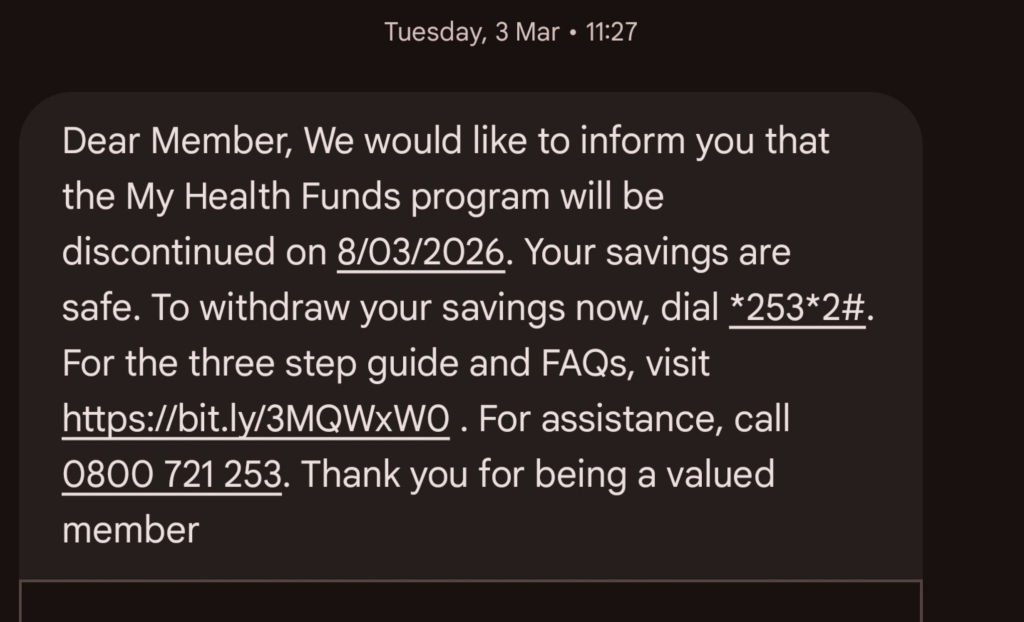
M-TIBA first informed users on March 3 via SMS and its website that the MHF wallet would be discontinued, stating that access to insurance benefits on the platform would remain unchanged.

An SMS from M-TIBA notifying users about the discontinuation of the MHF wallet. Source: Screenshot from an M-TIBA user

Users were asked via SMS to withdraw their balances via USSD or receive M-PESA refunds by March 8, 2026. M-TIBA also said it would process refunds using verified details, with any unresolved balances sent to the Unclaimed Financial Assets Authority, the government agency that holds unclaimed funds until owners come forward.

Refunds began on April 8, and users who had not withdrawn their balances by the March 8 deadline received their wallet savings automatically.

On its website, CarePay said withdrawals would be free, and funds would remain safe, but did not fully explain why the savings product is being retired.

“M-TIBA has some exciting updates on how we’re evolving to better serve you and millions of others,” the company said on its website, without providing further detail.

Launched in 2015, M-TIBA built its early momentum on the idea of ringfencing healthcare funds so they cannot be spent elsewhere. The MHF wallet allowed individuals, employers, and donors to allocate money strictly for medical use across a network of providers. It provided an option for users who could not afford insurance but wanted a structured way to save for care.

CarePay said on its website it will focus on “improving health insurance management,” pointing to a model where insurers and partners drive usage rather than individual savings.

“Since we launched the M-TIBA wallet, we’ve helped many people save and access healthcare, and thanks to your trust, we’re growing into something even bigger and better,” CarePay said on its website. “That’s why we aim to focus on improving health insurance management to ensure more people get access to more affordable healthcare and a better experience.”

CarePay has not disclosed how many users are affected, the total value of refunds, or how many accounts may be transferred to the Unclaimed Financial Assets Authority due to failed verification. It has not outlined clear alternatives for users who cannot transition to insurance products. The shutdown follows scrutiny in 2025 after a cyber attack exposed user data, as reported by TechCabal. M-TIBA said it will delete personal data once MHF accounts are closed, in line with its privacy policy. It has yet to disclose whether the decision is linked to security, compliance, or cost pressures.

  •  

A decade of Uber in Kenya shows gains for riders, losses for drivers

Uber’s arrival in Kenya in January 2015 was a turning point for the country’s urban transport sector. The American ride-hailing app made it possible to summon a car from a smartphone, see a fare estimate before boarding, and pay by cash or card. 

At that time, it was the first taste of tech-enabled convenience for riders in Nairobi. The service quickly spread beyond Nairobi to Mombasa and Kisumu. Over the past decade, Uber has influenced how Kenyans think about taxis, forced regulators to amend transportation laws, and created new earning opportunities for thousands of drivers (Uber declines to share how many drivers work on its platform in Kenya).

Uber’s growth coincided with fare reductions, a high commission structure, and heavy driver protests. The company has been sued, probed by the government, and experienced repeated strikes. 

It now enters its second decade with Uber Safari, a new product that links its platform to Nairobi’s tourism economy. The launch has been met with praise and unease, signaling that many drivers and policymakers still have mixed feelings about Uber’s place in Kenya’s transport system.

Legal and regulatory changes 

When Uber entered the market, it was treated as a technology platform rather than a transport operator. This early classification gave it room to grow without being subject to the strict licencing requirements faced by traditional transport businesses. 

Local taxi associations pushed back, accusing Uber of unfair competition and calling for a level regulatory field. In 2015 and 2016, there were violent attacks on Uber drivers, including reports of vehicles being vandalised near popular pick-up points.

Amidst these issues, regulatory response took years to form. By 2019, the National Transport and Safety Authority (NTSA) had created a licencing regime for digital taxi operators, which required them to register, share trip data with regulators, and enforce a commission cap. 

Court cases by drivers further forced Uber to revise its contracts. A key ruling by the High Court held that Uber BV (its Dutch subsidiary) in Amsterdam could not avoid responsibility for fare decisions in Kenya. This clarified that drivers were in a contractual relationship with Uber Kenya and that any fare or commission change had to be fair and transparent.

Taxation has been another area of tension. The Finance Act introduced digital service tax in 2021 and later e-TIMS compliance in 2024, forcing Uber and its drivers to register for PINs and submit electronic invoices. While this improved tax compliance and gave the Kenya Revenue Authority (KRA) better visibility into ride-hailing income, many drivers say it increased their administrative and financial burden at a time when fuel prices were already eroding their margins.

Consumer protection rules also changed the way Uber operates. After a 2025 probe by Common Market for Eastern and Southern Africa’s (COMESA) competition authority, Uber was compelled to revise its terms so that disputes are handled under Kenyan law, not Dutch law. The same order required Uber to clearly communicate price surges and obtain consent from riders before adjusting fares mid-trip.

Get the best African tech newsletters in your inbox

Drivers’ experiences and repeated protests

The promise of Uber as a steady income stream drew thousands of drivers onto the platform. Many took loans or entered lease-to-own arrangements to acquire vehicles. At first, generous incentives and high base fares made it possible to earn comfortably. But fare reductions in 2016 and a 25% commission rate quickly strained drivers’ finances. Net earnings fell below what many needed to repay loans and maintain their cars.

At some point during the COVID-19 pandemic, drivers staged sit-ins outside Uber’s offices in Nairobi and occasionally switched off the app to disrupt service. Their demands included reducing commission to 10 or 15%, increasing fares to reflect fuel and maintenance costs, and allowing more flexibility in how drivers set prices. 

Uber responded by introducing a tipping feature, occasional fare adjustments, and maintenance discounts, but many drivers say the changes did not address the underlying problem that most trips were still unprofitable after expenses.

There is an ongoing debate about whether driving for Uber can be a main source of income. A 2025 IDinsight study found that Kenya’s platform drivers often work over 66 hours per week to break even. 

Earnings fluctuate based on demand, traffic, and competition from other platforms such as Bolt, Little, and Faras. While some drivers report making enough to sustain their households, others say the model pushes them into debt and forces them to work dangerously long hours.

“Most of the Uber cars on the road are financed through loans. Drivers often work long hours just to cover monthly payments, because if they fall behind, the cars are repossessed,” Paul Sakwa, a former ride-hailing driver who now uses an electric bike, told TechCabal on Wednesday.

The protests have rarely translated into lasting policy change. The NTSA’s 18% commission cap, introduced in 2022, was seen as a win for drivers but was only partially implemented, with platforms continuing to charge more through loopholes. Labour unions have tried to organise drivers into cooperatives and bargaining groups, but high turnover and oversupply of drivers make collective action difficult to sustain.

What Uber Safari represents

For its tenth anniversary in Kenya, Uber launched Uber Safari on Tuesday, a product that allows users to book guided tours of Nairobi National Park directly through the app for KES 25,000 ($194) during the day or KES 40,000 ($311) at night. Riders can choose day or night packages, reserve in advance, and get picked up in safari-ready vehicles. 

The idea is to merge urban ride-hailing with the tourism sector, creating a new revenue stream for licensed tour operators and giving Uber access to a premium segment.

“With Uber Safari, riders can choose between two unique offerings: a Day Safari or a Night Safari, both through Nairobi National Park – the first of its kind available through the Uber app. Using Uber Reserve, riders can pre-book their adventure directly in the app, then be picked up in a fully licensed, safari-ready Land Cruiser operated by licensed tour companies,” Uber said in a statement seen by TechCabal. 

Despite this, only drivers with special vehicles and partnerships with fleet operators can participate, leaving out the bulk of ride-hailing drivers. 

Get the best African tech newsletters in your inbox

Some see this as a missed opportunity, arguing that the company should first address earnings on regular trips before branching into tourism. Others worry that Uber Safari will create new pricing pressures by introducing its algorithm-driven approach to a sector that traditionally allows operators to negotiate higher margins.

“No wonder they don’t initially show the price on the app. KES 25,000 is enough for a holiday in Diani,” Kiruti Itimu, a media executive in Nairobi, told Techcabal on Wednesday. 

A tour operator, who requested anonymity and runs an office in Nairobi’s Westlands, told TechCabal that they already face high licencing fees and compliance costs, and fear Uber’s entry could trigger a race to the bottom in safari pricing. Supporters argue that Uber Safari could expand the market by attracting younger, tech-savvy tourists who might not book a traditional tour.

A half-day trip to the park typically costs between $43 and $138 per person with a tour company or park-operated vehicle, significantly lower than Uber’s rates.

A mixed decade, and what comes next

Uber’s first ten years in Kenya have been marked by undeniable growth and equally undeniable conflict. It pioneered digital ride-hailing, expanded payment options, and gave many urban residents safer and more predictable transport. 

It also expanded into food delivery, motorcycle taxis, and low-cost services such as Chapchap, changing how logistics and mobility work in Kenyan cities.

But the decade has also been defined by disputes over fairness. Drivers have protested fare cuts, taken Uber to court, and lobbied for regulatory protection. Regulators have responded with piecemeal reforms, some helpful, others burdensome. Passengers have benefited from lower fares and better service, but often at the expense of driver welfare.

Uber can double down on growth by finding new markets like tourism and continuing to optimise for riders, or it can work toward driving a more sustainable livelihood by sharing more revenue with its core workforce. 

Suppose the last ten years are any guide. In that case, the tension between profitability, driver welfare, and regulatory compliance will continue to influence Uber’s and, by extension, other ride-hailing platforms in the Kenyan story.

Mark your calendars! Moonshot by TechCabal is back in Lagos on October 15–16! Meet and learn from Africa’s top founders, creatives & tech leaders for 2 days of keynotes, mixers & future-forward ideas. Get your tickets now: moonshot.techcabal.com

  •  

The Backend: At Payble, no SME is “too small”

Millions of Africans turn to micro and informal businesses daily because there is nothing else. There are no jobs, safety nets, or savings. These businesses are not formed out of an ambition to build an empire but out of a need to put food on the table tomorrow. And because of this, they rarely grow beyond survival.

The 2024 Moniepoint Informal Economy Report shows that just 1.3% of Nigeria’s informal businesses make over ₦2.5 million ($1,500) monthly profit. Most earn less than ₦250,000 ($150) a month, and spend nearly all of it on feeding and family obligations. They keep no books, do not know their actual net profit, and often make decisions that wipe out their working capital. When money runs out, they borrow from friends, relatives or loan sharks, usually without repayment plans or grace periods, sinking deeper into debt.

A problem of this scale is an interlocking mess of missing education, inadequate credit, weak infrastructure and the sheer exhaustion of living hand-to-mouth. 

This is the context Payble is walking into. Founded by Roosevelt Elias, with Eghonghon Daniels as COO and Ayo O. as CTO, the startup is trying to do something almost unreasonable. Roosevelt told me that Africa’s smallest businesses should have the kind of resource planning technology and financial structure usually reserved for large corporations.

Roosevelt adds that he sees Payble as a way of breaking the cycle. “The problem is not that microentrepreneurs lack ambition,” he explained, “it’s that the system keeps them trapped in survival mode.” 

Get the best African tech newsletters in your inbox

For Payble, that means starting from the ground up. The platform bundles together inventory tracking, cash flow monitoring, invoicing, payments, and access to credit, but it does so with the understanding that its users may never have had formal business training.

The startup has embedded learning modules into the product itself. A kiosk owner who records daily sales is nudged to see his or her weekly profit margin and is guided through a straightforward pricing or stock management lesson. 

A salon owner gets prompts on when to separate business money from personal money and is shown in real time what that discipline would do for their cash flow. Roosevelt explains that the idea is not to turn every trader into an accountant but to slowly shift the mindset from hustle to enterprise so that decisions can be made with data, not guesswork.

This is slow, painstaking work that takes more than software and a swanky, new startup. Per Roosevelt, Payble has had to design for informal commerce’s chaotic, hybrid nature, where paper receipts and digital wallets coexist and income can be highly seasonal. 

The young company is experimenting with AI agents that provide operational insight—like flagging when inventory is about to run out or cash flow will not cover next week’s purchases—but the system is tuned to speak in the local language to avoid alienating its users.

Where’s credit? 

In a market where 70% of micro business owners have taken credit but just 12% have accessed formal financial services, Payble has chosen to make credit a last step, not the first. 

Users are encouraged first to build a history of transactions on the platform so that when they borrow, the loans are tied to actual business needs, like restocking fast-moving items, rather than plugging personal cash gaps. Roosevelt believes this approach reduces default rates and teaches owners to deploy capital intentionally.

The startup structure itself is lean but deliberate. It was founded in 2023 and operates with a small core team split between Lagos and remote locations, with partnerships to handle distribution and merchant onboarding. 

While Roosevelt will not disclose how much capital the company is currently trying to raise, he says it is in talks with early-stage investors and is committed to focusing on sustainable growth rather than chasing vanity metrics.

For all its ambition, Payble is not immune to the ecosystem’s constraints. The infrastructure for digital payments remains patchy, and education is a long game that requires trust. Yet Roosevelt insists the problem must be solved at its roots. 

“What makes Payble different is that we don’t treat micro-businesses as “too small.” We build for them — low-cost, easy-to-use, and designed to fit into their daily realities. In other words, Payble gives the corner shop or market vendor the same infrastructure as a big company, but without the barriers.”

The startup has begun piloting partnerships with banks and insurers to create bundled products – small-ticket health cover for market traders, overdraft facilities for verified merchants, and micro-savings accounts that lock away a fraction of daily revenue. 

These collaborations matter because they turn a dead-end economy into one with upward paths, where a business can grow from one table in the market to a small shop, and then to a formal SME.

Payble’s approach is contrarian precisely because it claims to discard the common wisdom that informal businesses will always stay informal. In my understanding, the company believes that with the right tools, hundreds of thousands of these traders can be formalised not by coercion but by the natural incentive of making more money and spending less time worrying about survival.

Payble at Moonshot 

In October, Roosevelt will speak at Moonshot by TechCabal, a gathering of some of Africa’s most serious founders and investors. He told me it is more about pressure-testing ideas with peers who know how to build, and will share the difficulty of building for users who are often too busy surviving to sit still for onboarding, and the emotional toll of running a company trying to solve structural problems at scale.

“I believe Moonshot can inspire and empower the next generation of founders. It creates a stage where entrepreneurs can see that they’re not alone, that others are breaking barriers, raising capital, and solving problems at scale. When stories are shared openly in a forum like this, it builds collective belief and momentum.” 

  •  

Kenya’s cybersecurity ‘talent gap’ is a hiring problem

Next Wave Logo

First published O6 July, 2025

Kenya’s cybersecurity ‘talent gap’ is a hiring problem

cybersecurity

Image: Pixbay


This week, my colleague Adonijah published a piece about how Kenya’s digital economy is expanding rapidly and how that growth has come with its own set of problems. Banks, telecom companies, and insurers are expanding their mobile-first services. Government services are also going online, and with that comes a sharper need for cybersecurity. The risks are growing, and so is the demand for talent that isn’t just there, or so we have been made to believe.

Kenya’s cybersecurity workforce gap is often framed as a supply problem, and the result, we’re told, is understaffed banks, overworked tech teams, slow response to incidents, and dangerous exposure to digital threats. But, this version of the story sidesteps a harder question: what if the problem isn’t that the talent doesn’t exist, but that hiring systems are too rigid and narrow, and too flawed to recognise it?

The dominant logic across these sectors (especially in banking, for this context) is that hiring cybersecurity professionals should be technical, standardised, and rigorous. Roles are posted with lengthy checklists that include multiple certifications, years of experience, and specialised areas of expertise. Interviews, if they happen at all, are modelled after global formats, usually by solving a puzzle on a whiteboard, proving you know complex algorithms, or passing a coding test under pressure. But few local candidates make it through these filters, not because they aren’t skilled, but because the format itself works to exclude them.

Next Wave continues after this ad.

cardtonic

It’s Upskill with Cardtonic season again. Applications for Upskill 3.0 are open

Now is your chance to win one of the 20 units of 2024 M4 MacBook Pro Laptops we are giving away. If you’re a techie in software engineering, design, data science, product management, and content creation, this is for you!

Find out more here!

Technical interviews often reward the ability to perform under artificial, time-pressured conditions, not real-world competence. I spoke with former college and high school classmates who work in banking, telecommunications, and big tech (Google and Microsoft). Before they were hired for these international roles, they admitted to being asked to solve sorting problems, tree traversals, and optimisation challenges they hardly face on the job.

They were expected to write perfect code on a whiteboard or shared doc, from memory, without syntax help, debugging tools, or a collaborative setup. There’s an unspoken belief that this is how you separate “real” engineers from the rest. But what it actually filters for is who studied computer science in the right way or who enjoys brain teasers under surveillance. It is something that just doesn’t work.

This problem is shaping how local employers screen tech talent. In Nairobi, technical interviews are increasingly mimicking this pattern, especially in firms that want to compete with or supply to international partners. And in the process, they’re weeding out strong candidates who think differently, communicate differently, or just haven’t had the luxury to rehearse interview puzzles for weeks.

I have been told by the same group that certifications are treated as mandatory in most Kenyan cybersecurity job listings (I now understand why they are such a big deal on LinkedIn). Yet a Certified Information Systems Security Professional (CISSP) certification costs more than most entry-level IT workers make in several months.

Next Wave continues after this ad.

Alltalentz

All Talentz has launched Nigeria’s first nationwide tech hackathon, with TechCabal as media partner. Interested teams should register by July 4, 2025. The event runs from July 14 to August 23 in Lagos, and winners get ₦10M, a TechCrunch Disrupt trip, and opportuninty fr jobs. All applicants will join a global tech talent pool.

Register here!

And even those who invest in it still find themselves screened out if they lack the ‘right’ work history or can’t demonstrate fluency in jargon during interviews. Meanwhile, there are thousands of capable IT professionals, including network engineers and support staff who’ve spent years in adjacent roles, responding to incidents, managing infrastructure, or securing systems informally. They’re already doing half the job, but because hiring filters are rigid, they never even get interviewed.

Candidates who struggle with high-pressure environments tend to flounder in traditional interview formats. A close friend who worked in a software development firm in Uganda described how a colleague with a shy streak consistently failed interviews, despite being easily the most talented developer they had ever worked with. His mind worked differently, but the process never made space for that.

In other cases, some say that interviews are adversarial, especially for Kenyan banks. You’re asked to perform a trick the interviewer already knows the answer to, under judgment, with little real collaboration or feedback. And if you ask for clarification or go off-script, you risk triggering visible frustration. Some interviewers even nitpick syntax during whiteboard sessions, defeating the point of the tool as a sketchpad for thinking.

Next Wave continues after this ad.

moonshot

Africa’s tech ecosystem is alive with ambition, and Moonshot 2025 is catalysing it into unstoppable momentum. Our theme, “Building Momentum,” honours past builders and calls for doubling down on systems, capital, policies, and partnerships.

Expect new formats, deeper conversations, and broader voices. This is where vision becomes action. If you’re building, funding, or enabling Africa’s innovation economy, join us October 15–16 in Lagos. Early Bird tickets are 20% off! Let’s build the future, faster, smarter, together.

Reserver your spot!

What’s most concerning is that this interview culture—while claiming to be objective—is riddled with bias. Candidates who don’t live in Nairobi or didn’t go to JKUAT or Strathmore are less likely to be taken seriously. And because the process rewards fluency in academic algorithms and fast recall over real-world problem-solving, it disproportionately advantages younger candidates who recently studied those topics or those who have the spare time to grind interview prep. People with practical business experience, like delivering on projects, managing security under pressure, or navigating messy legacy systems, are penalised because they can’t whiteboard a binary search tree in 20 minutes.

This is how Kenya has ended up with a false perception of a shortage. A talent pool that exists but is largely invisible to current hiring filters. Employers say they can’t find people, but what they often mean is they can’t find people who fit a very narrow image of what skilled looks like. And in chasing that image, they’re letting real, practical, trainable talent walk out the door.

Kenn Abuya

Senior Reporter

Thank you for reading this far. Feel free to email kenn[at]bigcabal.com, with your thoughts about this edition of NextWave. Or just click reply to share your thoughts and feedback.


We’d love to hear from you

Psst! Down here!

Thanks for reading today’s Next Wave. Please share. Or subscribe if someone shared it to you here for free to get fresh perspectives on the progress of digital innovation in Africa every Sunday.

As always feel free to email a reply or response to this essay. I enjoy reading those emails a lot.

TC Daily newsletter is out daily (Mon – Fri) brief of all the technology and business stories you need to know. Get it in your inbox each weekday at 7 AM (WAT).

Follow TechCabal on Twitter, Instagram, Facebook, and LinkedIn to stay engaged in our real-time conversations on tech and innovation in Africa.

If you liked this edition of Next Wave, please share with your friends. And feel free to reply with thoughts and feedback. We welcome those.

18, Nnobi Street, Surulere, Lagos, Nigeria

View in Map
You received this email because you signed up on our website or made purchase from us. If you know longer wish to recieve these emails, please unsubscribe

  •