South African small businesses are shifting from a survival mindset to more deliberate, disciplined growth strategies as economic conditions slowly improve, though lingering global uncertainties keep their optimism in check, a report released on Thursday shows.
The latest SME Pulse Report by SME funding startup, Lula, found that entrepreneurs are moving beyond short-term crisis management and focusing on operational optimisation after years of navigating power cuts, high inflation and steep
South African small businesses are shifting from a survival mindset to more deliberate, disciplined growth strategies as economic conditions slowly improve, though lingering global uncertainties keep their optimism in check, a report released on Thursday shows.
The latest SME Pulse Report by SME funding startup, Lula, found that entrepreneurs are moving beyond short-term crisis management and focusing on operational optimisation after years of navigating power cuts, high inflation and steep interest rates.
“The story of SMEs in 2026 is no longer one of pure survival, but not yet one of full recovery either,†Lula Chief Executive Trevor Gosling said. “What we’re seeing instead is measured optimism. Businesses are becoming more deliberate about where they deploy capital, which opportunities they pursue, and how they protect cash flow.â€
The report points to improving affordability for small businesses over the past 12 months, with easing inflation and greater energy stability restoring some predictability after prolonged pressure.
Business confidence has also improved. The RMB/BER Business Confidence Index rose to 47 in the first quarter of 2026, the highest level in nearly five years, building on gains in late 2025. Inflation has moderated from previous highs, and the South African Reserve Bank has begun cutting interest rates, with the prime lending rate at 10.25% by May 2026.
However, the report cautions that conditions remain fragile. Escalating conflict in the Middle East has driven up global oil prices, threatening to push inflation back up and delay or reverse further interest rate relief. Gosling said the external environment has already shifted rapidly since the report’s data was compiled earlier this year.
“SMEs are operating in a market that can change very quickly and often without warning,†he said. “Businesses cannot afford to become complacent.â€
The report also noted a shift in how SME owners view funding. Many still rely on personal savings or credit, but there are growing signs that business funding is being seen less as a last resort and more as a strategic tool for growth. Some businesses are now using finance proactively to secure stock ahead of demand or expand operations rather than waiting for cash flow pressure to build.
“The future of SME finance will not simply be about access to capital,†Gosling said. “It will increasingly be about helping businesses make smarter decisions and giving them the confidence to act at the right time.â€
South Africa’s SME sector faces a financing gap estimated at more than ZAR 350 B (USD 18 B), according to the OECD. The Lula report suggests businesses that embrace funding as a growth enabler rather than an emergency measure are better positioned to scale.
The report is based on Lula’s internal affordability, funding and operating environment data, alongside broader SME sentiment research conducted with News24.
Millions of Africans turn to micro and informal businesses daily because there is nothing else. There are no jobs, safety nets, or savings. These businesses are not formed out of an ambition to build an empire but out of a need to put food on the table tomorrow. And because of this, they rarely grow beyond survival.
The 2024 Moniepoint Informal Economy Report shows that just 1.3% of Nigeria’s informal businesses make over ₦2.5 million ($1,500) monthly pr
Millions of Africans turn to micro and informal businesses daily because there is nothing else. There are no jobs, safety nets, or savings. These businesses are not formed out of an ambition to build an empire but out of a need to put food on the table tomorrow. And because of this, they rarely grow beyond survival.
The 2024 Moniepoint Informal Economy Report shows that just 1.3% of Nigeria’s informal businesses make over ₦2.5 million ($1,500) monthly profit. Most earn less than ₦250,000 ($150) a month, and spend nearly all of it on feeding and family obligations. They keep no books, do not know their actual net profit, and often make decisions that wipe out their working capital. When money runs out, they borrow from friends, relatives or loan sharks, usually without repayment plans or grace periods, sinking deeper into debt.
A problem of this scale is an interlocking mess of missing education, inadequate credit, weak infrastructure and the sheer exhaustion of living hand-to-mouth.Â
This is the context Payble is walking into. Founded by Roosevelt Elias, with Eghonghon Daniels as COO and Ayo O. as CTO, the startup is trying to do something almost unreasonable. Roosevelt told me that Africa’s smallest businesses should have the kind of resource planning technology and financial structure usually reserved for large corporations.
Roosevelt adds that he sees Payble as a way of breaking the cycle. “The problem is not that microentrepreneurs lack ambition,†he explained, “it’s that the system keeps them trapped in survival mode.â€Â
Get the best African tech newsletters in your inbox
For Payble, that means starting from the ground up. The platform bundles together inventory tracking, cash flow monitoring, invoicing, payments, and access to credit, but it does so with the understanding that its users may never have had formal business training.
The startup has embedded learning modules into the product itself. A kiosk owner who records daily sales is nudged to see his or her weekly profit margin and is guided through a straightforward pricing or stock management lesson.Â
A salon owner gets prompts on when to separate business money from personal money and is shown in real time what that discipline would do for their cash flow. Roosevelt explains that the idea is not to turn every trader into an accountant but to slowly shift the mindset from hustle to enterprise so that decisions can be made with data, not guesswork.
This is slow, painstaking work that takes more than software and a swanky, new startup. Per Roosevelt, Payble has had to design for informal commerce’s chaotic, hybrid nature, where paper receipts and digital wallets coexist and income can be highly seasonal.Â
The young company is experimenting with AI agents that provide operational insight—like flagging when inventory is about to run out or cash flow will not cover next week’s purchases—but the system is tuned to speak in the local language to avoid alienating its users.
Users are encouraged first to build a history of transactions on the platform so that when they borrow, the loans are tied to actual business needs, like restocking fast-moving items, rather than plugging personal cash gaps. Roosevelt believes this approach reduces default rates and teaches owners to deploy capital intentionally.
The startup structure itself is lean but deliberate. It was founded in 2023 and operates with a small core team split between Lagos and remote locations, with partnerships to handle distribution and merchant onboarding.Â
While Roosevelt will not disclose how much capital the company is currently trying to raise, he says it is in talks with early-stage investors and is committed to focusing on sustainable growth rather than chasing vanity metrics.
For all its ambition, Payble is not immune to the ecosystem’s constraints. The infrastructure for digital payments remains patchy, and education is a long game that requires trust. Yet Roosevelt insists the problem must be solved at its roots.Â
“What makes Payble different is that we don’t treat micro-businesses as “too small.†We build for them — low-cost, easy-to-use, and designed to fit into their daily realities. In other words, Payble gives the corner shop or market vendor the same infrastructure as a big company, but without the barriers.â€
The startup has begun piloting partnerships with banks and insurers to create bundled products – small-ticket health cover for market traders, overdraft facilities for verified merchants, and micro-savings accounts that lock away a fraction of daily revenue.Â
These collaborations matter because they turn a dead-end economy into one with upward paths, where a business can grow from one table in the market to a small shop, and then to a formal SME.
Payble’s approach is contrarian precisely because it claims to discard the common wisdom that informal businesses will always stay informal. In my understanding, the company believes that with the right tools, hundreds of thousands of these traders can be formalised not by coercion but by the natural incentive of making more money and spending less time worrying about survival.
Payble at MoonshotÂ
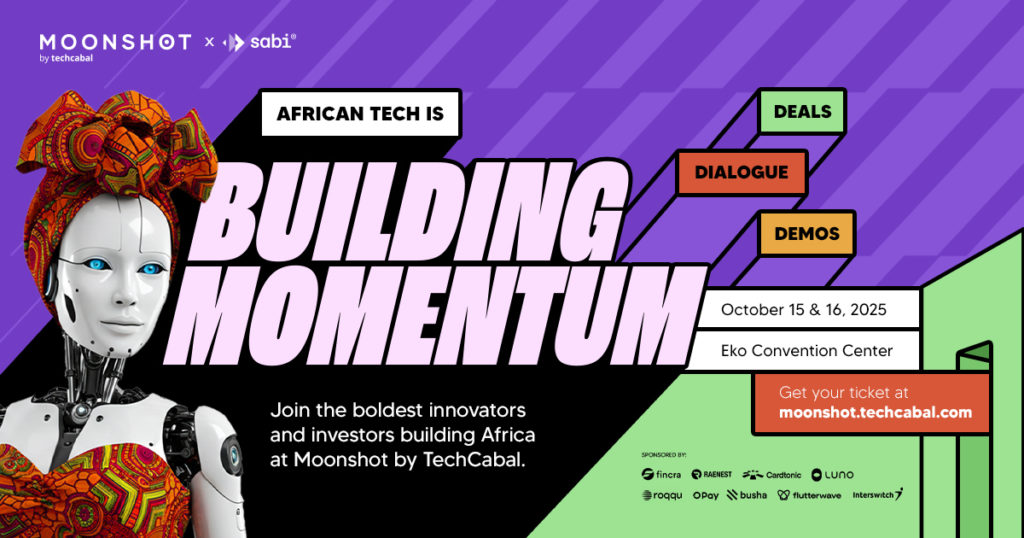
In October, Roosevelt will speak at Moonshot by TechCabal, a gathering of some of Africa’s most serious founders and investors. He told me it is more about pressure-testing ideas with peers who know how to build, and will share the difficulty of building for users who are often too busy surviving to sit still for onboarding, and the emotional toll of running a company trying to solve structural problems at scale.
“I believe Moonshot can inspire and empower the next generation of founders. It creates a stage where entrepreneurs can see that they’re not alone, that others are breaking barriers, raising capital, and solving problems at scale. When stories are shared openly in a forum like this, it builds collective belief and momentum.â€Â

 Connexion