
 Connexion

Why African Men Are Finally Embracing Skincare
Slowly but steadily, more African men are beginning to take skincare seriously, not just as an aesthetic pursuit, but as a reflection of wellness, self-respect, and changing ideas about masculinity.Â
By Joseph Jonathan
I attended an all-boys secondary school, the kind where masculinity was constantly being performed, tested, and policed. There was always some unwritten contest about who was the toughest, the most rugged, the least bothered about anything remotely “softâ€. I remember one harmattan season when a few boys brought lip gloss to school, not for fashion, but simply to keep their lips from cracking under the dry weather. Still, they were ridiculed endlessly. Some were called names. Others tossed the lip gloss away and never brought it back.
Looking back, it’s both funny and sad, how even basic grooming, like moisturising chapped lips, was treated as a betrayal of boyhood. In that environment, the message was clear: to be a “real manâ€, you had to be tough, indifferent, and unconcerned about your appearance. Self-care, especially of the visible kind, was suspect. To care about your skin—your lips, your face, your body—was to risk being called feminine or worse.Â
Before now, the average African man’s approach to skincare was remarkably minimal. Grooming, for many, was a ritual of utility, not care. A bath with black soap or any soap really. A quick rub of petroleum jelly (vaseline) or body cream, if you managed to get your hands on one. The idea of using separate towels for the face and body sounded excessive; a single towel, often sun-dried and scratchy, did the job for everything. Skincare was treated as something indulgent or ornamental, and by cultural expectation, that meant it belonged to women.
This attitude was not just personal but social. In many African households, grooming beyond the basics was policed by gender expectations. A boy who stared at the mirror too long risked being called vain or unserious. Face creams were dismissed as “womanlyâ€.Â
Pimples were simply part of life. Few men thought to ask why they had oily skin or dark spots, let alone whether there was anything they could do about it. And even when they did, they were more likely to reach for a harsh antiseptic soap than an actual skincare product. Skincare, where it existed for men at all, was seen as reactive, not intentional.

For the longest time, society insisted that to be a man was to be tough, unbothered, and oddly indifferent to one’s appearance, as if masculinity meant neglect by default. But something is shifting. Slowly but steadily, more African men are beginning to take skincare seriously, not just as an aesthetic pursuit, but as a reflection of wellness, self-respect, and changing ideas about masculinity.Â
What was once neglected or laughed off has become a site of self-awareness. A new generation, exposed to global media, health-conscious discourse, and peer influence on social media platforms like TikTok and Instagram, is challenging the old binary that tied skincare to femininity and neglect to masculinity. In doing so, they are not only reclaiming their skin, they are reshaping the culture.
As with any cultural shift, the natural question is: why now? What’s driving African men to embrace skincare? There are quite a number of factors really.Â
Considering the fact that skincare has always been seen as feminine, it is no surprise that for most African men, their entry point into skincare came through the women in their life. It could be through “stealing†the girlfriend’s bodywash from the bathroom cabinets. Or sisters who, tired of gatekeeping beauty secrets, hand over their cleansers and serums with a warning: “Don’t waste itâ€. What started as casual borrowing has turned into full-blown ownership.Â
Take Tobi, a 26-year-old Lagos-based designer, who now swears by his five-step routine but used to wash his face with only water. “It was my girlfriend who put me onâ€, he laughs. “She got tired of me using her products without asking, so she bought me my own moisturiser and cleanser. At first, I didn’t take it seriously, but then I noticed my face was clearing up, and I actually started feeling more confidentâ€. What started as a girlfriend’s nudge has become a ritual of self-respect. “Now I even remind her to wear sunscreenâ€, Tobi says, half-joking, half-proud.
While the strength of a woman (shoutout to Shaggy) is quite persuasive, another factor is the growing awareness of skin health. Acne, razor bumps, hyperpigmentation, and others aren’t just cosmetic concerns; they affect confidence, mental health, and self-image. For a long time, men simply endured them in silence. But now, with more information and access to products, they’re treating their skin with intention. Skincare isn’t vanity. It’s strategy. It’s control.
For Ebuka, a historian and researcher based in Enugu, skincare wasn’t something he thought much about until his face reacted badly to a body cream. “I was told it had vitamin C or whatever, and that I shouldn’t use it on my face or step into the sun with it,†he recalls. That caution came from a female friend and it stuck. “To be honest, the average woman knows way more about skincare than most guys,†he admits.
Then there’s the social media effect. Platforms like TikTok and Instagram have normalised self-care for men. Influencers—from barbers to lifestyle creators—are openly sharing their routines, breaking down ingredients, and reviewing products. The comment sections are filled with questions from men who are newly curious: “Is this good for oily skin?â€, “How do I deal with dark spots?â€Â
In these spaces, skincare has become communal; a dialogue, not a secret. While some men still scoff at skincare online, those who are curious now find support from a growing community of enthusiasts: a community that barely existed a few years ago.
Economic growth and urban exposure also play a role. As more African men work in corporate settings, entertainment, tech, and media, appearance becomes part of the professional package. Showing up well-groomed—clean-shaven, well-moisturised, intentional—signals self-respect. It screams: I’m paying attention to detail.Â
Media influencer, Phil Badung, shares that he only started paying attention to skincare in April of last year. “Honestly, it was peer pressure that triggered the shiftâ€, he says. “I’ve always had good skin, never dealt with acne or breakoutsâ€. But as a content creator, he began to notice how other creators’ skin looked brighter and more refined. “That got me thinkingâ€, he adds. “Then I started getting tanned from sun exposure. Around that time, a skincare store reached out for an influencer deal, that was the sign I neededâ€.
Like Badung, other African men are also beginning to pay closer attention to their skin, not necessarily because of underlying skin issues, but because they’re becoming more aware of how they present themselves to the world.Â
In cities like Lagos, Accra, Nairobi, and Johannesburg, it’s no longer unusual to find men strolling into skincare clinics, booking facials, asking for sunscreen — sometimes shyly, sometimes boldly. Whether it’s driven by career demands, digital visibility, romantic appeal, or simple self-care, the shift is happening: men are slowly shedding the myth that skincare is a feminine pursuit.
Unsurprisingly, the market has caught on. More skincare brands across the continent are now tailoring products and messaging to men. From premium brands like Arami Essentials and R&R Skincare to drugstore-friendly options in open markets and online shops, there’s an expanding range of products made with African skin and climate in mind. Some brands run gender-neutral campaigns with male models front and centre, challenging the idea that skincare is still “women’s territoryâ€.Â
According to a forecast by Mordor Intelligence, the men’s grooming and skincare market in Africa is expected to register a compound annual growth rate (CAGR) of 6.45% between 2025 and 2030, a reflection of changing perceptions, growing disposable incomes, and increased access to products tailored specifically for men.Â
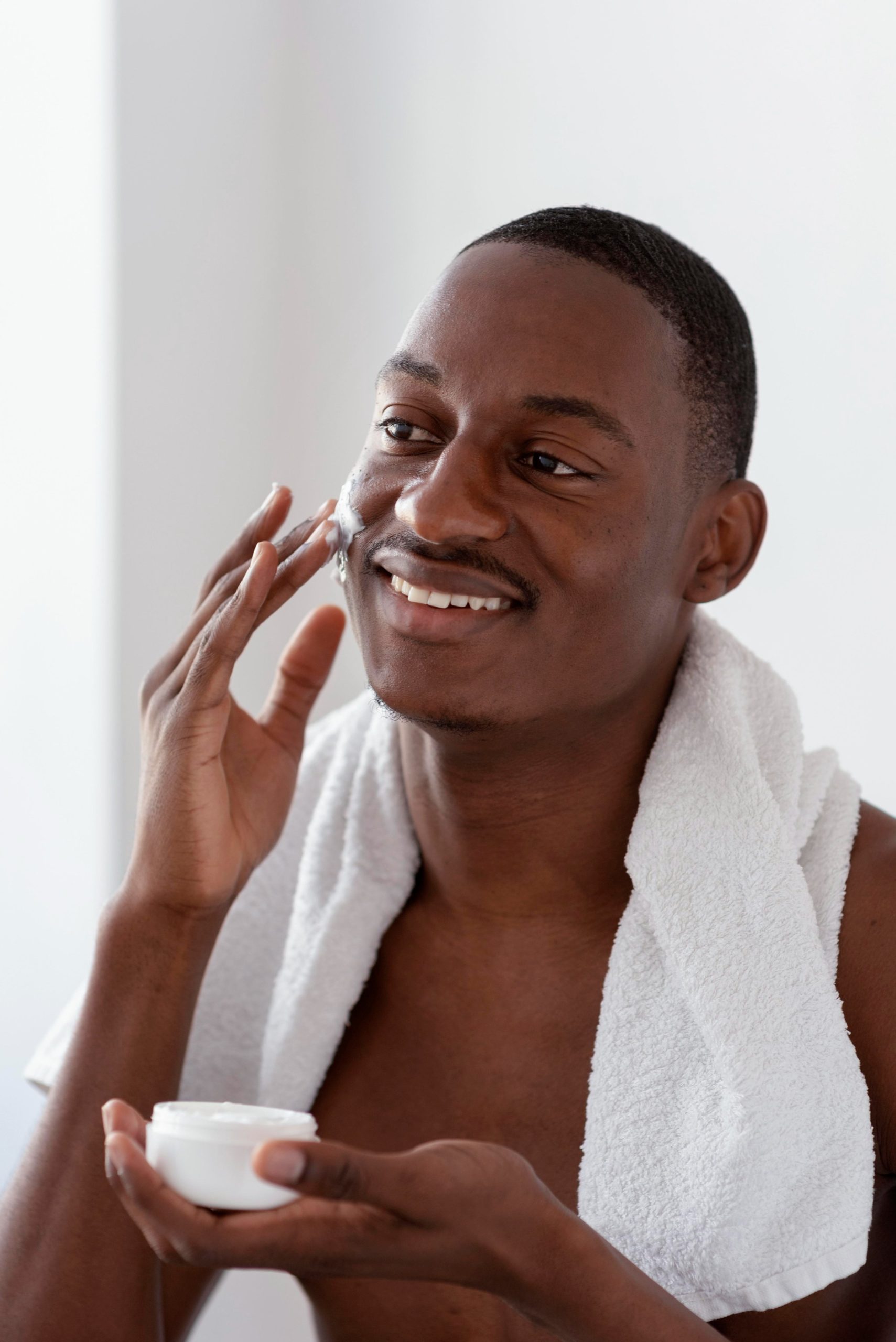
There’s something quietly revolutionary about African men reclaiming skincare as a form of joy. In societies where men are expected to be hardened, silent providers, the simple act of gently massaging moisturiser into your skin can feel like a protest. It is resistance to toxic masculinity, but it’s also restoration. Skincare becomes a moment of solitude, a habit of healing, a ritual of care in a world that rarely encourages men to pause, let alone pamper.
It won’t fix everything. But it’s a start. It represents something larger: a cultural shift toward self-awareness, softness, and emotional health. So if you see a man exfoliating with intent or patting sunscreen onto his forehead, don’t laugh. He might just be loving himself, for the first time in a long time.
Joseph Jonathan is a historian who seeks to understand how film shapes our cultural identity as a people. He believes that history is more about the future than the past. When he’s not writing about film, you can catch him listening to music or discussing politics. He tweets @JosieJp3.
The post Why African Men Are Finally Embracing Skincare first appeared on Afrocritik.
