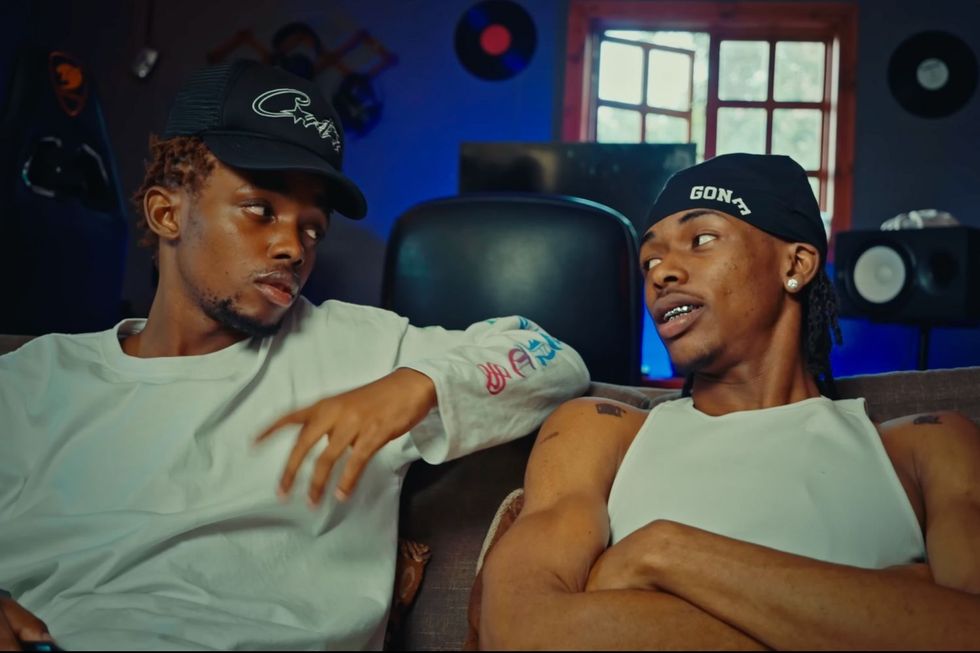
As this season of Afrobeats Intelligence winds down, Joey Akan sits with Peruzzi, the Nigerian singer-songwriter behind hits like “Majesty†and “Relationship.†It’s an interview long in the making, and as Akan tells him early on: “These things, when I do them, I usually think, ‘When it happens, it’s the right time.’â€
Timing becomes a subtle through-line in the 47-minute conversation – the way it shapes growth, career shifts, and creative evolution.
“I had to go back and sit down and think, like, what would Peruzzi really do regardless of what’s trending,†the artist reflects. “I don’t wanna be boxed.†Still, he acknowledges that the rush of early success came with distractions. “I had to get through that phase to get here. This is the part where they really understand why I was created in the first place, why I decided to do this.â€
Akan, ever the thoughtful interviewer, guides the exchange with quiet intention, curiosity, and clarity, giving Peruzzi room to reckon with his past and articulate what’s next. They’re not afraid to delve into the depths of fame; “I was lost in it, I was carried away,†Peruzzi admits, a sober reflection, delivered with the weight of someone who has lived the high life.
Fresh off her 2025 BET Award win for Best International Act, Nigerian pop sensation Ayra Starr released her latest single, “Hot Body†today, a sultry, dancehall-tinged song – her third release this year – that is as seductive and alluring as the summertime vibe it possesses.
Produced by Ragee and The Elements, “Hot Body†channels humid nights and a languid, late-night dancefloor mood. The beat leans into a bouncier, percussion-heavy groove, while Ayra Starr's voice carries the same magnetic allure that defined her previous releases. The lyrics are enticing; “Look what a hot body can do/ look, focus,†she insists, then, a revelation: “body be dancing/ slow whine, summer body so fine.†She turns up the sensuality without losing the sheen that has defined her career thus far. The video, lo-fi with VHS textures, sees her in top shape, lost in her world, ready and willing to walk into the night.
Is it a photoshoot? Is it a brief moment outside before going back into the club? Is Ayra Starr about to jump into the pool? It’s all of them at once, distilled into a series of frames where the artist and the camera are locked in motion.
Since her 2021 breakout, 19 & Dangerous, Ayra Starr has charted an upward course and is showing no signs of slowing down anytime soon. Her Grammy-nominated hit “Rush†remains the most-streamed solo track by a Nigerian female artist on Spotify. The accompanying video made her the youngest African woman to hit 100 million views on YouTube. She’s been a consistent force across award circuits too, winning Female Artist of the Year at both the Headies and AFRIMMA Awards, plus two major African Entertainment Awards USA titles in 2024.
Her sophomore album, The Year I Turned 21, was released in mid-2024 and was one of the most-streamed Afrobeats albums on Spotify that year. It featured high-profile collaborations with artists like Giveon, Anitta, Coco Jones, and Seyi Vibez, bridging genres and geographies while at it. The album’s success helped the superstar lock in her spot as the second most-nominated act at the 2025 Headies.
Earlier this month, she signed a management deal with Jay-Z’s Roc Nation, reflecting her growing pull beyond the continent. It also aligns with her ongoing stadium tour across Europe, where she’s opening for Coldplay. The tour has exposed her music to massive audiences across cities like Paris, Amsterdam, Berlin, and London. She is also booked to perform at Global Citizen 2025, one of the year’s most high-profile international concert platforms. The lineup includes the likes of Tyla, The Weeknd, and Shakira.
With more than four billion career streams under her belt and a major international infrastructure now behind her, Ayra Starr is operating at a different tier.
South African starTyla and Nigerian pop sensationAyra Starr will join a high-profile lineup at this year's Global Citizen Festival, set to take place on September 27 in New York City's Central Park. The event will be headlined by The Weeknd and Shakira, and hosted by long-time Global Citizen ambassador Hugh Jackman.
The festival continues Global Citizen's mission to end extreme poverty and drive action on global issues. This year, the campaign is focused on providing energy access for one million people on the African continent, ensuring quality education for 30,000 children worldwide, and protecting 30 million hectares of the Amazon rainforest. The festival will also push to recruit 40,000 volunteers across New York City.
Tyla, who recently won a Grammy Award for Best African Music Performance, is riding high after a breakout year that saw her single "Water" become a global hit. Her appearance at the Global Citizen Festival marks another significant milestone in her growing international career.
Ayra Starr, one of Nigeria's most prominent voices in the new wave of Afrobeats, will also take the stage. Known for her chart-topping hits like "Rush" and her boundary-pushing style, the artist continues to gain traction across global markets. Both artists represent a younger generation of African talent reaching broader audiences while staying grounded in their cultural roots.
Their participation in the festival reflects Global Citizen's growing attention to Africa as a central part of its advocacy. One of the campaign's core goals this year is to help bring clean and affordable energy to communities across the continent. Through its Scaling Up Renewables in Africa campaign, Global Citizen plans to raise $1.5 billion to train 50,000 young workers in solar installation, grid maintenance, and other essential energy services. The initiative could provide reliable electricity to over a million people, while also supporting jobs and reducing emissions.
In a statement, Global Citizen CEO Hugh Evans said: "Ending extreme poverty is within our reach – but only if we come together to ensure governments and corporations deliver on their promises: scaling up renewable energy, protecting the Amazon, and investing in education for the next generation."
Tickets to the festival are free and can be earned by taking action on Global Citizen's app or website. These include signing petitions, emailing world leaders, or volunteering time to local causes.
Since its inception, Global Citizen has helped secure $49 billion in commitments, positively impacting the lives of more than a billion people. With artists like Tyla and Ayra Starr on board, the 2025 edition brings Africa even closer to the heart of this global movement.
It’s been over a decade since former South African President and global icon Nelson Mandela passed away. Every year on his birthday, 18 July, South Africans, and everyone around the world, are asked to dedicate 67 minutes of their time to helping others. The number marks the years Mandela spent in service — from his early legal work in Johannesburg and underground activism, to his imprisonment on Robben Island alongside other stalwarts of the liberation struggle.
This year, Mandela Day arrives during a particularly volatile moment in the country. Just last week, Lieutenant General Nhlanhla Lucky Mkhwanazi publicly accused Police Minister Senzo Mchunu and other senior officials of disbanding a task team investigating political assassinations in KwaZulu-Natal, and of concealing evidence. These are serious allegations, with the potential to shake national politics. In response, President Cyril Ramaphosa has ordered the formation of a commission of inquiry.
All this unfolds against a backdrop of deepening instability. The Government of National Unity is fragile, always one disagreement away from collapse. In Mandela’s home province, the Eastern Cape, recent floods have resulted in deaths and left communities reeling. At the same time, budget cuts to key health programmes are raising alarms about the state’s ability to care for its people.
OkayAfrica took to the streets to speak to young South Africans about their thoughts and feelings about Mandela Day. For Sivenathi, a student at the University of the Western Cape, the day represents “the effort and progress made towards addressing the injustices of the past.â€
She continues: “It also poses a solution for us to work together towards addressing those injustices, and taking a collaborative and bottom-up approach to addressing the issues we face as a society because of our past.â€
Buhlebethu Magwaza (31) agrees. As the project lead at Youth Capital, a campaign advocating for key policy changes to solve youth unemployment, she recognises the urgency of a youth locked out of employment opportunities. She plans to spend Mandela Day helping young people format their resumes and with reading and comprehending job descriptions. For her, the day is about “collective action.â€
“It’s about what you can do with your community to give back. It’s about being courageous, it’s about unity, and doing something for someone. Mandela was really about nation building and what we can do to ensure that everyone contributes to a better South Africa, continent, and even the world,†she says.
Compassion and courage are two values of the revered former statesman that she still abides by today. “To solve today’s development problems, we need to be courageous. In the same breadth, we need to be compassionate; people are going through a lot. We need to remember that we exist within our communities; therefore, we must remember to always be kind in whatever we do,†she says.
The legacy of the man, however, has not gone unquestioned. For many, Mandela’s vision of a “rainbow nation†feels increasingly out of step with South Africa’s present-day realities. The post-apartheid promise of equality and justice remains unfulfilled for millions. Rising inequality, corruption, unemployment, and deep mistrust in political leadership have led some to view Mandela Day as symbolic at best, performative at worst.
But Magwaza reckons the day is still relevant.
“Especially in a world that is going through so much,†she says. “It’s always important that you give back. You go back to communities, see what can be done, and how you can contribute. As someone who works in the youth unemployment space, I think now more than ever we need to pull together to come up with solutions,†she says.
Thapelo Tapala (13), a student, learnt that fighting for one’s rights is important while being taught about Mandela in school. But he doesn’t think that people nowadays pay attention to the day. To his generation, Mandela represents freedom. “We’re young people who need our rights and our freedom,†he says. His cousin Anesu (15) agrees that young people don’t really pay attention to Mandela Day anymore. “I think it’s just another day for them. He does mean a lot to us, even though we don’t really show it in anything we do. He fought for our freedom, and that is why we are where we are now,†he concludes.
Samthing Soweto had just stepped out of his Uber when we connected online to talk about his new album, Touch Is A Move (Good Morning). It followshis 2020 EP, Danko!, and marks his first full-length releasesince Isphithiphithi redefined the game for him in 2019. Spanning seventeen tracks, the album is pure bliss, dotted with skits that feel like overheard conversations, and music that moves fluidly between the ephemeral and the ethereal. It draws from a broad palette: hip-hop, Afropop, Amapiano, Kwaito, and more.
"I think it's just luck and favour, and the audience deciding, okay, we're gonna keep you around. We like what you do, we're gonna keep you around," he says, responding to OkayAfrica's question about what it is that has sustained him for so long without releasing a full album. There were singles in between, however. "Amagents" arrived in 2022 as a cautionary tale to his daughter about the trappings of romantic love. "Ayafana amagents, ayafana amajimbozi," he sang, essentially letting her know that the game is rigged and that all men are the same – in how they set you up, in how they lie to you, in how they steal your heart.
"Songs are more valuable now than they were before. It used to be entire projects. If you have a really good song, you're good for at least six months," says the artist. "If you make music that people like, they'll remember you," he says.
There's a certain ease that comes with knowing, like knowing the sun will rise and set, as it has since time immemorial. Ease also comes in trusting that your favorite artist will deliver stunning work, no matter how long they take between projects. Samthing Soweto is one of those rare artists—a soothsayer of song, a titan, and a juggernaut who holds our hands through chaotic times. Since emerging with The Soil nearly two decades ago, he has left his mark on at least four distinct South African genres and done so as a singular, genre-defying force.
With The Soil, he helped popularise a cappella music for a new generation, infusing it with street-corner harmonies and township soul. He carried that melodic instinct into his early solo works – cult classics like This N That Without Tempo (2010) and Eb'suku (2014), which blended folk sensibilities with poetic introspection. As a member of the alt outfit The Fridge, he crafted sweet, searching love songs that defined the Johannesburg underground for a time. The Fridge was part of an ecosystem that included acts likeThe Brother Moves On, Impande Core, andBlk Jks – all of whom helped write the script for an alternative cool that still echoes through today's generation of bold, Black musicians.
Then came the turning point. Between late 2017 and early 2018, a collaboration withSun-El Musician changed the trajectory of both their careers. "Akanamali," which first appeared on SoundCloud, became a runaway summer anthem. What followed in 2019 was a string of hits – "Lotto," "AmaDM," and "Akulaleki" – all within the space of a few weeks. Isphithiphithi, which arrived in September of that year, cemented his place in the mainstream, proving him not just a genre chameleon but a pioneer. Samthing Soweto became one of Amapiano's most soulful and definitive voices. And that's not nearly it; he's done incredible work in hip-hop withStogie T, and also helped produce Makhafula Vilakazi's earlier poetry outings.
Isphithiphithi thrust him into popular consciousness, which was a welcome relief from all the years he'd spent toiling in the underground circuit.
"It's nice, because that was the point. I was always an artist," he admits. "Even before I made money, I was an artist. As an artist, I've always done art, and I do as much as I can. But when my daughter was born, I had to make money. Then I started being a commercial artist, someone who would make money from the art." He says the process has been "crazy humbling."
"It changed for the better in the sense that I was able to make ends meet. If it weren't for that, I would have stayed the artist that I was and played for whoever needed to hear me play. I was shy, and kept myself away from people's eyes," he says, and ends with a gratifying "I am happy."
The album recording process started in earnest in 2021, but it was a start-and-stop process that tested the limits of his artistic resolve. The arrival of "Amagents" signalled that an album was coming, but there were just too many false starts for that to materialise. Relationships were tested, but he still found himself back to the matter at hand: making another groundbreaking album that would shift the paradigm yet again, because that's just what he does. "I just kept on giving up. I probably gave up five times," he says.
He takes time, lets ideas percolate, re-visits, and edits until it feels right. Something he did before the album release was announced was to leak snippets online as a way to gauge public reception. "Deda," the second single, was first released in August 2023 and has garnered over two million viewson YouTube to date.
"I was trying to figure out what to do next. In 2021, I had the idea that this was the type of music I wanted to make. But I wasn't sure that people would like it," he says. So he read Ryan Holiday's book, Growth Hacker Marketing, about how multinationals grow their market share without using traditional marketing approaches. "When I read that book, it emphasised that instead of using big budgets, you can use what you have – from social media and stuff – to figure out what to do next. So you can ask your actual audience, and you'll find out exactly what they want based on the comments."
"This is all I have," he reveals amid our conversation, referring to the album. It's serious work to him, spirit work that requires him to reach within to pull out songs like the head-nodding kasi epic, "325", a reference to the BMW 3 Series 325i, otherwise known as a Gusheshe in South Africa. It's a song for the hood, for lovers, for those whose hearts haven't been made cold through contact with a harsh world.
"Ama Get Down," with Blxckie, is an instant hit. The harmonies at the beginning, Samthing Soweto's vocal inflections, more jazz than kwaito, are imbued with ancient spirits – the likes of Miriam Makeba, Victor Ntoni, and even Ladysmith Black Mambazo.
Production duties shift and blend seamlessly between a cast of three producers: Christer ("Ndandatho," "Ama Get Down," and "Don't Wanna Let Go"), J Smash ("325," "Yebo," and "Come Duze") and John Lundun, who produced "Deda."
"I kept on giving up. Every time I would have a setback, I'd just be like, It's fine, I'll find something else. But I had to go back to the music," he confesses. Time and space did help, but he'd always run into the same set of problems. "The last time was in March. I thought, 'Let me try one more time.' It came together, and I was like, okay, it's done now."
What he learned from this trial-and-error process was that life doesn't always happen the way we plan for it to. "But the point is to do it. You have to not stop, per se. You have to do what you need to do, and some of the solutions will find you as you do it. But you should not stop. It's one of those things where it's like, if you can't fly, you run; if you can't run, you walk; if you can't walk, you crawl; if you can't crawl, you roll. You do something," he emphasises. "I missed every deadline you can imagine. I didn't even think it was gonna be released. At this point, I'm just happy it's gonna come out."
For now, Samthing Soweto is happy that people outside his immediate circle are listening to his work. "For a very long time, just a few people and I knew it existed."
Global music icon Angélique Kidjo has been selected to receive a star on the Hollywood Walk of Fame, making her the first African musician to be honored in this way. The Beninese singer, known for her powerful voice and commitment to social justice, was named as part of the Walk of Fame Class of 2026 under the ‘Recording’ category.
The announcement was made in Los Angeles by the Hollywood Chamber of Commerce. The organization, which oversees the Walk of Fame, confirmed that Kidjo joins a list of 2026 honorees that includes Bone Thugs-N-Harmony, Miley Cyrus, and Intocable.
Kidjo’s selection marks a major moment in music history. While artists from Africa have long shaped global culture, few have been acknowledged by institutions like the Walk of Fame. This inclusion, overdue as it may be, once again brings a strong voice from the African continent into focus.
"I may be the first African singer to get a star on the Hollywood Walk of Fame, but I am certain I won’t be the last," she tells OkayAfrica. "Many will follow, and it fills my heart with joy!"
Born in Ouidah, Benin, Kidjo began her career in West Africa before moving to France in the 1980s. She rose to fame through a unique blend of Afrobeat, funk, and pop. Her lyrics, sung in Fon, Yoruba, French, and English, explore themes such as identity and liberation.
She has released more than a dozen albums over the course of her career. Her projects have included reinterpretations of classic works, such as her reimagining of the Talking Heads’ Remain in Light, and tributes to women and African heritage on albums like Eve and Mother Nature. She has performed at major venues including Carnegie Hall and the Hollywood Bowl, and has collaborated with artists such as Alicia Keys, Burna Boy, Philip Glass, and Carlos Santana.
Beyond music, Kidjo is known for her humanitarian work. She is a UNICEF Goodwill Ambassador and the founder of the Batonga Foundation, which supports the education of girls across Africa. Her advocacy for women’s rights and cultural equity has earned her awards from the United Nations, Amnesty International, and the World Economic Forum.
The Hollywood Walk of Fame, which began in 1960, features over 2,700 stars along Hollywood Boulevard. Receiving a star is considered one of the highest honors in American popular culture. The Walk celebrates contributions to entertainment in categories such as film, television, radio, live theatre, and recordings.
With this recognition, Kidjo takes her place among the most celebrated performers of our time.
AfroFuture, the dynamic celebration of African culture, music, and innovation, is making its long-awaited U.S. debut in Detroit this August. In partnership with Bedrock, the festival has announced a two-week series of immersive, community-driven events leading up to the main event on August 16 - 17, 2025, at the Douglass Site.
Titled The Road to Detroit, the pre-festival programming aims to energize the city while connecting the African diaspora. Running from August 11 through August 28, these events will spotlight Detroit’s rich Black cultural landscape, combining culinary experiences, nightlife, tech innovation, cinema, and live performance.
Kicking things off is the AfroFuture Countdown Bar Crawl taking place from August 11 - 15. Here, festival-goers can sip custom cocktails at some of Detroit’s most iconic venues, such as the Hush Harbor, The Vinyl Society, and Paramita Sound, all while unlocking exclusive rewards like VIP passes and limited-edition merch.
Food lovers can indulge in Taste of Detroit Restaurant Week (August 11 - 18), which offers curated prix-fixe menus and chef demos at standout Black-owned restaurants such as Ivy Kitchen, Kola Lounge, and Salt + Ko.
Innovation takes center stage on August 13 with Diaspora Connect: Innovation For Global Black Futures, a pitch competition hosted by Black Tech Saturdays and Venture 313. Finalists will compete for up to $10,000 in equity-free funding in categories like digital culture, creative industries, and community development. The event will take place at TechThree in Midtown and is free to attend with an RSVP.
On August 14, poetry lovers can immerse themselves in poetry me, please – A Diasporic Spoken Word Experience at the historic Willis Show Bar. Featuring musicians and spoken word artists from across the diaspora, the night promises to be intimate and deeply moving.
Every Thursday throughout August, Afrocentric Movie Nights will take place at Lowkey Cinema, featuring screenings of films like Sun Ra’sSpace Is the Place, the Ethiopian post-apocalyptic sci-fi romance film, Crumb, and radical intersectional feminist Lizzie Borden’s dystopian docu-fiction drama, Born in Flames.
On August 15, the festival taps into Black music history with Samples n’ Friends X AfroFuture Experience, a communal celebration of samples, trivia, and karaoke spotlighting AfroFuture artists, Afrobeats, and Motown classics.
To round things off, a lineup of official pre- and after-parties will keep Detroit buzzing all weekend, with events like the Jerk x Jollof Pre-Party, Obi’s House, Toasted Life, and PVO.
“Bringing AfroFuture to Detroit isn’t just about launching a festival — it’s about building a cultural movement long before the first stage is set,” said Abdul Karim Abdullah, AfroFuture CEO & Co-Founder. “AfroFuture Detroit and its leadup events will honor the deep ties between the city and the African diaspora, amplify diverse voices, and foster and strengthen meaningful connections.”
Southern Africa's music scene is currently undergoing an exhilarating renaissance — a vibrant blend of history and boundary-pushing innovation. Across the region, artists are boldly redefining genres, merging the ancestral with the avant-garde, and crafting sounds that resonate far beyond their borders. From South Africa's pulsating electronic beats and razor-sharp lyricism to Lesotho's compelling storytelling and Zimbabwe's infectious dancehall rhythms, this collection of standout tracks reveals a region bursting with creative energy and artistic confidence.
Each artist featured here commands their own unique space, like Ciza's chart-climbing dancefloor anthem, which marries irresistible grooves with cinematic flair; Brotherkupa's fearless reimagining of jiggy rap with a rebellious edge; or Ntate Stunna's gripping narrative follow-up that pushes Lesotho's rap scene into new cinematic territory. The soulful introspection ofMoonchild Sanelly, the magnetic swagger ofNasty C, and the genre-defying sounds of Kharishma's Limpopo-rooted lekompo further highlight the rich diversity fueling this creative explosion.
This is a sonic landscape where tradition meets experimentation, where stories of resilience, love, and identity unfold over infectious beats and intricate flows. Collectively, these songs showcase the artistry, innovation, and cultural pride that define the music horizon of 2025.
Read ahead for the Best Southern African Songs of 2025 So Far.
Ciza - “Isaka (6AM)” feat. Jazzworx and Thukuthela (South Africa)
"Isaka" is an undisputed banger. Since its release in April, the song has climbed the charts, entered the hearts of dance music lovers, and given dance floors another reason to come alive. The Tarryn Tippens-directed video is a lavish display that mirrors the track's energy, allure, and infectious groove, securing its place within the lush and evolving terrain of South African electronic music.
This track is a bold statement from some of Lesotho's most potent artists. Led by Sannere, who is arguably the artist of the moment, "Ho Ba Monna" gathers a constellation of the country's sharpest talents to interrogate the myths and expectations of masculinity in a time that demands truth, vulnerability, and emotional depth. Each voice adds a distinct texture, offering not just musical range but layered perspectives. The result is a timely, resonant anthem that reflects Lesotho's evolving sound and places it squarely within the global conversation.
Jah Prayzah - "Kuno" (Zimbabwe)
Jah Prayzah has carved out many musical bags in the many years he's been active in music, and he can twist and turn at any point to reveal a different side of his artistry. "Kuno" was the first release from his new album, Ndini Mukudzeyi. He digs deep to sing his heart out about love, legacy, and the bonds that remain unbroken after life has ended. It's also an assurance to the one left behind that the ancestors see them and know them. Jah Prayzah is a formidable artist.
Oriiginelle - “Nguwe” feat. Jay Jody (Eswatini)
On "Change," Eswatini emcee Oriiginelle traded lavish bars with South Africa's Zulu Mecca and effectively marked the 'real rap' register with one of 2024's underrated releases. "Nguwe" carries the same jazzy, lo-fi feel and finds a vulnerable Oriiginelle singing her lungs out and stacking harmonies, with lines like "still got so much work, I'm ill-prepared" before busting meticulous raps using flows integrated into some form of a higher power. Jay Jody stays on topic and elevates the song to a super saiyan level, rapping: "But I ain't perfect, ke na le diphoso (I have my own flaws)." This is elegant rap music that will resonate now and forever.
Gabopatwe & Mpho Sebina - "Lerato" (Botswana)
"Lerato," a stirring duet by Botswana's Mpho Sebina and Gabopatwe, is as close as music comes to the sound of joy. Rooted in longing and desire, it's a moody, slow-burning love song that speaks to the sweet surrender that happens when love takes over completely. Sebina's featherlight vocals and razor-sharp pen glide effortlessly over Gabopatwe's delicate, expressive piano work as his fingers trace every emotional contour of the track. It's a luminous offering for lovers everywhere.
Taniâ - “Dioguito” (Angola)
Angolan artist Taniâ breathes fresh life into Bernardo Jorge Bangão's classic "Dioguito," transforming the semba staple into a dynamic dialogue between tradition and modernity. Her voice glides effortlessly over the track, weaving nostalgia and innovation, while Francisco Alexandre Pedro's vibrant production injects just the right bounce to keep heads nodding and feet moving. It's a seamless blend of past and present that honors the roots while pushing forward.
Dlala Thukzin, Kabza de Small, MK Productions - "Muthi" feat. Zeh McGeba, Masuda (South Africa)
About a month ago, a clip surfaced online featuringKabza De Small and Dlala Thukzin in the studio, cooking up what one can only imagine to be sizzling bangers. Some of the fruits from that collaboration are featured on 031 Studio Camp 2.0, a refreshing approach to electronic music rooted in a deep understanding of spirituality and a future-forward mindset unafraid to break new barriers. "Muthi" is sonic alchemy delivered in Dlala Thukzin's 3-Step grooves, Kabza De Small's unmistakable baselines, and Zeh McGeba's reassuring vocals. We might have another song for the summer with this one.
Kharishma - "Fly High Lekompo" (South Africa)
Kharishma is the moment. Her main occupation? Dishing out hits, which she does superbly. On "Fly High Lekompo," a melodic earworm rooted in South Africa's Limpopo province, she uses the infectious beat as a springboard to showcase the full range of her talent. The result is both catchy and commanding, a clear reminder that she's a force to be reckoned with.
Ntate Stunna - "Robari 2" (Lesotho)
With his debut offering, Sesotho Fashioneng, Ntate Stunna ushered a new age of Lesotho rappers, ones who drew from the innovations of both Famo musicians and rappers of an earlier time, such as Kommanda Obbs and Skebza D. The original "Robari," taken from that album, is a vivid tale of a robbery gone wrong. A series of unfortunate events leaves the protagonist at odds with himself, wondering how he'll escape a situation that now involves police officers. On the Flash Cortez-produced follow-up, Ntate Stunna disregards imminent danger and tries to negotiate with the hostages. "Toronko kapa mokhohlane/ ke re nka mpa ka baleha/ lebaka le nke keng ka tšoaroa, ke tsoile ka parole ene ha ke sa itlaleha, ("Jail or funeral/I'd rather run away/ I can't be arrested, I haven't been reporting for parole/")" he raps, as the cinematic soundscape elevates the song's impact. This is how you do a follow-up.
Shandesh & Mvzzle - "Sdudla or Slender" (South Africa)
Shandesh is a rising voice from Limpopo championing the lekompo sound — a genre defined by staccato percussion, synth-heavy production, and the signature use of auto-tune. Popularized by acts like Shebeshxt and Kharishma, lekompo gives voice to the everyday highs and lows of South Africa's youth. With "Sdudla or Slender," Shandesh adds another anthem to his growing catalog, building on the momentum of his 2024 breakout EP Versatile and further cementing his place in the genre's vanguard.
Brotherkupa - "Today Is A Good Day" (South Africa)
Brotherkupa's aura is currently unmatched. Alongside artists like Mfanatouchline and collectives like The Qwellers, he's ushering in a new era of jiggy raps and outlandish production that borders on disrespect in the best way possible. Here, samples are chopped, sped up, slowed down, reversed, and paired with buzzing 808s. It's an entire vibe. And the streets are responding: his fourth album, Before The Worst, shot to number one on streaming platforms upon release. Echoing the sunshine and glory of Ice Cube's 1992 hit. "Today Is A Good Day" is more than a statement — it's a lifestyle, a religion, and a way of life.
Killer T - "Magunje" (Zimbabwe)
In the animated video for "Magunje," Zimbabwean dancehall stalwart Killer T portrays an easy, carefree life. The song celebrates the finer things, luxuries, and pleasures that, while enjoyable, might still attract trouble with the authorities. Through a series of hilarious incidents, Killer T maintains an energetic flow that drives the song from start to finish, adding to its charm and playful defiance.
lordkez - "Aweh" (South Africa)
South African R&B is in a mighty healthy place right now, with new releases emerging left, right, and center across the burgeoning scene. Lordkez, a staple of this sonic wave, whose reign has blessed us with collaborations withMaglera Doe Boy,Bas, andShekhinah, shines on "Aweh," a colloquial term for "yo." The vibes are vibing; the choreography by the inimitable Tarryn Alberts is on point, and her command of the music elevates the track to another level.
Voltz JT - "Medzai Fridge" (Zimbabwe)
Every track the Zimbabwean emcee Voltz JT touches turns to gold. With a voice that echoes the gravitas of rap's greats and a mastery of flow that stretches words, flips meanings, and reassembles them into nuggets of inside jokes, prophetic wisdom, and unapologetic badassery, he carries an entire scene on his back. "Medzai Fridge" (Shona for "put it in the fridge") is bass-heavy, raw, unfiltered, and impossible to ignore. Beware of the funk.
Lowfeye - "Tango" feat. Usimamane (South Africa)
Lowfeye and Usimamane butt heads and unleash pure lyrical warfare. Lowfeye sets it up, leaving the slate clean for his counterpart to run wild on the beat. "This how it be, nobody's safe when I step out the house," he declares in the opening line. Usimamane wastes no time, making it clear that every rapper in the game is his offspring. He even slips in a shoutout to Riky Rick before passing the mic back to Lowfeye, who excavates words so jiggy they deserve their own dictionary.
On "Sheleni," Eswatini's Grixxly puts his own spin on the one thing that rules us all: money. Teaming up with Lyrikal Busta and Sarnilo, the fire-spitting emcee trades intensity for ease. The trio glides over the beat with effortless, laid-back flows that make the track feel timeless. It's a smooth, head-nodding anthem that reminds us that sometimes, the best flex is not stressing at all.
Tieho - “Mohuli” (Lesotho)
If distinctive melodic flows and heavyweight rap bars are your thing, then Lesotho emcee Tieho is about to re-arrange your worldview. His latest release rides a warm synth bed and a chopped vocal sample from Lihoba tsa Matšekha, unfolding into a fully-formed cautionary tale about the fleeting nature of material wealth. Tieho stretches syllables, bends language to his will, and locks into rhyme schemes with surgical precision, all delivered over Emjay Elphy's minimalist but striking production.
Nasty C - "Psychic" (South Africa)
Nasty C is the undisputed don of modern South African hip-hop. With a decade's worth of hits to go back on, the artist doesn't seem intent on resting on his laurels. "Psychic" is the rage-inspiring song of the season, a display of the skill that the emcee has mastered over the years. It's full of memorable lines ("I gotta pay, rent/ so don't be nervous baby, hit the link"), the beat is anthemic, with horns that sound like moments before the earth ends, and the vibe is generational, proof that Nasty C is not the one to mess with at any time.
Moonchild Sanelly - "Mntanami" (South Africa)
Moonchild Sanelly bares new layers on Full Moon, her most cohesive and emotionally resonant project to date. There's a striking honesty that pulses through the album — a kind of vulnerability that doesn't come overnight but is earned over years of living, breaking, and healing. On "Mntanami," she digs into old wounds, not for nostalgia's sake but to make peace with the past and move forward. The production feels cosmic, bold, experimental, and unmistakably hers. It's the sound of an artist in full bloom.
Cassper Nyovest - "Kusho Bani" [South Africa]
It's been over a decade sinceCassper Nyovest crashed into the mainstream with "Gusheshe," and in that time, he's remained one of South African music's most polarising figures. He's filled stadiums, launched a successful liquor brand, and undergone a spiritual transformation. Now, with "Kusho Bani," he returns to form, firing back at doubters and reminding the game of his staying power and knack for crafting hits. The song has introduced a new language to the cultural lexicon; "hosh kharamima," a phrase that appears in the song, is used by lovers across the board to express their admiration for their significant other.
Sjava - "Uyena" (South Africa)
Sjava's new EP Inkanyezi stands as a singular achievement in South African music. Recorded live during an intimate December 2024 performance, the project comprises entirely unreleased material. His command of the stage, his ability to hold space and guide emotion, is masterful. On "Uyena," he leads listeners through a gospel-tinged journey that blurs the line between concert and communion.
Internet Girl - "Treat" (South Africa)
Internet Girl's sound is an edgy mix of pop-rock, trap, and electronica fed through effect pedals, post-teenage angst, and the fleeting state of youth—all delivered through frontman TK's raw, unfiltered, and emotionally resonant lyrics. "Bhati Ntsika, where's your posi?/ they don't understand I got divorced parents/ and to my son I'd be the worst parent," he raps, his voice a fuzzy haze of broken childhood promises and the looming responsibilities of adulthood. Internet Girl is the sound of now.
Lesotho's saveHXPE wears his influences on his sleeve. Following up on "Real," released earlier this year, he channels a Kendrick Lamar-esque cadence to magnetic effect. Baby Daiz adds the extra seasoning, elevating an otherwise intimate affair into a rap banger with serious replay value.
Each year, amapiano brings fresh hits, innovative trends, and new sounds to get fascinated by. The music's range seems endless as it delicately embraces different aspects of the human experience.
Six months into the year, amapiano remains the cultural lifeblood of South Africa's music scene – and increasingly, the world's. It's a genre that doesn't just soundtrack the moment but shapes the very fabric of how we move through it. From sold-out orchestral concerts to social media storms, every month has brought with it a unique blend of groove and growing pains.
This year began with a reminder of amapiano's position as language, movement, attitude, and community. From grassroots platforms like Sniper Zone to polished YouTube hubs like Piano City, the genre has shown its ecosystem is as layered as its thumping log drums. February brought standout tracks from both titans and newcomers, with DJ Maphorisa and Lesotho's Ntate Stunna offering just a glimpse of the genre's pan-African and cross-generational appeal.
March came with mourning. The tragic passing of Yallunder, a singular vocalist who lent soul to amapiano's depths, rippled across the community. Her powerful and poignant voice lives on in tracks with Kelvin Momo, De Mthuda, and others. But alongside the grief, there was movement: "Biri Marung" dominated YouTube, Sir Trill made a triumphant return, and dance crews were already plotting the next viral routine.
Then came April, a month packed with fireworks. PCee's livestream calling out industry exploitation (and, allegedly,Uncle Waffles) reminded us of the tensions simmering beneath amapiano's high gloss. The back-and-forth highlighted ongoing questions around power, gatekeeping, and recognition. Still, the music didn't stop.Davido's emphatic shout-out to South Africa as the rightful home of amapiano on The Breakfast Club felt like a much-needed affirmation. Kelvin Momo's Red Bull Symphonic headliner status further proved that the genre is not only global but also elite.
May carried momentum and messiness. DJ Speedsta and Nadia Nakai's critiques of amapiano's dominance drew ire from the masses and reopened old wounds in SA's music discourse. Meanwhile, Scotts Maphuma's public apology didn't land as intended, igniting conversations about fan respect, accountability, and what it means to be "made" in a genre that thrives on community co-signs.
Yet, despite the drama, amapiano's global grip tightened. Uncle Waffles' Canadian tour visuals reinforced her as an icon in motion. The release cycle was unrelenting: Kelvin Momo's "Thato Ya Modimo," Daliwonga and Mas Musiq's"Bas'tholile," Sfarzo Rtee's"Sechaba," and De Mthuda's resurgent "Mthuthuzeli," as well as Sam Deep, Stixx, and Nvcho's "Kings of Kwapi Vol. 1," all made strong cases for Piano's sonic elasticity and spiritual core.
Amapiano is multiplying its forms, reach, and resonance. If the first half of 2025 is anything to go by, the second promises even more fireworks.
Read ahead for the best amapiano songs of 2025 so far.
DJ Maphorisa's undeniable presence in the amapiano scene remains unchallenged with "Ngibolekeni," a track that feels like the festive season refused to end in the best possible way. From the moment the beat drops, there's an unmistakable sense of familiarity: log drums that hit just right, infectious chants, and a groove tailored for dancefloors and street corners alike. It's the kind of song that sounds like December, even in June. Far from a solo flex, "Ngibolekeni" brings together a cast of some of the most sought-after voices in the game right now.Blxckie delivers slick, melodic bars that ride the beat with ease; Scotts Maphuma adds raw, streetwise charisma; LeeMcKrazy, with his rising star status, brings the spark; and PCee, known for his viral hooks, locks it all in with a chant-ready refrain.
TeepeeMassoxs and Kelvin Momo - "Opera"
"Opera" is a nostalgic nod to early amapiano, tapping into the amapiano's jazz-rooted foundations with warm keys, lush pads, and a deep, pulsating bassline that lingers long after the beat fades. It's the kind of track that doesn't demand your attention with high-energy drops. It instead pulls you in slowly, with finesse and atmosphere. On this standout cut from his debut album, The Beginning, TeepeeMassoxs teams up with Kelvin Momo, one of the architects of the "private school piano" sound. Their collaboration yields a moody, meditative groove that evokes the sensation of a late-night drive through Johannesburg's quieter corners or a 3 AM moment of clarity on a dance floor somewhere deep in the city.
Trappybeats - "Gululu"
Malawi's Trappybeats follows up his breakout hit "Cardio" with "Gululu" — a high-octane, club-ready banger that reinforces his position as one of the most exciting figures in the burgeoning Nyasa-piano movement. Amapiano's global reach continues to expand, and Trappybeats brings a distinct Malawian flavor to the sound, blending local rhythm sensibilities with the genre's signature log drums and deep grooves. "Gululu" wastes no time establishing its energy. It opens with a propulsive beat, layered vocals, and percussive flair that keeps things moving at a pace slightly quicker than a typical amapiano. But it's around the two-minute mark where Trappybeats pulls a masterstroke: weaving in elements of Bacardi house, the Pretoria-born subgenre known for its gritty percussion and minimal loops. The transition is seamless, injecting the track with fresh momentum and nodding to the cross-regional dialogue currently shaping the African dance music landscape.
Anything touched by Mellow & Sleazy tends to turn to gold. Their production is unmistakable: gritty, inventive, and full of bounce. Add Focalistic to the mix, and you've got a certified banger in the making. This particular track may have gotten lost in the December release flood, but it's worth revisiting. The song is a masterclass in how far amapiano's sonic boundaries have stretched. Mellow & Sleazy's beat leans into the unconventional. It's the kind of track that hits just as hard in a packed tavern as it does in a headphones-only, late-night listen. Reece Madlisa brings his signature charisma and streetwise flair, riding the beat with a swagger that feels playful and sharp.
On his first release of the year, Mr. JazziQ calls in the cavalry, linking up with fellow amapiano giants Vigro Deep and Mellow & Sleazy, alongside rising stars Cowboii and Xduppy, for a heavy-hitting posse cut titled "Majozi." It's the kind of all-star link-up that only happens occasionally. Still, when it does, it reminds us why amapiano remains one of the most dynamic and collaborative genres on the continent. What makes "Majozi" even more special is that it marks a first for Mr. JazziQ. The release is accompanied by a music video, which also adds new dimensions to his growing catalog and star power. "The song was created late last year in conjunction with my strikers, Mellow & Sleazy, Vigro, Duppy, Cowboii, and Scotts Maphuma," JazziQ shared. "I remember the exact night that the beat was created. We all wouldn't stop dancing to the arrangement we had just put together, and obviously, everyone in the studio was dressed in NIKE that night."
Ntate Stunna - "Moya" feat. DJ Ngwazi, Lowly
Ntate Stunna has carved out a unique space for himself, one where versatility is also a calling card. He can drop fierce battle tracks with punchline precision one day, then pivot to something deeply personal and spiritually resonant the next. "Moya" is the latter: a powerful anthem about endurance and self-belief. Built on a stirring instrumental that blends emotional piano chords with gospel-tinged harmonies, the track is a testimony and tribute that finds Ntate Stunna reflecting on the challenges he's faced, from the early struggles of trying to break into the industry to the triumph of his 2020 breakthrough, a moment that changed everything.
Odeal - "Blame U" feat. DJ Maphorisa and Xduppy
Straight out of South East London, Odeal has built a reputation as a multi-genre artist seamlessly blending Afrobeats and R&B with an unmistakable electronic edge. On "Blame U," he dives deeper into his passion for electronic music, reimagining a standout track from his Lustropolis album with the help of amapiano heavyweights DJ Maphorisa and Xduppy. The result is a sultry, sophisticated makeover that pushes amapiano's boundaries into more sensual territory.
Sir Trill, B33Kay SA & DJ 2K - “iMpumelelo” (feat. Msongi, Tumisho, De Soul)
Like many amapiano artists, Sir Trill began his musical journey rooted in hip-hop, honing his skills in a genre known for its lyrical dexterity and storytelling. Since then, he has seamlessly transitioned into amapiano, lending his distinct voice and style to tracks that have become genre-defining anthems. Hits like "John Wick" alongside De Mthuda and Da Muziqal Chef and "Isingisi" with Semi Tee and MDU aka TRP cemented his status as a key player in the scene. With "iMpumelelo," Sir Trill breathes fresh life into the music's evolving soundscape and firmly re-inscribes his lane.
Shakes & Les have firmly established themselves as trusted purveyors of amapiano, skillfully navigating the genre's diverse sonic terrain. Their catalog balances instrumental-heavy, groove-driven cuts like "Funk 66" with more vocal-centric tracks, such as "Funk 99," featuring Lee McKrazy's smooth delivery. This versatility has earned them a dedicated following that appreciates their production prowess and their unchallenged ability to collaborate with artists who craft memorable hooks. Their latest offering, "Hamba Nabo," continues this tradition with a sleek, polished sound that had already gained significant traction on social media in the lead-up to its official release earlier this year. Deep basslines ripple through the mix, creating a hypnotic effect that simultaneously disorients and engages listeners.
DJ Maphorisa, Xduppy & Enny Man Da Guitar - "Dlala Ka Yona" (feat. Focalistic, Ricky Lenyora, Uncool MC
In a conversation with OkayAfrica, Xduppy opened up about the breakthrough moment his 2023 hit "Bhebha" brought him: catching the attention of none other than DJ Maphorisa. The connection sparked a creative partnership that quickly flourished, with the duo working closely until they amassed enough material for a double album. Out of this prolific collaboration came standout tracks like "Ngomoya" and "Rough Dance," both of which showcase their seamless chemistry and knack for crafting amapiano bangers. Among these, "Dlala Ka Yona" stands out as a reminder of just how electrifying Focalistic can be when he locks into the groove. Riding a Bacardi-flavoured beat that bubbles with raw energy and infectious rhythm, the rapper delivers his verses with abandon, leaving nothing on the floor. His sharp flow and magnetic presence are further amplified by Ricky Lenyora and Uncool MC, who bring an extra dose of intensity and flair, pushing the track to the edge of a full-blown club anthem.
Skyla Tylaa - "Bombshell (Cheza) (feat. Diamond Platnumz, Tyler ICU, Khalil Harrison & DJ Exit)
Amapiano meets Afropop in "Bombshell (Cheza)," a high-voltage collaboration fromSkyla Tylaa,Diamond Platnumz,Tyler ICU, Khalil Harrison, and DJ Exit. Blending the sounds of South Africa, Tanzania, and the UK, this genre-bending anthem has already begun making waves, with unreleased teasers racking thousands of videos and millions of views on TikTok alone. The London-born Skyla Tylaa marks her first official foray into production with a track that lives up to its name. "Bombshell (Cheza)" takes the stabby synths and rumbling basslines reminiscent of gqom, flips and filters them through an explosive, club-ready amapiano template, and laces them with Diamond Platnumz's commanding vocals alongside regular Tyler ICU collaborator Khalil Harrison.
Beyond dance music, amapiano is a keeper of memory. On "Ghana Ghana," the artists adopt a cadence reminiscent of Oskido's "Tsa Mandebele," which features Candy. This one will force people to leave whatever they're doing, flood the dancefloor, and request multiple rewinds. The alchemy of all of these artists on one song, from DBN Gogo to Soul Jam, Massive95K to Ego Slimflow, results in an exceptional jam that won't leave your mind.
Sfarzo Rtee, Jazzworx, and Thuthukhela - "Asiyeni" feat. DBN Gogo
Current 3-step darlings Jazzworx team up with Sfarzo Rtee for a wild yet soulful ride through the lush, expansive terrain of amapiano. Known for their ability to balance rhythmic precision with melodic richness, Jazzworx continues to carve out a sound that's both forward-looking and emotionally resonant. At the heart of this sonic escapade is Thukuthela, whose voice floats, soars, and heals. His performance is featherlight yet full of presence, gliding effortlessly over a four-on-the-floor groove that's as dazzling as it is deeply soothing. The beat pulses with the hypnotic swing of 3-step, while lush chords and atmospheric layers create a dreamy, almost cinematic mood.
De Mthuda - “Gijima” feat. Zawadi Yamungu and Sipho Magudulela
Zawadi Yamungu draws from a vocal tradition as ancient as time. Her voice echoes the spirit of matriarchs like Princess Magogo, the Zulu poet and musician whose compositions were rooted in oral tradition, and sonic visionaries like Busi Mhlongo, who channeled ancestral memory through genre-bending expression. With this rich lineage behind her, Zawadi brings something far deeper than just vocals to "Gijima." She brings an invocation. Over De Mthuda's masterful instrumentation, she doesn't merely sing; she conjures. The log drums and layered textures serve as the rhythmic bones of the track, but it's Zawadi's voice that imbues it with soul. Sipho Magudulela's warm saxophone melodies further anchor the track in feeling, threading intimacy and breath into its already rich sonic palette.
Mas Musiq, Daliwonga & DJ Maphorisa - “As’galavante”
Mas Musiq is no stranger to amapiano. While the hard lockdown was driving us crazy, he emerged from the chaos with Auti' eSharp, a bona fide classic featuring the likes of Young Stunna and longtime collaborator Aymos. Now, linking up with Daliwonga – hitmaker behind anthems like "AboMvelo" and "Gangnam Style" – Mas Musiq taps into a frequency that resonates deep in the bones. The music and mood are hypnotic, emotive, and unmistakably homegrown. Together, they craft music that feels both intimate and immense, a soundtrack for late-night cruises and early-morning reflections alike.
Missed our May 2025 amapiano hits? Catch up on the hottest amapiano tracks from De Mthuda, Kelvin Momo, Sfarzo Rtee, and more.
At least 78 people so far have lost their lives in the Eastern Cape’s O.R. Tambo district in South Africa, following days of relentless rainfall, SABC News reports. Among the victims are six high school learners and two adults who drowned on Tuesday, June 10, 2025, when a 22-seater minibus carrying 13 learners from Jumba Senior Secondary School was swept into a river on the R61 bridge in Decoligny, one of the worst-hit areas near Mthatha.
“[The rescue workers] waited for the water to subside. By the afternoon, only the roof of the taxi was visible, and by around 5 p.m., the windows could also be seen. When they finally got inside, there were no learners,” reported SABC News on Wednesday, June 11.
The flooding follows a severe cold front that hit South Africa beginning Sunday, June 9, bringing heavy rains and plunging temperatures across the country. The South African Weather Service had issued level 6 and level 8 warnings, but many communities, particularly in rural areas, were unprepared, and emergency response efforts have been criticized for their sluggish rollout.
President Cyril Ramaphosa acknowledged the disaster during the Africa Green Summit yesterday, where he described the situation as dire. “The Eastern Cape is suffering from floods that are unprecedented and have easily killed more than 49 people,” he said. “We send our condolences to those families who lost their loved ones and will support the Eastern Cape government to deal with this disaster.”
Ramaphosa went on to acknowledge broader climate-related challenges facing the country and the continent. “We have also witnessed deadly heatwaves, heavy rains, and fires here in the Western Cape. We have also witnessed tropical cyclones in other parts of our continent and prolonged droughts, particularly in the Free State and Eastern Cape.”
He visited the province today, where he attended the National Disaster Management Center and visited the site of the school bus accident. He also went to console Ongezwa Mhlabathi, who lost her mother and her three children.
“We are very, very disturbed that so many people have passed away, but it could have been much worse. The response teams acted quickly,” said the President during an address today.
Speaking to the SABC yesterday, Basic Education Minister, Siviwe Gwarube, expressed how a lot of the parents affected hadn’t just lost their children, but their homes as well. “It’s incredibly hard. It’s probably one of the hardest things I’ve ever had to see,” she said. The minister continued that they were still awaiting a press conference by the Department of Cooperative Governance and Traditional Affairs to declare a disaster. “That’s what will determine what kind of resources are available,” she said. The press conference had not yet been held at the time of writing.
According to reports, 127 schools and 20 health facilities in the province were damaged, with around 1000 people seeking housing in community shelters when their houses were submerged under water or washed away. Roads and bridges have also been affected.
What’s happening in the Eastern Cape plays into the broader climate justice conversation happening worldwide. The devastating floods this week are part of a pattern of intensifying climate events disproportionately affecting rural and historically underserved communities. In recent years, South Africa has swung between extremes, such as the 2022 KwaZulu-Natal floods that killed over 400 people and displaced tens of thousands, or prolonged droughts that continue to dry up reservoirs and farmlands in the Eastern Cape and Free State, threatening water and food security.
“Despite these dire circumstances, the response from the Eastern Cape provincial government has been shamefully inadequate, with no disaster management preparedness to speak of,” reads a statement from the Economic Freedom Fighters. It continues: “As a result, the EFF calls for an immediate declaration of a National State of Disaster and demands that the response to this crisis be led entirely by national government structures, not by the Eastern Cape provincial government. The scale and urgency of this disaster far exceed what this provincial administration can handle, particularly one so deeply compromised by corruption, incompetence, and a proven history of looting public resources meant to uplift the people.”
Donations can be made at the Red Cross Offices in Grahamstown, Port Elizabeth, and East London. The Eastern Cape government has also called on those who can assist to drop off any donations at government buildings in the province. Meanwhile, the Black Coffee Foundation is also on the ground, requesting items such as non-perishable food, toiletries, blankets, and warm clothing. The South African Red Cross Society has also mobilized emergency response teams to the area, and the Gift of the Givers Foundation has also urged people to donate to its bank accounts.
Afrobeats veteran Olamide assembles an all-star cast on “99,” a banger released ahead of his forthcoming self-titled album. From Young Jonn to Asake and Seyi Vibez, the Nigerian contingent supplies the colorful hedonism that’s been at the center of its pulsating music culture, and with his riveting verse, Zimbabwean Daelcolm polishes off the guest performances. It’s a fine celebration of the African sound, with disco flourishes that should make it bang in the U.S. – Emmanuel Esomnofu
K.O. - “Supernova” feat. Cassper Nyovest
K.O stands as a towering figure in South African pop culture. From his pioneering days with Teargas to a genre-defining solo career, he’s long mastered the art of hitmaking. On “Supernova,” a standout from his latest album Pharacity, K.O offers a sleek, retro-futuristic reimagining of Lebo Mathosa’s “I Love Music,” reintroducing the late icon’s classic to a new generation. Joined by Cassper Nyovest, the rapper delivers cryptic, staccato bars that only he could make land. This serves as a reminder of his enduring command of style and cultural resonance. - Tšeliso Monaheng
Diamond Platnumz – “Katam” feat. Bien
A sweet tease of a record, “Katam” has guitar licks and soft drums that will set your heart rolling. There’s that inimitable East African flavor that Diamond Platnumzhas perfected throughout his career. But now we hear even more soul and less activity, a touch that is amplified by the feature Bien. The ex-Sauti Sol man has a voice and tone that’s impossible to miss, and he relishes this beat, going over and over with Diamond as they toast East African ladies. With a video to follow, this has strong potential to become a hit song, no less, considering the profiles of the musicians. – EE
June Freedom – “Spiritual”
In what sounds like a tribute to Fela Kuti, the production on “Spiritual” plucks colorful drums and an effervescent note that never goes away. June Freedom’s ever-alert vocals find just the perfect spirit for it, floating with the enchanting allure of a ballet dancer across the record’s sonic space. “Spiritual” is a song about desire and all that goes in between; every performance here delivers on its simple but evocative premise. – EE
Mlindo The Vocalist - “Izinkomo Zika Baba” feat. Cowboii, DJ Maphoris & Madumane
Mlindo The Vocalist crept into the scene unannounced and never quite left. “Inkomo Zika Baba,” a striking amapiano cut from his forthcoming album (due in July), sees him team up with Cowboii and DJ Maphorisa. It’s the sound of summer in the heart of winter, a tender, groove-laced confession from a man lost in the heat of love. - TM
ZerryDL – “My Amigo”
For those paying attention, ZerryDL is one of the more inventive storytellers around. Between himself and his siblings, Shallipopi and Famous Pluto, the family contributed to the rise of an interesting subgenre that strongly entrenches southern Nigeria’s narratives on the country’s sprawling street pop culture. “My Amigo” carries a theme you’ve heard before—fake love among friends—but Zerry’s language and cadence make all the delivery, grooving assuredly over Busy Pluto’s thumping club-ready production. — EE
Maleek Berry – ‘If Only Love Was Enough [LP]’
For an artist who’s been part of the Afrobeats story for over a decade, it feels a little strange that Maleek Berryis only releasing his debut album now. But Berry has largely operated on his own time and with his own style, shunning popular choices for what has felt true to him. Holding such a dramatic premise, the title of the project prompts a lot of thought, and through its 15 songs, the artist charts an expansive storyline over taut sonic choices that mostly revolve around Afropop and R&B, with features coming from assured voices such as Wizkid, Tiwa Savage, and Zlatan. Read our exclusive new interview with Maleek Berry. – EE
Banda Banda - “Sombhuluka” feat. Fatoumata Diawara & Muneyi
While he may be best known for his work with Zoë Modiga, composer and producer Banda Banda’s footprint on South African live music is both deep and expansive. He operates on a frequency entirely his own– one that, as “Sombhuluka” reveals, resonates far beyond local borders. Featuring the masterful voices of Muneyi and Fatoumata Diawara, the track vocalizes the things we often dare not say. “Sombhuluka” is love personified: a feeling that travels through language and spirit, completely unbound by geography. - TM
Ric Hassani – ‘Lagos Lover Boy [LP]’
Through this sprawling journey that centers Lagos and its infamous love narratives, the artistic Ric Hassanihits another incredible milestone. It’s a setting and story that has attracted many artists, and yet for those who are attuned to their impulses, it’s a rich field. Hassani certainly makes the journey varied, even including several interludes that ease the album through its different soundscapes and concepts. – EE
Nasty C - “Soft” feat. Usimamane
It seems Nasty C has only grown more powerful since embracing his independence. He’s already delivered “Psycho” and “Nobody,” so there’s no real reason he needs to go this hard. But he does. As the title suggests, this track offers a gentler landing than his usual high-octane fare, revealing a more measured but no less lethal side of the rapper. TM
Mayorkun – “Blessings On Blessings (B.O.B)” feat. Davido
Off his Still The Mayor album comes this great union, the mentor and his mentee. Mayorkun definitely has a lot to be thankful for, recently announcing his deal with Sony Music Africa, which he attributed to Davido’s help. Indeed, their collaboration has that groove and movement about it, with bouncy percussion that leans towards Mayorkun’s tendency for upbeat production. “Follow who know road,” in this context, is quite clear considering the duo’s relationship, a history that consistently translates on wax. – EE
The last time Joey Akan caught up with Lojay, it was at the dynamic Nigerian artist’s house. This time, the roles are reversed: Lojay is in Akan’s territory – the Afrobeats Intelligence podcast – for a free-ranging, joyful conversation that lasts just over an hour.
"It's interesting how much you've grown since then," Akan reflects, as Lojay lounges comfortably on a white sofa, dressed in a black hoodie and relaxed jeans. That growth becomes a central theme, echoed in Lojay’s thoughts on artistry, honesty, and intention. “At the end of the day, it’s like, what do you truly want? Are you doing it for something else?” he muses, a mindset he applies to everything from music-making to getting a tattoo.
Akan’s poise allows the conversation to meander without ever losing track. He riffs off Lojay’s reflections, guiding the dialogue with an ease that feels more like a catch-up between old friends than a formal interview. The result is an atmosphere that invites candor, laughter, and the occasional surprising admission.
Lojay speaks openly about the emotional layers that shape his music, like why heartbreak often inspires his most potent songwriting, how fame has complicated his relationships, and the burden of always being viewed through the lens of success.
Something beautiful is happening in African cinema right now, and there's no better time than Pride Month to celebrate it. Filmmakers across the continent are telling queer stories with a boldness and authenticity that's impossible to ignore. From Windhoek to Morocco, these films offer intimate portraits of LGBTQ+ experiences that are both rooted in their cultural contexts and universally resonant.
It's not easy work. Many of these directors and actors are creating space for voices that have long been silenced, often in countries where being openly queer comes with real risks. But they're doing it anyway, crafting everything from swoon-worthy romances to sharp social commentaries that explore how sexuality, tradition, and modern African life intersect.
Here's a list of African-themed queer films OkayAfrica has compiled for you this month.
Valentina - Mozambique/South Africa
Valentina follows the emotional journey of a transgender teenager who flees her hometown in search of safety and the freedom to live authentically. Navigating new environments and fragile relationships, Valentina faces the dual pressures of transphobia and displacement. She is forced to confront the precarity of queer existence in a society that refuses to see her. The film is set between Mozambique and South Africa, touching on intersectional themes of gender, identity, and migration. - Tseliso Monaheng
Where to Watch: Apple TV
14 Years and A Day - Nigeria
In this gut-wrenching story of self-discovery and acceptance, a young queer woman is left feeling adrift and seeking solace after a big, conclusive fight with her partner. Finding herself alone at dinner, this young woman is soon swept into an encounter with a stranger who uproots all she thinks she knows about herself and the security of all she trusts. Co-written and jointly directed by Uyaiedu Ikpe-Etim (Ifé) and Ayo Lawson (Nightmare On Broad Street), 14 Years and A Dayis a gripping tale that raises honest questions about self-understanding while offering cherished moments of freedom, even in a country resistant to the varied forms of queerness. The film stars Adunolaoluwa Osilowo, Alexandra Maduwagwu, Fola Francis, and others. - Nelson Chukwu
Where to watch: TBD
Kapana (Namibia)
Kapana is a groundbreaking film, the first Namibian feature to center an openly queer narrative. Set in the bustling streets of Windhoek, Kapana tells the story of George, a closeted working-class man who sells grilled meat (kapana) at a local market, and Simeon, a confident and openly gay professional. When their paths cross, an unexpected romance blossoms, one that challenges both men to confront internalized shame and societal expectations. They also find themselves facing the difficult terrain of vulnerability and trust, especially in a country where being openly queer is still taboo. Kapana is directed by activist and theatre-maker Philippe Talaver. - TM
Where to Watch: YouTube
All The Colours Of The World Are Between Black and White - Nigeria
In All The Colours Of The World Are Between Black and White, two men navigate their growing affection for each other even as life and societal dictates slowly pull them apart. This film, which screened at the 73rd Berlin International Film Festival under the Panorama section and was awarded the Teddy Award for best LGBTQ-themed feature film, places a bet on dramatizing only the ordinary. Even though both men are up against a draconian law, they still manage to find space to be, to linger in the moment, just before their lives are changed forever. Written and directed by Babatunde Apalowo (his first ever directorial work), All The Colours stars award-winning actor Tope Tedela (A Soldier’s Story, Silence, Pink Butterfly, Cake), Martha Ehinome Orhiere (Wura, The Origin: Madam Koi-Koi, No Letters For Miss Seemah, Dwindle), Riyo David ( Mikolo, Walking With Shadows) and others. - NC
Where to watch: TBD
The Blue Kaftan (Morocco)
Set in the ancient medina of Salé and directed by Maryam Touzani, The Blue Kaftan is a tender and emotionally complex story of love and identity. Halim, a master kaftan tailor, runs a traditional shop with his wife, Mina. Their quiet, loving routine is disrupted when they hire Youssef, a young apprentice whose presence awakens long-suppressed desires in Halim. As Mina battles illness and the trio grows closer, the film delicately navigates the unspoken tensions between love, duty, and personal truth. - TM
In this gripping film, Director Natasha Ayoo and writer Shishi Wanj pose a compelling question: to what extent will the pursuit of love take us? The story follows Desiree, who will stop at nothing to claim the woman she loves. Don’t Talk To Strangers is dark and startling, juxtaposing queerness with a contemporary tale that is relatable to most modern relationships. - NC
Where to watch: TBD
Kanarie (South Africa)
Kanarie is a bold exploration of queer identity within one of South Africa’s most repressive institutions: The apartheid military. Set during apartheid in 1985, the film follows Johan, a small-town boy with a passion for Boy George and Depeche Mode. Drafted into compulsory military service, he’s assigned to the South African Defence Force choir. As Johan forms bonds with fellow conscripts and begins to fall for one of them, he must also come to terms with the tensions that exist between his sexuality, his faith, and the nationalist ideals that surround him. - TM
Sometimes, life puts us at the center of our most beautiful experiences at the most inconvenient times. That sentiment flows through the stunning film Shall We Meet Tonight. Directed by Wapa Ezeigwe, this story follows two women in Nigeria: one, about to be tied down by the bonds of an arranged marriage, and the other, an elegant seamstress who embarks on an intimate but secretive relationship. It’s a story that revels in stolen moments, revitalizing the thrill and danger of finding love in a forbidden place. The film stars Goodness Emmanuel (The Griot, Eyimofe: This Is My Desire, Come With Me, Night Nurse), Uzoamaka Onuoha (Diiche, Inside Life, Schooled, Stories by Her), and others. - NC
Where to watch: TBD
I Am Not A Witch (Zambia/UK)
Rungano Nyoni’s 2017 satirical drama, while not explicitly a queer narrative, resonates with queer and feminist readings, offering an enlightening perspective on how society views and disciplines difference – whether it be gender non-conformity, disobedience, or any form of otherness. When nine-year-old Shula is accused of witchcraft by her rural Zambian village, she is sent to a government-run witch camp where women live out their days while bound in ribbons. Shula must decide whether to accept her fate or risk everything for freedom. - TM
Where to Watch: Prime Video
Nyame Mma (Children Of God) - Ghana
After Kwamena returns to his hometown Sekondi following the death of his father, we are introduced to the story of a queer man who is confronted with a home that spat him out because of his queerness. Now in his 30s, Kwamena reunites with his estranged lover, Maroof, who, due to societal pressure, is about to marry a woman. The story inNyame Mma (Children of God)centers on this double grief, both for his father and for a love that cannot be rekindled. Dense, poetic, and visually stunning, Nyame Mma is a brilliant directorial effort from writer and filmmakerJoewackle J Kusi. The film stars Kobina Amissah-Sam (Beasts of No Nation, The Burial of Kojo), Papa Osei A Adjei, and others. - NC
In February 2019, South African MCYugen Blakrok embarked on a European tour that was meant to wrap by August. A year earlier, she’d appeared alongside Vince Staples on “Opps,” a standout track from the firstBlack Panther soundtrack.
After more than a decade of steady grinding, critical acclaim had finally caught up with her, and bookings rolled in. When August came, she extended her visa. What began as a three-month stay extended to six months and has stretched into six years with only periodic returns to her Eastern Cape hometown when time and money allowed.
The 2019 tour supported her second album,Anima Mysterium — a hazy sonic universe of dusty beats and cryptic rhymes that referenced everything from sci-fi to the occult. The record featured heavy hitters likeFifi the Raiblaster and Kool Keith. It was produced entirely by longtime collaborator Kanif the Jhatmaster – a Johannesburg underground legend known for his work with Hymphatic Thabs, Robo the Technician, Bravestarr, and others.
Yugen describes the making of her new album as “a physical challenge” — one that began with building a studio from scratch inside a crumbling old house in the South of Spain. “It felt very DIY,” she tells OkayAfrica. “It reminded me of how we started making hip-hop. We’d do sessions, someone would bring a computer, we’d borrow a mixer — it felt very grassroots.”
It was a stressful time, but one she now sees as “clarifying.” “Kanif was a supporting force. He really had my back, especially when the loneliness hit, being ‘the Black’ in every situation. He’s the only person here who knows where I come from,” she says.
Having traveled back and forth from Europe on three-month Schengen visas since 2016 — and seeing firsthand how expensive the exercise was – Yugen and Kanif decided to partner with one of the many labels that approached her in the wake of the Black Panther movement.
“It was as strategic as, hey, we can keep getting ourselves three-month visas, but if we’re linking with a European label (IOT Records), they can get me as long as I need to do what we need to do,” she says. “They were small enough that we could holler at them face-to-face, say what we like and don’t like. And they were open enough to assist us. This same industry that we needed to learn — we knew we had to be in it, not on a three-month tourist basis, but in it, from South Africa to the global scene.”
Living in Europe has been both generous and disorienting. There’s the matter of persistent ignorance. “A lot of people out here are very European in how they engage with African things — often dismissive, and just ignorant, because of the kind of information they receive about us,” she reveals.
“I was forced to find a new way of seeing,” she continues. “We were far from the comforts of Iapetus (their Johannesburg-based independent label). That only really hit when the urge to start recording came. We’d been in Europe for four years, moving between rentals and living in other people’s spaces. You carry yourself differently in someone else’s house.”
This prolonged feeling of displacement eventually led to an outburst, creatively and emotionally. “By the time we started recording, we’d finally found space in this super-old house we were renovating. Building a studio from scratch — I’d never done that before. That physical process shaped everything.”
Being so far from home brought out another side of her already layered superpowers. She found herself “less afraid” to pursue the things she wanted and more willing to explore beyond the terrain she’d carved out on her two previous offerings. Her debut,Return of the Astro-Goth, was a monumental achievement that shifted the scope of what was possible for an “underground” hip-hop artist in South Africa. It featured labelmates Shorty Skillz, Alka, and Likwid Skillz, with whom she had formed a rap group called Sista Slash.
“It doesn’t make sense to keep holding yourself back because we’re in a different situation. It’s a different socio-politics. The things I was fighting for in Joburg are not the things I was fighting for in Marseille or Berlin. That sense of identity — expand it on a personal note and an artistic note.”
In between sober reflections and philosophical asides, Yugen drops hilarious observations — like no longer being labeled an “up-and-coming artist,” a tag that trailed her back home. Europe, for all its complexities, feels like a clean slate: an opportunity to define her artistry on her terms, far from the tempting familiarity of home.
“There’s no story I can hang on to. There’s no one I can say, ‘You gatekept me.’ They don’t know me; I don’t know them. So, who am I, and what do I want to present? Of course, there’s the other side — there’s no comfort, no familiarity.” Moving to a new place and picking up a Mediterranean language or two also changed how she thinks. “Suddenly, there’s space for different expressions, words that I don’t have in my language,” she says.
Going into the new album, she wanted to present ideas shaped by this new environment.The Illusion of Being is where experience meets intent, a project anchored by the willingness to start anew, to explore what lies beyond the familiar. It’s a bet on oneself that unfolds across 13 intricately linked songs. These include mantras like “Fighter Mantra,” nods to “the eternal sisterhood” like “The Grand Geode” featuring Sa-Roc, and clear-eyed confessionals like “Lonely,” which opens with a clip from James Baldwin. This is timely, as this year marks his centennial, speaking on writing, identity, and humanity.
“Where would a fleeing Black man go if he wanted to escape? There may not be as much humanity in the world as one would like to see, but there is some. There’s more than one would think.”
That gives way to a contrabass-driven delicacy over which she flows:
“I’ve stood my ground when my worst side refused to flee violence /refused to seek asylum / faced the tiger, tamed her vicious roar to gold silence.”
For Yugen, the mission is bigger than herself. “[We have] the desire to build something as a halfway point between where we’re from and where we’re going for other artists. One day, the idea is to get the skills, get a spot, and extend all of what we’ve learned to others.”
French AlgerianDJ Snake has unveiled “Patience,” a music video in form, but in every other sense, a cinematic short film.
Shot in Senegal by French director and cinematographer Valentin Guiod, the seven-minute visual is a poetic exploration of migration and endurance that pays homage toAmadou & Mariam’s 2008 classic, “Sabali.” The song and its film are made more poignant by the recent passing ofAmadou Bagayoko, whose performance in the film would be his last.
Set against the sun-soaked terrain of the West African nation, “Patience” follows a young man navigating the emotional and physical terrain of departure as he leaves home in search of something better. His story is one of millions across West Africa, where economic precarity, climate change, and instability continue to push people to migrate.
Actor Omar Sy (Lupin, Les Intouchables) makes a powerful appearance, grounding the film’s emotional weight with a deeply felt yet understated performance.
The release of “Patience” is accompanied by a behind-the-scenes mini-documentary, which offers insight into the film’s production and its resonance with both cast and crew.
“It started with a song I’ve loved for years — ‘Sabali’ by Amadou & Mariam,” DJ Snake tells OkayAfrica. “I used to listen to it on repeat. One day, I played a loop from an edit I had been working on for my team, and everyone felt the same thing: this was something special. That moment sparked the beginning of “Patience.”
“But I didn’t want to just release a song. I felt the urge to give it depth and purpose. The migrant crisis is often reduced to numbers and headlines, but behind it are stories of hope, loss, and courage,” DJ Snake continues. “I didn’t want to make a political statement — I wanted to offer something emotional, something poetic. The short film became a way to express that: using beauty and silence to speak to the heart, and to remind people of the humanity behind these journeys.”
Once the idea for the music video struck him, he hurried to complete the song while also sharing the concept with creative director Charly Dengelser. In turn, Dengelser began scouting for producers.
He found Hugo Nathan of the production company Birth, whose main challenge was how the team would visually interpret the song. “We did want to touch on immigration, but to portray it as more of a symbolic departure [...] Bringing on board Omar, a great cinematic talent, [suddenly] increased the project exponentially,” says Nathan, who also appears in the documentary.
“[DJ Snake] told me the theme he wanted to explore, and then he said he wanted to do it in Senegal,” Sy says in the documentary. “When you look at Africa in the context of Europe, and these African youth with these dreams and desires about life in Europe, and they take immediate risks – it’s between a successful exile and death. And they’re aware of it when they take the risk, but they do it anyway.”
“Shooting in Senegal was incredibly powerful,” DJ Snake says, “Omar Sy is a close friend, and having him involved gave the project a lot of heart and intention. Amadou & Mariam — whose iconic track “Sabali” inspired the song — are true legends, and I’m honored to have their support. But what really brought the story to life were the younger actors, like Alassane Diong and Anna Diop. Their performances were so honest and moving. They carried the emotional weight of the film and gave it its soul. Working with them was a real highlight.”
In the documentary, Dengelser shares a memory of the first time he heard DJ Snake’s re-work in a Parisian neighborhood. “[He] was working on a new track with a musician, and at the end of the session, he told us, ‘I have something here.’” That something is a sonically balanced track that combines drill sensibilities with a song that has been interpreted in other genres, from the Southern trap of Future to the electronic turns of Theophilus London.
DJ Snake, who has partnered with an international maritime and humanitarian organization dedicated to saving lives at sea called SOS MEDITERRANEE, concludes: “It’s the story of a young African man who does everything possible for an exodus or exile in Europe. Unfortunately, this is the case for many young people who are prepared to die to get out. It’s a story that has been repeating itself since the beginning of time, and that rings more and more true for us today.”
With Sabbatical, writer and director Karabo Lediga mines a memory to produce a no-holds-barred critique on the strangers we become once we leave home to establish our own lives. Lesego (played by the impressive Mona Monyane) is on track to become CEO at the financial firm she works for when an investigation threatens to upend her aspirations. She wakes up in her childhood home following a heavy night, and what unfolds is an up-close view of a life becoming undone.
"I had a really invasive surgery while living alone in Joburg. At the time, I didn't have anyone to take care of me post-surgery because I had a six-week recovery. I had to go home to my mom," Lediga tells OkayAfrica, adding that the period felt like a re-examination of her relationship with her mother.
Lesego's mother, Dorothy, played by the decorated, acclaimed Clementine Mosimane, who is nothing like Lediga's mother, fondly holds on to the memories of her daughter as a child. She is confident in the version of Lesego that exists in her head, a version corroded by the passage of time; this is where the conflict arises.
"We have two different cultures now because of apartheid. I had to go and learn Whiteness, and [my mother] worked hard for me to attain that. But I came back home as a foreigner, so I was really interested in examining that generational gap, which I think is very common in the global South, where people are immigrants. However, we're immigrants in our own country when we go to Whiteness and leave our homes," says Lediga.
Over a day, Lesego discovers that she is under investigation at work and that her bank accounts have been frozen. Panic ensues as she tries to undo the damage quickly taking root, leaving her mother confused and in the dark. Lesego decides to lay low for a bit, hoping that the smoke clears.
There were things Lediga was intentional about throughout the film, small details that contribute to the greater story. For instance, Lesego's mother knocks and enters her room while she's still dazed and confused, trying to figure out what is happening. She makes two universally applicable comments — one about unopened curtains and windows, and another about how late in the day it is for her daughter to still be asleep.
"There's a certain respectability that is interesting to me and that a lot of people of my generation and younger break. It's a cause for conflict, which is great for film. I'm also obsessed with nostalgia because it can be neat and romantic. It's how we remember stuff, but it's not always factual," says the director.
Being a black woman on television sets means that Lediga, who has just over two decades of experience as a writer, director, and sometimes actor on South African television classics such as the Pure Monate Show and Bantu Hour, has to consistently watch her own back by paying attention to the slightest detail. She brought this keen eye into Sabbatical, her directorial debut for a full-length feature film.
"I was very deliberate about creating the entire visual deck on my own," continues Lediga. "It's a great opportunity, to be exact, not to try to freestyle too much. It can sometimes put you in a corner, but it's good if you can be malleable. I think it's good to be prepped."
Lediga says that she wanted to distinguish between Lesego's work world, which is plush but cold and unwelcoming, and her home, which is warm and filled with distorted recollections of old events. "Much of it was borrowing from family albums, which I use a lot. Even not being too wide in the frame of the old world. It's almost like going through an album," she says.
The world of independent filmmaking requires an unrepentant attitude, an unshakable self-belief, and an abundance of community. Lediga reached out to this community about her film; her brother Kagiso Lediga's production company, Diprente, took this project on, and regular collaborators such as Loyiso Gola and Chris Forrest.
"The biggest challenge as a South African filmmaker is always casting from the heart, not from the frame. It's risky. I love making these decisions in independent film because it's a different ball game when you have a client, such as a streamer or a broadcaster. I chose who I thought was great for the role, [and] it's a risk I'm proud of," Lediga concludes.
The nominees for the 25th annual BET Awards have officially landed, and African artists are making their presence felt. From Lagos to Johannesburg, Dar es Salaam to Accra, a diverse slate of continental talent has secured nominations across major categories, underlining the global rise and influence of African music.
This year, Nigerian pop powerhouse Ayra Starr leads the African contingent with three nods – Best Female R&B/Pop Artist, Best New Artist, and Best International Act. It's a significant moment for the 21-year-old, whose debut album, The Year I Turned 21, has positioned her as a standout voice in the Afro-pop landscape. Ayra's nomination haul cements her arrival as a local chart-topper and a fully-fledged global star.
Another Nigerian trailblazer, Tems, earned double nominations in the BET Her category for “Burning” and “Hold On,” both from her critically acclaimed debut Born In The Wild. Known for her introspective writing and haunting vocals, Tems continues to expand the boundaries of soul and R&B, infusing them with the spirit of Lagos while resonating with audiences worldwide.
Across the Best New International Act category, the spotlight turns to a new class of African talent defining the moment: Nigeria’s Shallipopi, UK-based Nigerian artist Odeal, South Africa’s Maglera Doe Boy, Tanzania’s Abigail Chams, and Durban’s genre-bending producer Dlala Thukzin all made the cut. It’s a testament to the explosive creativity bubbling from African scenes that increasingly set the pace for pop music at large.
Speaking on this year’s nominations, Senior Vice President & Co-General Manager at Paramount Africa and Lead at BET International, Monde Twala, reflected on the significance of this moment: “The 2025 nominations reflect the incredible creativity, influence, and impact of African artists who are shaping culture and pushing boundaries. These talents represent the diversity and heartbeat of a new generation, and the global resonance of our sounds.”
The awards continue to spotlight excellence across Black entertainment. US rapper Kendrick Lamar leads all nominees with ten nods, including Album of the Year for GNX and Video of the Year for “Not Like Us.” Rising star Doechii, with her genre-bending debut Alligator Bites Never Heal, earned six nominations, tying with Drake, Future, and GloRilla. Meanwhile, SZA and The Weeknd both earned four nominations each.
Celebrating its 25th anniversary this year, the BET Awards, dubbed “Culture’s Biggest Night”, returns to the Peacock Theater in Los Angeles on Tuesday, 10 June, broadcasting live on BET (DStv Channel 129 and GOtv Channel 21) at 01:00 WAT. The milestone event will also include the free 2-day BETX Fan Fest, co-produced by Live Nation Urban, with concerts, panel discussions, and community activations.
As African artists continue to break borders and redefine genre, their growing visibility at institutions like the BET Awards marks more than just individual wins; it’s a reflection of how the global cultural map is being redrawn.
At the end of March this year,DJ Maphorisa andXduppy released an incredible collection of songs stretching across two albums. Titled Ngomoya and Rough Dance, the albums cover the gamut of South African electronic music and tip the scale in favor of the country remaining the global behemoth it’s already become.
Ngomoya leans into soulful amapiano, weaving themes of spirituality, longing, and love; the Rough Dance delivers pure, unfiltered ‘sghubu’ – that bass-heavy catharsis tailor-made for dancefloor therapy. Both sides complement each other with specially curated features that energize the music, pay homage to the greats, and collectively imagine a future where the genre is non-existent. Blxckie, Mawhoo, Nanette, Daliwonga, Scotts Maphuma, and many others lend their talents to the project.
Xduppy first met DJ Maphorisa following the success of his 2023 hit, “Bhebha,” a sonic departure from the norm that infused ‘quantum sound’ — a reference to the public transport taxis that would be fitted with the most insane sound system for maximum bass impact, popular among high school students — into the amapiano template.
In an interview with OkayAfrica, the producer says that the album came about as a result of countless studio sessions that happened with no immediate goal in mind besides being creative. “We had planned on dropping an EP but realized we’d made more than enough,” Xduppy tells us. “We do studio [work] every week. It becomes hard to know exactly when we started working on the project.”
Xduppy grew up with a father who was a house music head and a mother who was into gospel. He discovered hip-hop independently and was on that track until he switched it up. However, he still has some rap bangers in the vault.
“I started producing in grade 8 or 9. It was a bit hectic because I didn’t have a laptop. I had to move from one place to another, borrow my friend’s laptop, take it back, skip a few months without producing, and return. This was in 2017/18,” he says. The artist and producer used the bursary money given to students through the National Student Financial Aid Scheme program to buy his first laptop. He installed the music software FL Studio and started producing house and hip-hop songs. That was shortly before the 2020 lockdown.
In Jamaican patois, ‘duppy’ can refer to a malevolent spirit. In his case, it comes from the nickname Dub-G (double G), a reference to the first letters of his name, Gomolemo Gumede. It went from that to just Dub and then Duppy, following the release of Drake’s “Duppy Freestyle.”
Most popular amapiano songs have a gang of artists credited with writing and production duties. Xduppy credits this to the openness of the genre, something he reckons is missing from genres like South African hip-hop. It’s through a phone call to Sleazy of the duo Mellow & Sleazy that he got invited to a studio session that changed the course of his fledgling music career. With time, he met Ftears, Shaunmusiq, and Myztro, with whom he produced “Bhebha.”
“I was just working on some music. I originally made [‘Bheba’] at Sleazy’s just by playing around. He heard it and said that it goes crazy. Myztro’s studio was five minutes away from us. They came through, we worked the song, and let it go. It’s funny; people don’t even know that it’s me singing on it,” he says. “I was just trying to create new sounds. People got a hang of the wave and did their own versions of it.”
The Ngomoya and Rough Dance sessions with DJ Maphorisa didn’t have a linear trajectory. Sometimes, an old song would spark an idea for the feel and approach of whatever they’d work on, or they’d take chords, tweak them, and incorporate them into a song. “In the end, something always came out,” he says.
The results are impressive. In two months, the albums have managed to rack up millions of plays across streaming platforms and introduced music lovers to bangers they’ll bump to until the year ends. “Abantwana Bakho,” featuring Young Stunna and Thatohatsi, is blazing dancefloors, with “Sangena,” featuring Scotts Maphuma and TOSS, closely following behind.
“We were having a hard time deciding which songs would be on the album. We tested them out at our gigs and got people’s opinions online,” he says. “I feel amapiano is gonna be bigger than what it is now. It will keep spreading because it’s also moving with the times.”
We’re getting deeper into the year, and the music releases keep piling up. For April, our bag packs treats from Eswatini, Lesotho, Angola, Zimbabwe, and beyond. Tap in and make sure to update your listening habits with the awesomeness we have.
Internet Girl - “Treat” (South Africa)
Internet Girl’s sound is an edgy mix of pop-rock, trap, and electronica fed through effect pedals, post-teenage angst, and the fleeting state of youth—all delivered through frontman TK’s raw, unfiltered, emotionally resonant lyrics. “Bhati Ntsika where’s your posi?/ they don’t understand I got divorced parents/ and to my son I’d be the worst parent,” he raps, his voice a fuzzy haze of broken childhood promises and the looming responsibilities of adulthood. Internet Girl is the sound of now.
Jah Prayzah - “Kuno” (Zimbabwe)
Jah Prayzah has carved out many musical bags in the many years he’s been active in music, and he can twist and turn at any point to reveal a different side of his artistry. “Kuno” is the first release from his forthcoming album, Ndini Mukudzeyi. He digs deep to sing his heart out about love, legacy, and the bonds that remain unbroken after life has ended. On “Uzuyi Bheke,” he features South African rapper illRow, who details the struggle one faces when trying to escape street life and go on a straight and narrow path.
Paras Sibalukhulu Dlamini - “Yobe” (South Africa)
On his debut album, Ingoma Busuku, multi-layered vocalist Paras Sibalukhulu Dlamini finds a delicate sweet spot that swings between Zulu vocal traditions advanced by the likes of Shaluza Max and Mbuso Khoza, and an undefined, new territory that he can get to own with time. He also gathers a heavy set of cats to help him advance his vision. Nduduzo Makhathini handles production duties, while a cast of musicians from across South Africa, Switzerland, and France completes the cipher. “Yobe” sets the tone for meditative reflections on spirituality, tradition, and what it means to be an African in the modern age.
Taniâ - “Dioguito” (Angola)
Angolan artist Taniâ updates Bernardo Jorge Bangão’s classic, “Dioguito.” In her hands, the semba classic morphs into a cultural counterpoint that brings the old and new together. Her voice floats effortlessly, while Francisco Alexandre Pedro’s production adds the bounce necessary to keep head bopping.
Dlala Thukzin, Kabza de Small, MK Productions - “Muthi” feat. Zeh McGeba, Masuda (South Africa)
About a month ago, a clip surfaced online featuring Kabza De Small and Dlala Thukzin in the studio, cooking up what one can only imagine to be sizzling bangers. Some of the fruits from that collaboration are featured on 031 Studio Camp 2.0, a refreshing approach to electronic music rooted in a deep understanding of spirituality, and a future-forward mindset unafraid to break new barriers. “Muthi” is sonic alchemy delivered in Dlala Thukzin’s 3-Step grooves, Kabza De Small’s unmistakable baselines, and Zeh McGeba’s reassuring vocals. We might have another song for the summer with this one.
Sarnilo - “Autumn” (Eswatini)
“Autumn leaves are falling, hear me out I’m calling,” sings Eswatini-based artist Sarnilo on her latest release, “Autumn.” In the Tru Hitz-produced song, the artist utilizes her sultry voice to confess her feelings as she glides effortlessly on the song’s gospel chords.
Thope tse Khang - “Lerato” (Lesotho)
Lesotho’s Thope tse Khang are household names, made famous by their daring, provocative lyrics and addictive famo melodies. “Lerato” is taken off their second offering since signing to the Universal Music Group in 2024. Titled Ha E Lume, it’s a four-track collection of the material the group has come to be known for.
Voltz JT - “Crisis” (Zimbabwe)
Voltz JT is an emcee’s emcee. He has the vocal tone to command audiences, and the lyrical content makes him one of the dopest coming from the African continent right now. “Crisis” details the difficulties people from different corners of the world are experiencing right now; salaries don’t increase, only the cost of living does.
K.O - “Pharadise” (feat. Young Stunna)
On ” Pharadise,” revered artist and producer K.O dips into his emotionally charged bag (see: “Skhanda Love,” “Hate Love”) to unearth a beacon of hope for hustlers in the city of Johannesburg. “And my patience is running low; I wanna know,” he raps, taking the position of someone who has to suffer at the hands of these hustlers. Young Stunna, who also appeared on one of K.O’s biggest songs, “Sete,” adds his spiritually-tinged flavor on the chorus, begging and pleading to his creator to give him the power to overcome. “Pharadise” is the last single until his fourth studio album, Phara City, drops this June. In a statement, the rapper described the work as “a mirror held up to our lives, reflecting the raw, beautiful chaos we navigate every day.”
Grammy award-winning Afro-fusion icon Burna Boy continues to stretch the boundaries of sound and sentiment with “Sweet Love,” a reggae-tinged ballad that deepens the emotional spectrum of his forthcoming eighth studio album, No Sign of Weakness.
Arriving on the heels of the energetic Soul II Soul-sampling single “Update,” the new track signals a shift in mood. Introspective, sultry, and emotionally open, “Sweet Love” is a moment of tenderness from an artist known for his bold declarations of strength and swagger.
Produced by Major Seven, whose previous credits include work with Rihanna and Future, the song unfolds with the effortless sensuality of 1980s lovers rock, echoing the warmth and vulnerability of reggae greats like Gregory Isaacs and Dennis Brown. Over a plush, slow-burning groove, Burna Boy sings with a voice that’s as textured as it is heartfelt: “I want to give you love, sweet, sweet love,” he croons, letting the rasp of his tone carry the weight of desire, devotion, and longing.
“Sweet Love” helps position the forthcoming album as one of Burna Boy’s most emotionally layered projects yet. While his last release, 2023’s I Told Them…, leaned heavily into themes of legacy, cultural affirmation, and artistic authority, the new material feels looser, more personal, and in many ways more daring.
Like his genre-defying career, the artist’s latest single resists easy classification. There are flourishes of Afropop in the rhythmic structure, unmistakable reggae influences in the instrumentation, and echoes of the American soul, particularly the tortured passion of Otis Redding and James Brown, in his vocal delivery. But the fusion of these elements, bound together by Burna’s commanding presence, makes “Sweet Love” feel less like a throwback and more like a reimagining.
Burna Boy is set to take No Sign of Weakness on the road. His upcoming European tour starts in July, with confirmed dates in Berlin, London, and Helsinki. Additional shows are expected to be announced soon, continuing his trend of packing stadiums from Lagos to London, Johannesburg to Paris.

 Connexion