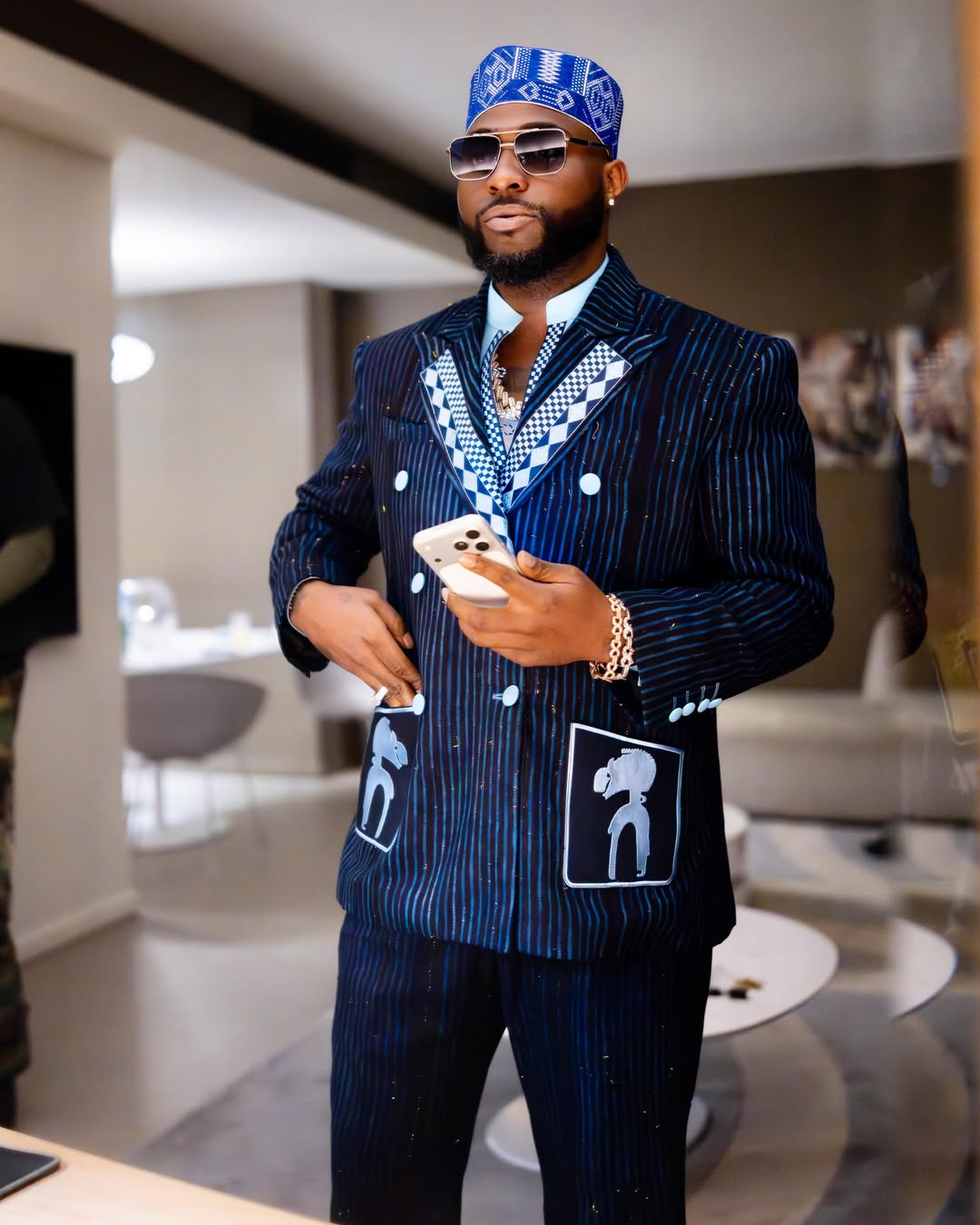
A detailed style shot of Nigerian music icon Davido showcasing his custom stage wardrobe during the Conakry stop of his 5IVE Alive global tour. Photo Credit: Davido/Instagram
We are not jealous of the people of Guinea today. Cough cough. Not only did they get to watch Nigerian Afrobeats star Davido perform live on his 5IVE Alive Tour, but they also got to see this outfit up close, and that, might be the bigger flex.
For his 5IVE Alive Tour stop in Conakry, Guinea, Davido stepped out in a dark n
A detailed style shot of Nigerian music icon Davido showcasing his custom stage wardrobe during the Conakry stop of his 5IVE Alive global tour. Photo Credit: Davido/Instagram
We are not jealous of the people of Guinea today. Cough cough. Not only did they get to watch Nigerian Afrobeats star Davido perform live on his 5IVE Alive Tour, but they also got to see this outfit up close, and that, might be the bigger flex.
For his 5IVE Alive Tour stop in Conakry, Guinea, Davido stepped out in a dark navy double-breasted pinstripe suit covered in subtle golden speckles that caught every stage light going. The jacket featured a layered lapel combining a classic pinstripe fold with an inner geometric black-and-white checkered pattern, and the lower patch pockets came framed in light blue trim with white graphic silhouettes of human figures printed on them. It is the kind of detailing that rewards a second look.
He paired it with matching wide-leg pinstripe trousers breaking cleanly over a pair of white sneakers, a light blue collared undershirt, tinted sunglasses, a structured blue patterned traditional cap, and a silver luxury watch on the wrist.
Afrobeats superstar Davido showing off a tailored navy pinstripe suit accented with graphic patch pockets and gold speckles for his performance wardrobe in Guinea. Photo Credit: Davido/Instagram
The whole look sits somewhere between sharp tailoring and a cultural nod, and it works completely. The traditional cap alongside the wide-leg trousers and white sneakers is what ties it together — dressed up enough for the stage, relaxed enough to remind you this is still OBO. Whoever put this look together deserves their flowers.
Guinea got a show and a fashion moment. We are not jealous. We are absolutely not jealous.
A detailed style shot of Nigerian music icon Davido showcasing his custom stage wardrobe during the Conakry stop of his 5IVE Alive global tour. Photo Credit: Davido/Instagram
We are not jealous of the people of Guinea today. Cough cough. Not only did they get to watch Nigerian Afrobeats star Davido perform live on his 5IVE Alive Tour, but they also got to see this outfit up close, and that, might be the bigger flex.
For his 5IVE Alive Tour stop in Conakry, Guinea, Davido stepped out in a dark n
A detailed style shot of Nigerian music icon Davido showcasing his custom stage wardrobe during the Conakry stop of his 5IVE Alive global tour. Photo Credit: Davido/Instagram
We are not jealous of the people of Guinea today. Cough cough. Not only did they get to watch Nigerian Afrobeats star Davido perform live on his 5IVE Alive Tour, but they also got to see this outfit up close, and that, might be the bigger flex.
For his 5IVE Alive Tour stop in Conakry, Guinea, Davido stepped out in a dark navy double-breasted pinstripe suit covered in subtle golden speckles that caught every stage light going. The jacket featured a layered lapel combining a classic pinstripe fold with an inner geometric black-and-white checkered pattern, and the lower patch pockets came framed in light blue trim with white graphic silhouettes of human figures printed on them. It is the kind of detailing that rewards a second look.
He paired it with matching wide-leg pinstripe trousers breaking cleanly over a pair of white sneakers, a light blue collared undershirt, tinted sunglasses, a structured blue patterned traditional cap, and a silver luxury watch on the wrist.
Afrobeats superstar Davido showing off a tailored navy pinstripe suit accented with graphic patch pockets and gold speckles for his performance wardrobe in Guinea. Photo Credit: Davido/Instagram
The whole look sits somewhere between sharp tailoring and a cultural nod, and it works completely. The traditional cap alongside the wide-leg trousers and white sneakers is what ties it together — dressed up enough for the stage, relaxed enough to remind you this is still OBO. Whoever put this look together deserves their flowers.
Guinea got a show and a fashion moment. We are not jealous. We are absolutely not jealous.
Currently, no African head of state is more popular and beloved than Burkina Faso’s Captain Ibrahim Traoré. Last Wednesday, in Ouagadougou, thousands of Burkinabes poured out into the streets for rallies in support of Traoré, who came into power in September 2022 through the second coup in the country that year.The rallies followed the announcement of a foiled coup plan and statements by General Michael Langley, commander of U.S. Africa Command, critical of Traoré and his governing style. At a S
Currently, no African head of state is more popular and beloved than Burkina Faso’s Captain Ibrahim Traoré. Last Wednesday, in Ouagadougou, thousands of Burkinabes poured out into the streets for rallies in support of Traoré, who came into power in September 2022 through the second coup in the country that year.
The rallies followed the announcement of a foiled coup plan and statements by General Michael Langley, commander of U.S. Africa Command, critical of Traoré and his governing style. At a Senate Armed Services Committee hearing in early April, Langley accused Traoré of misusing Burkina Faso’s substantial gold reserves to protect his military regime, rather than benefiting his country’s citizens.
Always spotted in his army fatigues, with a gun at his waist, Traoré is widely valorized as a living revolutionary, an ideal figure in times when Africa’s leadership crisis has only deepened. Since ousting Lieutenant Colonel Paul-Henri Damiba, Traoré - who, at just 37, is the world’s youngest head of state - has presented himself as a leader guided by his dedication to transforming Burkina Faso, while taking a stance against neocolonialism.
Similar to Mali and Niger, both junta-ruled allies and co-founding members of the Alliance of Sahel States, Traoré has severed Burkina Faso’s ties with former colonial rulers France, and has publicly denounced Western imperialism. His primary missions are to stabilize the country’s dire security concerns due to Islamist insurgency and improve his country’s economic fortunes, where over 60 percent of the population is multidimensionally poor.
To achieve his goals for economic growth, Traoré’s government has nationalized two gold mines, stopped the exportation of unrefined gold, and started work on a refinery expected to process 150 tonnes of gold annually. In addition to gold, Burkina Faso is rich in minerals, including zinc, manganese, copper, and phosphate, as well as untapped reserves of diamonds and bauxite.
Between his charisma as a self-proclaimed revolutionary, noble intentions, and defiant stance towards Western powers, it’s not surprising that Traoré has attracted the adulation of millions of Africans, despite being an autocratic ruler.
Shortly after Langley’s comments, Traoré bluntly stated that democracy was out of the question in Burkina Faso’s near future as far as he’s concerned. “If we have to say it loud and clear here, we are not in a democracy, we are in a popular, progressive revolution,” he said, adding that freedom of expression in this system is “[how] we end up with a society of disorder.” While these statements, which seem despotic, should drum up loud criticisms, Traoré is immune due to being placed on the revolutionary pedestal.
The zeal behind the support for Traoré is also tied to the many accusations and conspiracies of Western powers antagonizing African and Global South leaders, heralded as revolutionaries. For instance, Traoré has been hailed as the reincarnation of Captain Thomas Sankara, the revered Burkinabe military leader and revolutionary killed in a coup allegedly sponsored by France and the West.
From Ghana’s Kwame Nkrumah to DR Congo’s Patrice Lumumba, the role of Western and former colonial powers in removing beloved leaders and potentially destabilizing African countries has made many disillusioned and defensive when it comes to beloved leaders. That’s why criticisms instantly trailed Langley’s comments, especially as they were framed within the context of U.S. interests in West Africa and junta-ruled states allying with Russia and China.
Traoré is inching towards three years in power, and has about four years left as Burkina Faso’s military president. Last year, he upended his initial promise to return the country to democracy in July 2024, and a national dialogue, which civil society groups largely boycotted, recommending that he remain in power for five more years. The recommendation cites the country’s security situation and allows Traoré to run for election after the transition period.
The Islamist insurgency in Burkina Faso, which was cited as the main reason for both 2022 coups, has yet to get any better since the military came into power. About 40 percent of the country is still out of government control, and the army has barely gained ground in recovering areas taken by insurgents. Damningly, military forces have allegedly contributed to the deaths and rights abuses of civilians.
A Human Rights Watch report alleged that over 200 people were summarily executed by security forces based on accusations of collaborating with Islamist groups. In the last decade, tens of thousands have been killed, and over two million people have been displaced due to the insurgency. Traoré and his military government have yet to find a solution to the security concerns, and there’s no stated timeline against which to measure his performance.
For the most part, the adulation and acclaim for Traoré are primarily ideological, which raises skepticism about what he can achieve on a tangible scale. History also shows that African military leaders and revolutionaries tend to reveal a darker side as they spend more time in power. In Uganda, long-term President Yoweri Museveni came into power as a revolutionary and is now known as a strongman despite the East African country nominally operating as a democracy. It’s similar to Zimbabwe’s Robert Mugabe, who was forced to step down after decades of bad economic policies that continue to haunt the southern African country.
Generally, military governments in Africa have failed to yield positive outcomes. Even when they start with widespread support, they often leave citizens disillusioned. Across the continent, the second half of the 20th century was defined by militarism, an “ideology of rule by soldiers,” according to Samuel Fury Childs Daly in his bookSoldier’s Paradise, which examines the patterns of African military governments. “Nearly all militaries wanted to transform their countries, even though they didn’t always spell out exactly what they wanted them to become,” Daly writes.
The last thing Africa needs is leaders who can’t be held accountable and can lord their power over citizens without checks, even if they present themselves as crusaders. Having that level of power can corrupt, as the past has shown.
Traoré could very well be the type of leader who breaks the wheel, but he’s dabbling in established behaviors typical of military governments, especially restricting the country’s social and political atmosphere. Media in the country is also tightly controlled; the junta suspended a handful of media outlets for reporting on the alleged massacre, as published in the Human Rights Watch report.
In 2023, Traoré signed a general mobilization decree that allows the government to randomly conscript people aged 18 and above to fight against insurgents. Critics have decried the implementation of the decree as a way to target independent voices, such as journalist and activist Daouda Diallo, who was abducted and held to be conscripted for four months.
Amidst celebrating his anti-Western stance and autocratic leadership, the jury is still out on Captain Traoré’s legacy as an African leader. The next few years will show whether he’s truly earned the revolutionary tag or is in the same lineage as his predecessors across the continent over the decades.
In this month's Best West African Songs list, OkayAfrica travels through Côte d'Ivoire, where coupé-décalé is still ruling the scene, Ghana, where artists like Lali x Lola experiment with Afropop-influenced sounds, and Nigeria, where legends make triumphant comebacks. Tiwa Savage "You4Me" (Nigeria)The Queen of Afrobeats, Tiwa Savage, is entering a new era. Here, she returns to her R&B roots, ditching percussion for guitars and tender lyrics. After releasing the reggae-infused "Forgiveness" l
In this month's Best West African Songs list, OkayAfrica travels through Côte d'Ivoire, where coupé-décalé is still ruling the scene, Ghana, where artists like Lali x Lola experiment with Afropop-influenced sounds, and Nigeria, where legends make triumphant comebacks.
Tiwa Savage "You4Me" (Nigeria)
The Queen of Afrobeats,Tiwa Savage, is entering a new era. Here, she returns to her R&B roots, ditching percussion for guitars and tender lyrics. After releasing the reggae-infused "Forgiveness" last year, "You4Me" plays like an earnest, feel-good contemporary R&B track that still carries her subversive touch. The track samples Tamia's "So Into You," drawing clear connections between the influences Savage is drawing from for her upcoming project and the sounds she is looking to create. As is familiar with Savage's work, the writing is tightly constructed, and well-placed riffs anchor the vocals.
Serge Beynaud “Taper Dedans” (Côte d’Ivoire)
One of the prominent champions of coupé-decalé and loko loko, Serge Beynaud's new track "Taper Dedans" is instantly infectious and club-ready. The track is enlivened by a playful call-and-response, repetitive hooks that stick to the brain, and an explosive beat that would make a perfect soundtrack to an end-of-year music festival. With over a decade of working in the Ivorian music industry, Beynaud is one of the ardent voices that have continued to embody the communal and transformative essence of coupé-decalé while adding a modern spin.
Reekado Banks “Mukutu” (Nigeria)
In "Mukutu,"Reekado Banks keeps things seductively simple. Singing over a bouncy yet stripped-down beat, Banks offers a splashy, beach-ready track for the summer. More than a decade since his debut, it's clear that Banks still knows what it takes to make a hit song.
Dayo Lamar “Woody” (Côte d'Ivoire)
Dayo Lamar's "Woody" lends itself to classic hip-hop and EDM sensibilities. Executed as if in one breath, Lamar raps over a thumping beat, clearing his mind and getting his thoughts out without an interlude or chorus. "Woody" is a short, well-defined, and brilliantly executed confessional that places sufficient trust in the sharpness of Lamar's rap flows, the slimness of the beat, and the precision with which he delivers his message.
Team Paiya “Révolté” feat. Le Grand Homme (Côte d'Ivoire)
In many ways, Team Paiya's music carries an urgency that's difficult to explain yet essential to their impressive discography. Even though they were formed in 2022 and haven't been around for long in the star-studded music scene in Côte d'Ivoire, their energetic, blended approach to music has made them a crucial part of the current success of Ivorian music. In "Révolté," their latest track, the crew blends coupé décalé, rap, and boucan in a signature sound they call "maimouna 2.0." Like their previous hits, "Révolté" has an explosive, thrilling essence that, yet again, proves how attentive Team Paiya is to the sounds and messages that move the youth.
Joyce Olong "WWYD" (Nigeria)
Nigerian indie artist Joyce Olong created much of her latest, full-length project, Soseo, in Ghana. Tucked away in a serene and spiritually charged space, Olong became a channel through which several ethereal, otherworldly songs were birthed. "WWYD," a groovy, bewitching track, is one of them. Starting with short, sharp chants and an echoey, trance-like beat, "WWYD" quickly segues into a gentle pep before Olong's soothing voice enters, asking questions and beseeching a love interest. Known for languid sounds that inspire reflection and easy living, Olong takes these qualities (her most powerful artistic qualities) and throws them into a highly experimental pot, where everything feels light, honest, and aggressively beautiful.
Lali X Lola "Unstable" feat. Oiza x Meyi (Ghana/Nigeria)
Fast-rising Ghanaian musical duo Lali X Lola share much in common with their Nigerian counterparts, Oiza x Meyi. They're both identical twins, and their music sits at the fringe of the mainstream, often melding R&B with indie and exploring Afropop and folk. In their first and fitting collaboration, both duos bring their well-oiled charm, playful but sensitive lyrics, and experimental musicality to a lively track. "Unstable" explores classic themes of self-preservation, ultimately recognizing misdeeds and reaffirming one's strength amidst a chaotic relationship. Both groups share the same concerns regarding matters of the heart, and because they're both excellent documentarians of the state of modern romance, they're compelling to listen to.
Demmi "Still Rolling" (Ghana)
Ghanaian artist and producer Demmi (McDonald Otubuah) is an ardent student of modern Afropop. Thanks to his producer background, Demmi collects references from well-known and obscure sounds, which he then simmers into groovy yet deeply personal Afropop tracks. In his latest drop, "Still Rolling," that formula comes into play excellently. His lyricism is personal and anecdotal, the beat experimental but club-ready. For Demmi, "Still Rolling" is an alluring tease of something big to come.
Melissa "Tattoo" feat. Blaqbonez (Ghana)
Ghanaian R&B star Melissa teams up with Nigerian rapper and singer Blaqbonez for a sultry, emotion-heavy number on "Tattoo." Covering the plains of desire and tease, "Tattoo" evokes a blurry image of a sweaty dance floor filled with willing love interests. Blaqbonez's raspy tone and playfully brash lyrics complement Melissa's airy, fluttering voice. Ultimately, "Tattoo" blends the softness of R&B with the subtle bounce of Afropop into a song that would sound magical after a dip in the pool on a hot summer day.

 Connexion