

Vue normale

Reçu aujourd’hui — 13 juin 2026
  • ✇Afrocritik
  • “Blood Sisters Season 2” Review: EbonyLife’s Hit Thriller Returns to Netflix as Shoddy Merchandise
    Blood Sisters Season 2 is a repeat performance of the first season, except it is more Hollywood-ised, less technically capable, and happens to be both a courtroom drama and a prison drama in addition to its Thelma-and-Louise-on-the-run trope. By Vivian Nneka Nwajiaku It has been four years since EbonyLife and Netflix collaborated to dish out the hit Nigerian original series, Blood Sisters (2022), a crime thriller billed as a miniseries. For all its flaws (some of which I noted in my review at
     

“Blood Sisters Season 2” Review: EbonyLife’s Hit Thriller Returns to Netflix as Shoddy Merchandise

10 juin 2026 à 08:37

Blood Sisters Season 2 is a repeat performance of the first season, except it is more Hollywood-ised, less technically capable, and happens to be both a courtroom drama and a prison drama in addition to its Thelma-and-Louise-on-the-run trope.

By Vivian Nneka Nwajiaku

It has been four years since EbonyLife and Netflix collaborated to dish out the hit Nigerian original series, Blood Sisters (2022), a crime thriller billed as a miniseries. For all its flaws (some of which I noted in my review at the time), Blood Sisters felt like a breath of fresh air; though in retrospect, I now wonder if it only felt that way because it was the first Ebonylife-Netflix outing since the disastrous Chief Daddy 2 (2022) tarnished whatever goodwill the first Chief Daddy (2018) had managed to gain.

That inability to let sleeping dogs lie—or should I say EbonyLife’s tendency to revisit flawed but exciting releases hoping to milk them for commerce—has now led to Blood Sisters losing its limited series classification. The blood sisters, played by Nancy Isime and Ini Dima-Okojie, return in a second season where they spend four episodes dealing with the repercussions of the actions they took in the first episode of the first season.

To run through how we got here, Blood Sisters Season 2 follows best friends Sarah (Dima-Okojie) and Kemi (Isime), who become fugitives when Kemi kills Sarah’s abusive fiancé, Kola Ademola (Deyemi Okanlawon), on their wedding day, and both women hack the body to pieces and bury the parts in a shallow grave. Because Kola was the most beloved member of a wealthy and powerful family, Sarah and Kemi spent the four-part first season attempting to escape getting caught by the police or killed by the Ademolas, especially the ruthless matriarch, Uduak (Kate Henshaw).

By the end of that season, Sarah and Kemi resolve to stop running, but they also run into luck. Timeyin (Genoveva Umeh), the wildcard of the Ademola family, takes it upon herself to end her family’s reign. She shoots the family henchman Uncle B (Ramsey Nouah), her eldest brother Femi (Gabriel Afolayan), and Femi’s wife Olayinka (Kehinde Bankole). When the screen fades to black, Uduak is staring down the barrel of her gun.

Blood Sisters Season 2

At the start of Blood Sisters Season 2, we find out that only one of those gunshots served its purpose. Kola remains the only dead member of the Ademola family, but Femi is now paralysed. Uncle B is well and truly dead, though, and we meet his son “B Junior” (Ben Touitou), who is out for revenge. The problem is that B Junior has his sights set on the wrong people, to the benefit of the Ademolas.

You see, the Ademola family has closed ranks, despite their internal squabbles. In fact, Timeyin is now in charge of the family business. Kemi and Sarah now stand accused of more than Kola’s death and desecration; they are now standing trial for the murder of Uncle B and the attempt on the lives of the remaining Adebayos. And guess what? They once again find themselves running for their lives.

Really, the second season of Blood Sisters is a repeat of the first season, except it is more Hollywood-ised, less technically capable, and happens to be both a courtroom drama and a prison drama in addition to its Thelma-and-Louise-on-the-run trope. By the end of the second season, there’s too little to remember beyond the fact that the characters are in the same position that they were in for most of the first season, even regressing, considering that they had at least stopped running in the previous finale.

But even worse, there is a blatant lack of cohesiveness in both the plotting and the direction of the second season, and practically every element of production is either so mediocre or so incompetent that it makes the original series look like the best thing ever made.

The first season was directed by Kenneth Gyang (Sons of the Caliphate (2016); Oloture: The Journey (2024)) and the late Biyi Bandele (MTV Shuga Naija (2013)), and was definitely a Netflix original. The second is directed by Kayode Kasum (Unbroken (2019); Far From Home (2022)) and Daniel Oriahi (Oga! Pastor (2019); Etiti (2025)), and is streaming on Netflix without the traditional Netflix sound logo. Perhaps, with Netflix quietly cutting back on original programming in Nigeria, there might be budgetary explanations for the collapse in production value. But—and it hurts to say this about a project that has Oriahi attached, though he directs the better-shot half—it really does play as more of a craft issue.

Blood Sisters Season 2
Nancy Isime and Ini Dima-Okojie as Kemi and Sarah in Blood Sisters S2

Two minutes in, the visual worldbuilding falls apart as a prison van pulls into the vicinity of the “Lagos High Court” that has “Eko Judicial High Court” on the building and a “Faculty of Engineering” signpost within the shot. Before the first episode runs out, we would already have seen—quite visibly—the real-world building name plastered at the top of the university auditorium that has been staged as the courthouse. And by the second episode, you realise that the prison walls are practically the same as the walls of the court, and it suddenly makes sense why there is a jarring disconnect between the courtroom and the courthouse exterior.

It may sound like nitpicking, but these are just a few of many instances of the show’s manifestly confused production, and the cumulative effect is an on-screen world in which the suspension of disbelief is practically impossible. It is even more disconcerting and utterly unbelievable when combined with a tastelessly outlandish wardrobe, distracting hair and makeup, and way too many “creative choices” in the prison and court scenes that could not possibly be authentic in the Nigerian context.

Surely, the creatives behind Blood Sisters Season 2 do not expect their Nigerian audience to buy prison uniforms straight out of Orange Is the New Black, complete with the long-sleeved thermal undershirts, or lawyers randomly approaching the bench and practically testifying like they’re in an episode of How to Get Away with Murder. Other than the carefully constructed court sentencing that admittedly allows for an interesting, albeit undercooked, source of conflict between the two leading women, the court scenes are particularly exhausting due to their glaring lack of subject matter research.

Certainly, “dramatic licence” will be an easy justification for Blood Sisters Season 2 to fall back on. And even as a lawyer myself, I appreciate that accuracy does not always translate to good drama. But it is, quite frankly, a lazy cop-out for creative choices that are not in fact creative, especially when accuracy would likely be more dramatic than the choices made in pursuit of dramatic licence, which is the case with Blood Sisters Season 2 and its middling courtroom exchanges.

Blood Sisters Season 2
Still from Blood Sisters S2

Nothing truly works in this season of the show. In-world timelines have been discarded. Characters have been re-wired while remaining underdeveloped. The protagonists themselves are now barely sympathetic. The dialogue has deteriorated. Suspense is virtually non-existent, and the stakes are much less convincing than they used to be. 

Even the acting performances have fallen below the show’s own standard, as caricaturish portrayals abound, save for Uche Jombo’s dedicated turn as Sarah’s mother and Blessing Obasi-Nze’s embodiment of the show’s most powerful prisoner. But how much can the cast really do with material this irredeemable?

Ultimately, this season of Blood Sisters is four episodes of fluff, death and sex, with the latter almost always short of valid consent despite the show having no real interest in responsibly reckoning with those choices. It is a pity. The first season, at least, cared about its social relevance, exploring delicate themes with considerable prudence. 

Blood Sisters Season 2 is not bothered with that, or with standards, really. And as it arrives at another inconclusive end, the possibility of a third season feels very much like a threat. Where do I sign out?

Rating: 1/5

*Blood Sisters Season 2 is streaming on Netflix.

Vivian Nneka Nwajiaku is a writer and film critic writing from Lagos. She has a master’s degree in law but spends most of her time consuming, studying and discussing film and TV. She’s particularly concerned about what art has to say about society’s relationship with women. Connect with her on X @Nneka_Viv

The post “Blood Sisters Season 2” Review: EbonyLife’s Hit Thriller Returns to Netflix as Shoddy Merchandise first appeared on Afrocritik.
Reçu avant avant-hier
  • ✇Afrocritik
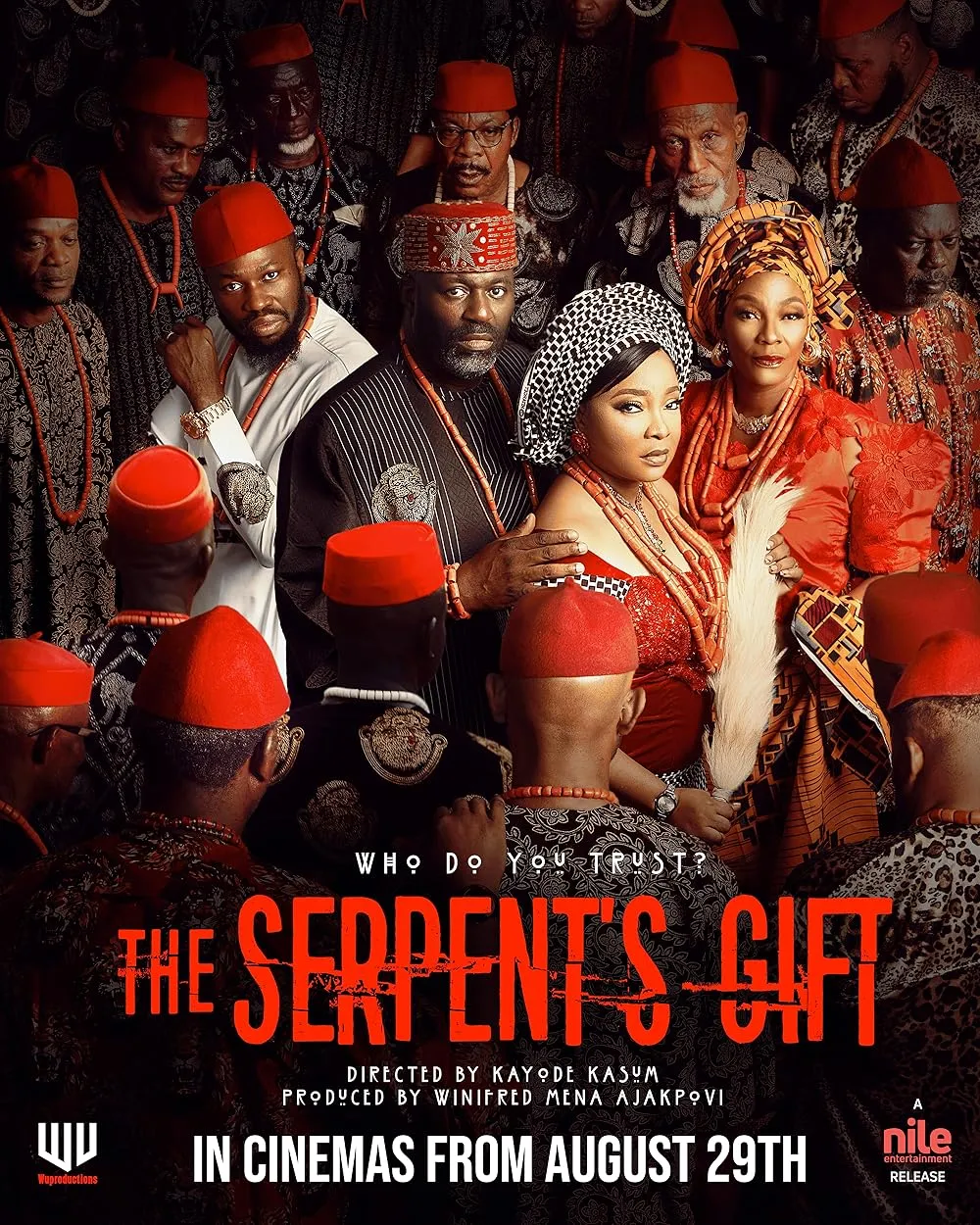
  • “The Serpent’s Gift” Review: Kayode Kasum’s Film Is Undone by Shallow Cultural Detail
    If The Serpent’s Gift had one lesson for Nollywood, it would be that cultural truth requires more than surface markers. By Joseph Jonathan Films do something blunt and unavoidable: they teach. Every shot, every costume, and cut either bolsters an image the world already carries about a people or complicates it. The Serpent’s Gift, directed by Kayode Kasum, signals an ambition to do the latter — to interrogate widowhood, wealth, and inherit
     

“The Serpent’s Gift” Review: Kayode Kasum’s Film Is Undone by Shallow Cultural Detail

15 septembre 2025 à 09:02

If The Serpent’s Gift had one lesson for Nollywood, it would be that cultural truth requires more than surface markers.

By Joseph Jonathan

Films do something blunt and unavoidable: they teach. Every shot, every costume, and cut either bolsters an image the world already carries about a people or complicates it. The Serpent’s Gift, directed by Kayode Kasum, signals an ambition to do the latter — to interrogate widowhood, wealth, and inheritance in a contemporary Igbo setting. Too often, though, it takes the cheaper route.

At its core, The Serpent’s Gift is straightforward: Nduka Sylvanus (Chico Aligwekwe), a wealthy businessman, dies suddenly; his young widow Ijeoma (Linda Ejiofor-Suleiman) finds herself under siege from relatives hungry for control of his empire. 

That premise, inheritance as battlefield, widowhood as vulnerability, has strong dramatic potential. But the film’s recurring error is a dramaturgical one: it treats certain customs as if they were the default script for contemporary Igbo culture, deploying them for maximum emotional jolt rather than interrogating their place in modern social practice.

The Serpent’s Gift
The Serpent’s Gift

Let’s be specific. The Serpent’s Gift repeatedly foregrounds widowhood rituals — the forced ceremonial walk, the insistence that Ijeoma drink the water used to bathe her late husband — and stages them as though they are normative in South-East Nigeria today. 

That choice reads like sensationalism disguised as ethnography. If you want the audience to understand why such practices persist (despite the fact that they hardly do nowadays), you show the debates, resistances, compromises, and legal or civic contexts that shape them. Instead, these rituals float in the frame as spectacle: dramatic curiosities to be watched, not social problems to be understood.

That tendency toward spectacle is compounded by sloppy world-building. Remove the language, and nothing about The Serpent’s Gift feels specifically Igbo. This isn’t a throwaway grievance — it’s the film’s central, damning weakness. The screenplay peppers dialogue with proverbs and local phrases, but the mise-en-scène often contradicts the claims of cultural specificity. 

There are moments so incongruous they yank viewers out of the drama: a wealthy businessman’s office decorated with the faces of national politicians who, in context, make no sense; an Ibadan branch of Nduka’s company where all the characters default to Igbo instead of English or a believable hybrid of Yoruba, Igbo and English; and, conversely, there are scenes set in Igbo contexts where the characters oddly switch to English. 

Even the funeral of a titled man is staged like an afterthought rather than the elaborate social event it should be. These are not minor slips. They signal a lack of scrutiny and research that makes the film feel like a pastiche — an image of Igbo-ness assembled from familiar icons rather than a living, internally consistent world.

Why does this matter? Because when a film claims cultural authenticity but fails to get the small things right, it invites two harms. 

First, it exoticises: audiences unfamiliar with Igbo culture will take these dramatised anomalies as normal practice. Second, it erodes trust among the community depicted. A scene that treats a titled man’s burial as underwhelming — when, by social and cultural expectation, such a burial would be elaborate, public and ritualised — doesn’t simply misread detail; it shrinks the stakes. 

If the director wants us to grieve the loss of a man whose wealth will evaporate into the hands of the wrong custodian, the funeral sequence should affirm why that loss matters socially and symbolically. Here it does not.

The Serpent’s Gift
Still from The Serpent’s Gift

Small details earn large consequences. The decision to have Ijeoma relay the news of her husband’s death to the family via conference call — with none of them present at the hospital during Nduka’s final moments — strains credibility. In many Igbo communities, illness and death are communal events with kinship obligations that mobilise the extended family. 

Yes, the film suggests that Nduka hid his terminal illness, which could explain why relatives were absent. But even secrecy has limits: sudden hospitalisation or end-of-life care would typically trigger communal intervention, whether through family networks, business associates, or community elders. 

By presenting absolute isolation as an unquestioned fact, the film bypasses the very tension it needed to dramatise — the clash between a man’s desire for privacy and a culture’s insistence on communal presence. That clash could have enriched the story; instead, we are left with a thin shorthand that weakens emotional stakes.

Performances, to the film’s credit, keep it watchable even when the script and world-building falter. Linda Ejiofor-Suleiman is the film’s moral gravity: she finds the narrow seam between resolute anger and brittle grief and carries the film through its less credible stretches. Her Ijeoma is not simply victimhood in motion; she’s a woman negotiating a public claim to legacy with private sorrow. 

Tina Mba’s Margaret gives the film its sharp, antagonistic edge — a matriarch, who at times feels deliberately overdrawn, but whose presence grounds the familial friction. Stan Nze’s Nonso, by contrast, often flirts with broadness; his greed is readable, but it lacks the textured human desperation that would have made him more than an archetype.

The screenplay (credited to Stephen Okonkwo and Ufuoma Metitiri) is a mixed bag. It nails cadences and the rhythm of local speech in places, and some lines resonate with the weight of oral tradition. Yet, the script is reluctant to interrogate the practices it stages. 

Instead of dramatising the legal, economic, and moral mechanisms that sustain certain rituals — the role of title societies, the influence of patriarchal inheritance laws, the social sanctions that enforce conformity — the film lingers on performative acts of humiliation. That’s a storytelling choice with consequences: the viewer learns what happens but never why it still happens, or how it is contested.

Technically, The Serpent’s Gift does offer some pleasure. The cinematography captures the South-East’s green pulse; there are moments of visual lyricism that suggest a respect for place. 

The Serpent’s Gift
Still from The Serpent’s Gift

The soundtrack, steeped in Igbo highlife motifs, works as an affective tether to a Nollywood lineage that can be both nostalgic and invigorating. Those formal strengths make the film’s missteps more disappointing: they show the crew had the tools to render a complex cultural portrait, but chose spectacle over nuance.

If The Serpent’s Gift had one lesson for Nollywood, it would be that cultural truth requires more than surface markers. Accuracy is not only about avoiding factual error; it is about showing social texture — the disputes, the negotiations, the everyday resistances that exist inside any living culture. To dramatise widowhood without showing its contested status in modern life is to flatten a subject that deserves interrogation. 

In the end, The Serpent’s Gift oscillates between two impulses: to honour and to capitalise. It wants to ask hard questions about legacy, gender, and wealth in contemporary Igbo society, and yet it keeps stepping onto a stage built of tropes that simplify its subjects for dramatic effect. Instead of deepening our understanding, the film rehearses stereotypes. And that is the most disappointing lesson it leaves behind.

Rating: 1.9/5 

Joseph Jonathan is a historian who seeks to understand how film shapes our cultural identity as a people. He believes that history is more about the future than the past. When he’s not writing about film, you can catch him listening to music or discussing politics. He tweets @Chukwu2big.

The post “The Serpent’s Gift” Review: Kayode Kasum’s Film Is Undone by Shallow Cultural Detail first appeared on Afrocritik.

❌