
 Connexion
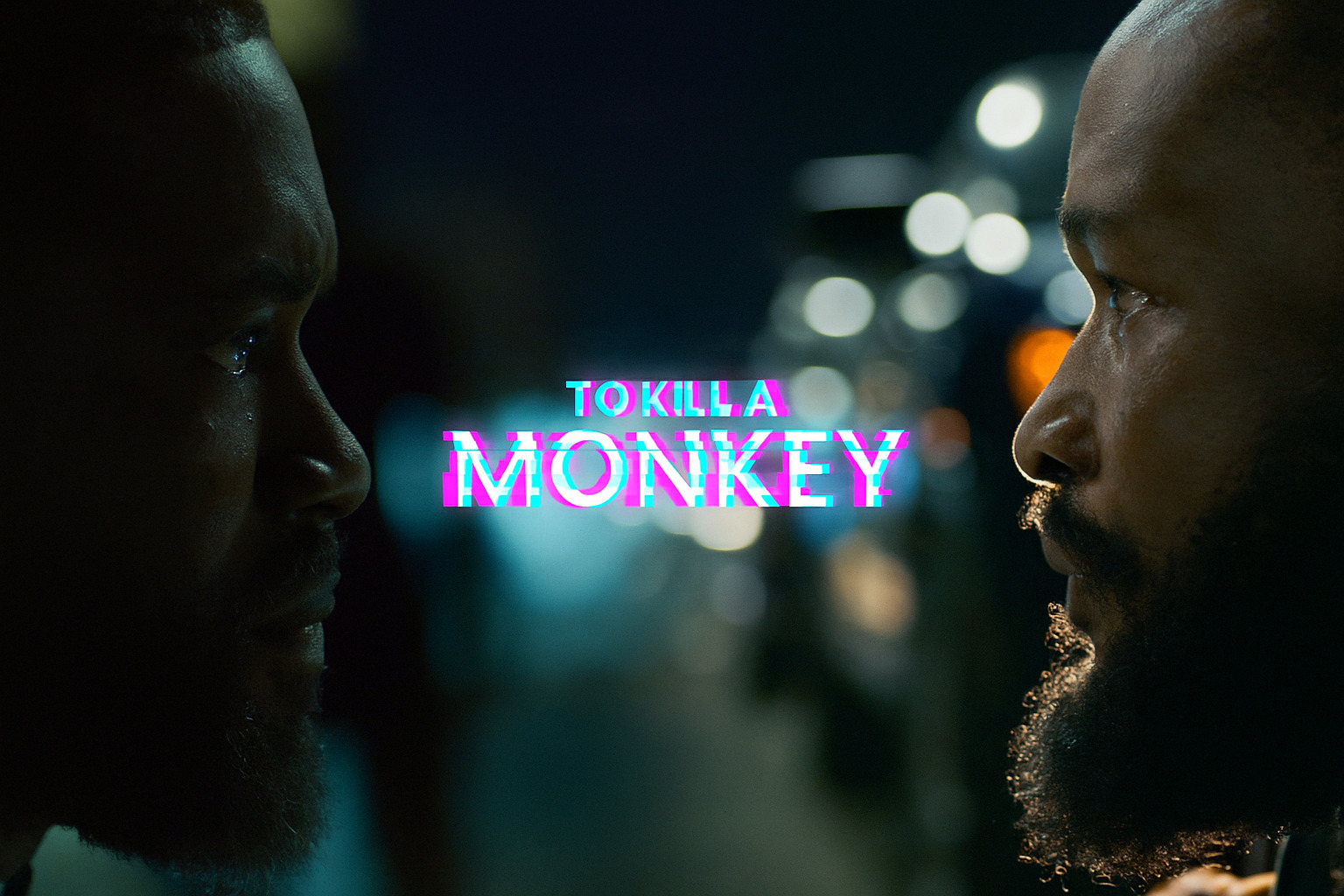

“To Kill a Monkey” Review: Kemi Adetiba’s Exciting Crime Thriller Series Is a Lesson in How Not to Tell a Story
For all the fuss about cybercrime and money in this show, the crime world of To Kill a Monkey is bland, feeble, and visually non-existent.
By Vivian Nneka Nwajiaku
There is more than one way to kill a monkey. But one way that certainly doesn’t work is by talking about how to do it. If there are areas in life where that rule does not apply, screen culture is not one of them. Because in film and TV, the rule is almost sacrosanct: you don’t tell a story by telling it, you tell it by showing.
And this is the primary failure of Kemi Adetiba Visuals’ hotly anticipated Netflix-commissioned crime thriller limited series: To Kill a Monkey (2025) talks so much that if you only listened without watching, you would not miss a lot.Â
There’s an opening sequence with an occult ambience, but To Kill a Monkey begins properly with a voiceover narration. The show’s lead, Efemini “Efe†Edewor (a remarkable William Benson, with a steady grip on his character’s range), husband, father and poverty-stricken first class graduate who once hated his own poor father and now feels empathy for him after having himself experienced raising a child in poverty, is stealing Wi-Fi from a facility to improve on his programming skills. We know these because he tells us, in so many words.
His wife, Nosa (Stella Damasus), is pregnant with triplets, news that makes his supervisor (Emeka Okoye) at the restaurant where he works tell him that God doesn’t like him. When only two of the triplets survive because they were severely underweight, Efe weeps, and though we can perceive that his tears are triggered partly by the pain of losing a child to poverty and partly by relief that he has one less child to provide for, Efe helps explain to us (by explaining to the doctor in the first episode, and to a law enforcement officer later on) that he in fact feels relief and guilt.
But his luck changes when he re-encounters an old acquaintance. Played by a larger-than-life Bucci Franklin who owns the screen every time, the brash Obozuhiomwem, simply called “Obozâ€, offers Efe a life-changing job. But Oboz runs a cyber fraud organisation, so Efe is initially hesitant to take up the offer. He doesn’t have the liver for it, he says.
However, when his poverty becomes unbearable, including incidents of workplace sexual harassment by a superior (a superb Constance Owoyomi), domestic sexual harassment experienced by his older daughter (Teniola Aladese) at the hands of a relative, and newborn babies who are hungry because their mother is too malnourished to produce milk, Efe returns to Oboz with a counter-offer. With his tech knowledge, and this amazing new tech called artificial intelligence—it’s certainly amazing to Oboz—they can exploit cybersecurity weaknesses and game the system, he explains.

Of course, the idea that you can steal a person’s physical appearance to defraud their loved ones blows the mind of the streetwise Oboz. It blows our minds, too. It’s an early highlight in the series and a timely plug-in for the real-life questions about digital safety and wellbeing in the AI era, especially in light of the internet fraud (aka “yahooâ€) menace in Nigeria. Who wouldn’t want to watch it play out?Â
Except, we don’t get to. To Kill a Monkey jumps four years into a future where Efemini’s family is now comfortable in wealth, and Oboz is now so much wealthier that he can easily afford a yacht. After two episodes of romanticising Efe’s poverty and hyping him up as a tech wiz, we don’t get to see him start to touch money. Neither do we get even one scene out of eight episodes where we see Oboz’s fraudulent empire actually take advantage of the almighty AI.
As a matter of fact, we don’t see how Oboz’s criminal empire operates beyond the one dramatised sequence in the first episode where Oboz makes his initial offer to Efe. For all the fuss about cybercrime and money in this show, the crime world of To Kill a Monkey is bland, feeble, and visually non-existent.
In the one plot point where To Kill a Monkey cares about showing, we are introduced to Inspector Mo Ogunlesi (Bimbo Akintola), an agent of the Nigeria Cyber Crime Commission who suffers from post traumatic stress disorder after losing her entire family in an accident. We don’t see the accident happen, but at least we know when it does, and we see how it affects her.
Returning to work after the time jump, Inspector Mo spends the rest of the show trying to manage her mental health and to prove that she can still do the work. She forms an alliance with Inspector Onome (Michael O. Ejoor), and together, they offer some of the more refreshing interactions in the series, and even more insight into the workings of the cybercrime world than the show’s cybercriminals themselves.
But her investigation is delivered inadequately and incoherently, with the screenplay hyperfocused on painting her as unreliable, at least to her direct superior (Ireti Doyle). In her scenes, the series attempts to take on a psychological thriller atmosphere, and it’s laid on so thick and so repetitively that it’s easier to be exhausted by her than to empathise with her.
At least, a good deal of Inspector Mo’s story is shown, which is more than we can say for others. The characters of To Kill a Monkey recite away actions, motivations, backstories, and even their behaviours. We’re supposed to believe that one character habitually neglects her children not because the series establishes a pattern—it does not—but because another character accuses her of it. And we have to accept that important events have taken place, like the raiding of clandestine cells that we did not even know still existed, just because characters report that they happened.
Even To Kill a Monkey’s most explicit villain, an old taker called Teacher (Chidi Mokeme, doing his best to render a villain that’s nothing more than fodder), who spends most of the series brooding over his losses and repeating the same threats, is introduced via dialogue, interspersed with sprinkles of his family life that only serve as a quick setup for the next grand event of gangsterism that Kemi Adetiba, the series’ creator, is eager to pull off.
And oh, Adetiba loves her grand events. Her references, too. Little details that do get shown, like envies and rivalries, are abandoned halfway in favour of bombastic moments that are often middling versions of foreign cult classics—some are KAV originals, though—and are barely established.
Adetiba cannot let us forget that this show comes from the same source as the King of Boys franchise, Nollywood’s answer to The Godfather. So, she lines up big gangster moments from the earliest point that she can to the last moment of the show, most of which, like many of the plot twists in this show, are manufactured and then explained away with some grandiose speech.
Don’t even get me started on the stressful Tarantino-esque monologues and dialogues that the characters in this show love to deliver, except that, unlike Quentin Tarantino, Adetiba’s monologues and dialogues are only mildly interesting, low stakes, and often end with no immediate consequences.
In one annoying instance, a character called Sparkles, played by Sunshine Rosman, delivers a lengthy monologue about her life’s story in a bid to make a point that she spends the rest of the show deviating from. And in another, Mokeme’s Teacher spends minutes outlining his supposedly intense plans for vengeance, only for us to watch so many of those plans fail.
In fact, there is so much yapping in To Kill a Monkey that in the finale, after a little speech that dampens what should have been a more interesting start to the final showdown, Efemini tells Inspector Mo, “This talking thing has truly now gone too farâ€. He could not be more right. And yet, his words are soon followed by a closing sequence that uses another voiceover narration to abruptly tie up major plot points.
For a film, that would be haphazard writing, but for an eight-episode TV series with all the space in the world for a story this simple to unfold properly, it’s even more egregious. Adetiba, who serves as the sole writer and director on all eight episodes of To Kill a Monkey, while also producing and editing, exhibits an overreliance on herself so much so that she doesn’t appear to have consultants of the type who can tell her that divorce agreements are not a thing in Nigeria, or that writing for TV is quite different from writing for film.
And that is indeed a part of the writing problem of To Kill a Monkey, that it isn’t structured like a TV series in the first place. Granted, TV in the streaming era is now skewed towards the binge model, but even with that evolution, good television still values the essence of the episodic format for a project with such lengthy duration.
Television typically distills the overall narrative into smaller, purposeful beats and breaks its story into tighter arcs with episodic climaxes. When rightly done, the result is storytelling that is effective and also maintains suspense. Not To Kill a Monkey, though. This one is a series that plays like one unending film with an inconsistent rhythm and barely any suspense.
Because To Kill a Monkey is focused not on unfolding the story but on exciting audiences with big thrills—and it is, in fact, exciting—characters are whoever the plot needs them to be at any point in time. And so, they feel more like plot devices than characters. Efemini is expectedly the most complex, and Oboz the most interesting, albeit underdeveloped, but the appeal of both and practically all the characters is less in their characterisation and more in the performances of the actors who portray them.
It’s a delight to watch Bucci Franklin and William Benson onscreen together, and scenes that have Oboz and Efe sparring are just spellbinding. Lilian Afegbai is fascinating as Idia, Oboz’s wife, and the contrast between her character and that of Nosa, played by the more experienced and appropriately moderate Stella Damasus, is entertaining to watch.
The unsung heroes here are the costume and set design departments, how they give finishing to the characters, especially the nouveaux riches, or the money-miss-road as we call them in these parts. But the element more likely to get praise is the original score by Oscar Heman-Ackah, the acclaimed music producer whose upcoming political musical drama, Finding Messiah, is also highly anticipated.
Unfortunately, having watched the viral Finding Messiah teaser, it’s not difficult to see how the atmosphere of that film may have seeped into the music of To Kill a Monkey. It really is a brilliant composition. But instead of propping up the film, it’s distracting, and its volume is in competition with the diegetic sound.
It’s saddening that To Kill a Monkey is nowhere near the excellence we hoped for. Sure, it’s exciting TV, but it’s also a lesson in bad storytelling. For a reference-heavy, Netflix-commissioned series, clearly, aspiration is not in scarce supply. And for a project from the stables of Kemi Adetiba Visuals, I don’t believe that it is talent or capacity that is missing. Perhaps, we are just content with excitement and spectacle. Hoorah, I guess?
Rating: 2.8/5
*To Kill a Monkey is streaming on Netflix.
Vivian Nneka Nwajiaku is a writer, film critic, TV lover, and occasional storyteller writing from Lagos. She has a master’s degree in law but spends most of her time watching, reading about and discussing films and TV shows. She’s particularly concerned about what art has to say about society’s relationship with women. Connect with her on X @Nneka_Viv
The post “To Kill a Monkey†Review: Kemi Adetiba’s Exciting Crime Thriller Series Is a Lesson in How Not to Tell a Story first appeared on Afrocritik.
