“I am the one who takes the little stories from friends in the neighborhood and adds my own twists to make them more captivating, more hilarious, or more dramaticâ€. – Achille Ronaimou
By Jerry Chiemeke
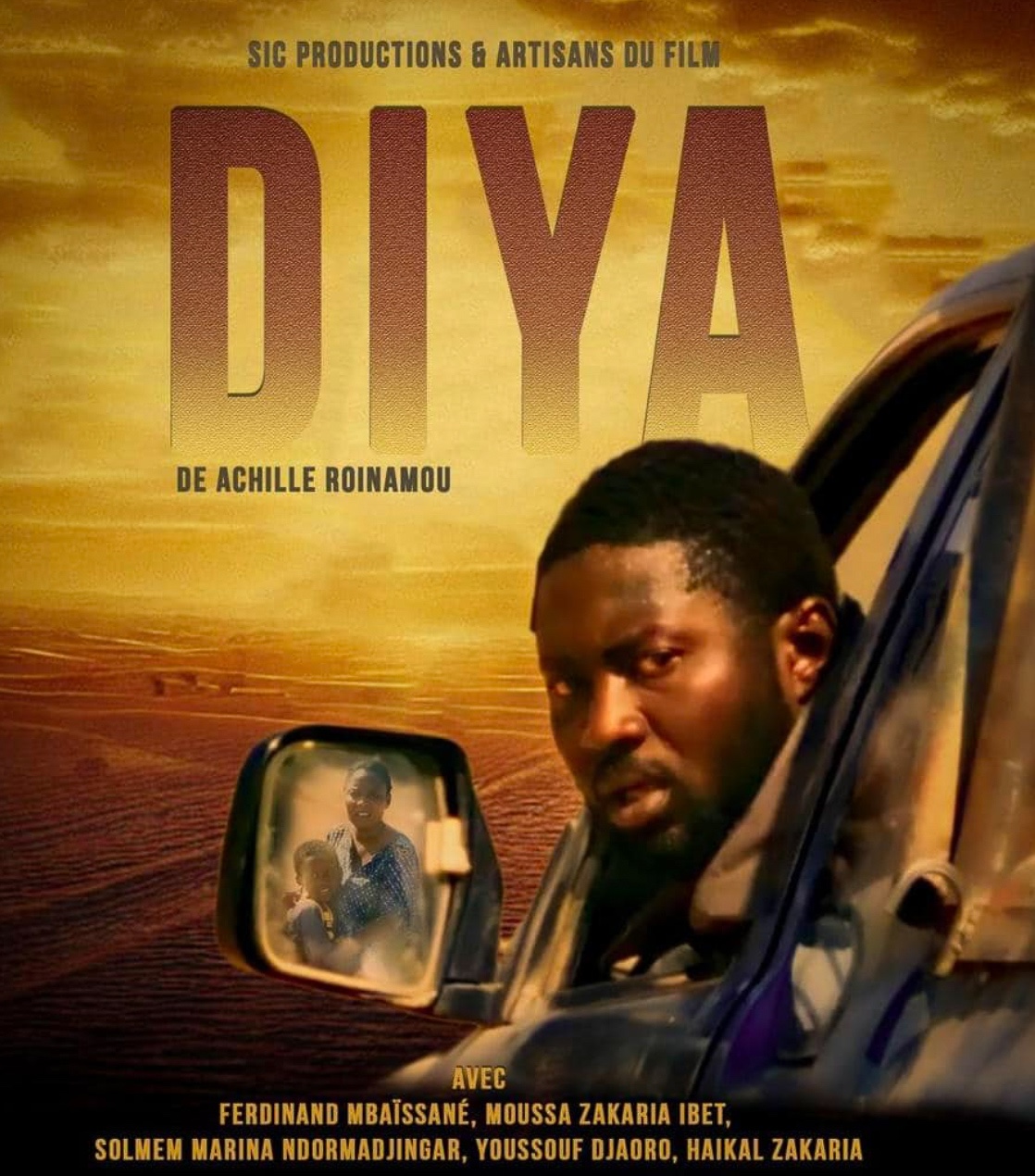
In his feature debut, Diya (Le Prix Du Sang), Achille Ronaimou crafts a morally complex drama that interrogates the collision between ancient customs and modern realities in contemporary Chad.Â
The film follows Dane Francis (Ferd
“I am the one who takes the little stories from friends in the neighborhood and adds my own twists to make them more captivating, more hilarious, or more dramaticâ€. – Achille Ronaimou
By Jerry Chiemeke
In his feature debut, Diya (Le Prix Du Sang), Achille Ronaimou crafts a morally complex drama that interrogates the collision between ancient customs and modern realities in contemporary Chad.Â
Dismissed from his job, stripped of his licence, and unable to secure employment due to his criminal record, Dane becomes a study in systemic failure. Ronaimou resists easy moralising, instead presenting a society where corruption, poverty, and rigid adherence to custom create seemingly impossible choices.Â
The film’s exploration of the Diya system proves particularly valuable in contemporary African cinema, where traditional justice mechanisms are often portrayed in simplistic terms. Achille Ronaimou avoids both romanticising and demonising the practice, instead presenting it as one element in an intricate web of social, economic, and political relationships that determine individual fate.Â
Diya
While the film occasionally overreaches in its ambitions, its commitment to moral complexity and its refusal to provide comfortable resolutions mark it as a noteworthy first feature.Â
In an exclusive interview with Afrocritik, Achille Ronaimou reflects on the events that inspired writing Diya, locations as characters in film, rigid traditional practices, and the use of cinema to alter perceptions of the African continent.
Diya, in the context of this story, translates to “the price of bloodâ€. Can you walk us through your decision to render this concept both as your film’s title and its central moral dilemma?Â
Interestingly, I never thought of any title other than Diya. I found this title even before I started writing the script. The first versions of my script tackled the subject from a rather violent angle, to the point of offending the sensitivities of some readers who believed that the film could provoke strong emotions in the Muslim community, which is very sensitive to religious issues, and label me as an anti-Islam filmmaker.Â
That’s because, indeed, Diya in Chad is a poor translation of the surah ‘Al-Nissat’ from the Quran. Therefore, for me, Diya, the price of blood, is exactly the title that will resonate best for this film. Even though the script was revised several times to produce this current version, the depth of the content has remained the same.
Achille Ronaimou
How did you first encounter this story that would become your feature debut?
During a family ceremony, a cousin of mine, long consumed by guilt, decided to confide in me. He told me that he killed a 10-year-old child. Several years later, he was scammed and ruined by the latter’s family, in the name of the Diya. In Chad, 7 out of ten people are directly or indirectly victims of this practice called Diya or blood money.Â
Hence, it’s a practice known to all, but the story of this cousin in particular touched me so much because it is the death of a child, an innocent person who pays a high price. One morning in January 2015, I set out to write the first draft of the script.
This is your first feature after directing shorts and documentaries. How did your documentary work on Minors in Prison (2013) and Kanoun (2012) inform your approach to bringing Diya to life?
My initiation to cinema through documentary was very decisive for the continuation of my career. Before that, I wrote short stories that, unfortunately, never got published; I love imaginative creation. I am the one who takes the little stories from friends in the neighborhood and adds my own twists to make them more captivating, more hilarious, or more dramatic. I have always loved writing, and documentary filmmaking has equipped me with another narrative channel because I can now combine both in my narratives, which are mostly scripted real events.
N’Djamena and Northern Chad almost become characters themselves in this story. How did you use geography and location to reflect the cultural and economic divides at play?
Diya is primarily a story of geography and religious confession. The setting and attire are characters in their own right. Following a civil war in 1979 in Chad, pitting southern Christians against northern Muslims, the population remained divided and dispersed according to their geographic and religious affiliations.Â
Thus, in N’Djamena, there are northern neighborhoods inhabited by Muslims, characterised by religious austerity, where one can hear the calls of the muezzin for the 5am daily prayers.Â
Women are all veiled and covered from head to toe, and men wear long boubous. However, in the southern neighborhoods inhabited by Christians, one will find bars, nightclubs, churches, and men and women proudly strolling the streets in Western attire. Therefore, one can never speak of Diya without referencing these very important details.
I was looking for a broken man, a sober man, intelligent but crushed under the weight of society. Ferdinand was that young man among others who reflected this image a bit. He was recommended to me by my first assistant, Cyril Danina, for whom he acted in one of his films over 15 years ago. We still had to work on him a little bit, especially with his acting. For almost a year, we worked with him so that he would be more comfortable in the character of Dane.Â
Working with (cinematographer) Cyrille (Hubert) and (editor) Guillaume (Talvas), how did you create the tension, dread, and chaos that mirror Dane’s psychological state?
Cyrille Hubert is a gem. I would say that the gods of cinema were with me (laughs). They sent me Cyrille from Heaven. I did not expect to have such a young, brilliant, and brave director of photography on set. It was his first time filming in Africa and in Chad where it’s over 40 degrees celsius in the shade.Â
Just like me, it was also his first feature film as a director of photography, but he had more field experience than I did. He fell in love with the script from the first reading and committed to shooting it by my side. He followed the script to the letter, and it hurt him every time I had to modify or remove a scene. He continually proposed a thousand angles for each shot, giving us multiple options in the editing room.Â
By having Ferdinand rehearse the scenes repeatedly, we ended up exhausting him, which sometimes isn’t a bad thing because that’s exactly when he can express the tension, fear, or chaos we’re looking for. I learned a lot from Cyril, and I would like to work with him again on my upcoming projects.
Guillaume Talvas is a very meticulous, rigorous, and creative editor; with him, we rewrote the script, focusing more on the psychology of the characters. He was the one who succeeded in bringing out Dane’s chaotic side on screen. I agreed with almost all his editing suggestions. Starting with a 150-minute rough cut, Guillaume did a remarkable job meticulously combing through every sequence to achieve a final film of 96 minutes, which is more fluid and dynamic.
The film poses questions about what really passes for good and evil. Without spoiling the ending, how do you want audiences to grapple with Dane’s ultimate choices?
I want the public to rise to the level of Dane’s spiritual maturity. After all he has endured in the name of Diya, it would have been legitimate for him to take revenge or to denounce his captors to the authorities. Instead, he chooses forgiveness. By handing little Younous back to his father, Dane breaks the chain of violence and vendetta. He rises above human baseness.
The ancient law of retaliation meets modern legal systems in your film. What does this collision reveal about justice in contemporary African societies?
Most Chadians and Africans wonder how such a practice can survive in the current era, where justice and human rights are known even to children. Diya is normalised, and Chadian authorities agree to concessions for its application. A practice that was originally intended to reconcile communities and avoid reprisals has today become a means of fraud and domination of the strong over the weak.Â
Thus, a murderer can pay the Diya to the family of the deceased and be free from any legal pursuit. It is a true social tragedy that outrages new African societies.
Still from Diya
Diya is distributed by Canal+ and produced by Sic Productions and Artisans Du Film. How important was this partnership in bringing authentic Chadian stories to wider audiences?
It is a beautiful collaboration that opens a global window on Chadian cinema, which is still unknown to the international public. I believe that I will be able to collaborate with Sic Productions for a long time; it’s one of the few Chadian production companies that has the vision of a revolutionary African cinema.
Looking beyond Diya, how has this feature debut shaped your vision for future projects? What stories are you burning to tell next?
This first feature film, recently praised by the public at TIFF, made me realise that there are things worth discussing. Where politicians have failed and tarnished the image of Africans, cinema can correct this by shedding light on it.Â
Thus, I want to continue along the same lines by addressing a topic as burning as the Diya. It concerns the conflict between farmers and herders, which is a conflict skillfully perpetuated by African leaders to keep the populations divided.Â
Livestock and agriculture have been the two nourishing pillars of Africans since time immemorial; they must be nurtured and energised, not hindered in their development through an endless conflict.
Jerry Chiemekeis a Nigerian-born writer, film critic, journalist, and lawyer based in the United Kingdom. His writing has appeared in Die Welt, The I Paper, The Africa Report, The British Blacklist, Berlinale Press, The Johannesburg Review of Books, Culture Custodian, Olongo Africa, and elsewhere. Chiemeke’s work has won or been nominated for the Pushcart Prize, Ken Saro Wiwa Prize, Diana Woods Memorial Award for Creative Nonfiction, Best Small Fictions, and the Quramo Writers Prize. He is the author of the critically-acclaimed short story collection, Dreaming of Ways to Understand You.
Diya is a morally complex drama that interrogates the collision between ancient customs and modern realities in contemporary Chad.Â
By Jerry Chiemeke
In the opening frames of Achille Ronaimou’s feature debut, Diya (Le Prix Du Sang), we are confronted with an ancient equation: life for life, blood for blood. Yet what unfolds across this 96-minute moral labyrinth is far more complex than the stark mathematics of retribution might suggest.Â
Ronaimou, who
Diya is a morally complex drama that interrogates the collision between ancient customs and modern realities in contemporary Chad.Â
By Jerry Chiemeke
In the opening frames of Achille Ronaimou’s feature debut, Diya (Le Prix Du Sang), we are confronted with an ancient equation: life for life, blood for blood. Yet what unfolds across this 96-minute moral labyrinth is far more complex than the stark mathematics of retribution might suggest.Â
Ronaimou, whose previous work includes the documentaries: Minors in Prison (2013) and Kanoun (2012), brings an ethnographer’s eye to this fictional excavation of Chadian justice, tradition, and the crushing weight of circumstance.
Ronaimou’s direction displays the confident hand of someone who understands that the most powerful dramas emerge not from grand gestures but from the accumulation of small indignities. Dane’s dismissal from work, his wife’s humiliating attempts to bribe police for the return of his license, the community’s grudging collection of funds—each detail adds another stone to the mountain of pressure threatening to crush his protagonist.Â
It’s precisely this attention to the bureaucratic machinery of oppression that elevates Diya beyond simple moral fable into something more uncomfortably recognisable. Ronaimou resists easy moralising, instead presenting a society where corruption, poverty, and rigid adherence to custom create seemingly impossible choices.Â
Equally impressive is Moussaka Zakaria Ibet as Oumarou, Dane’s cynical cellmate whose fluid ethics ultimately precipitate the film’s most dramatic revelations. Ibet brings a magnetic unpredictability to the role, embodying the kind of moral pragmatist who thrives in systems where traditional justice meets modern corruption. His performance suggests depths that Ronaimou, to the film’s credit, refuses to fully plumb, leaving us to grapple with the implications ourselves.
Still from Diya
Solmem Marina Ndormadingar provides the film’s emotional anchor as Delphine, Dane’s pregnant wife, whose loyalty remains unwavering even as danger escalates. Ndormadingar brings a grounded humanity to scenes that might otherwise devolve into melodrama, particularly in moments where Delphine must achieve a balance between consternation and empathy.
The film’s visual elements serve its moral complexity. Cyrille Hubert’s cinematography captures both the suffocating heat of N’djamena’s streets and the cooler expanses of Chad’s north, while Guillaume Talvas’s editing maintains the mounting tension without sacrificing clarity. The score by Afrotronix adds layers of foreboding that never overwhelm the performances, understanding that the film’s greatest power lies in its human moments rather than its mythic resonances.
Similarly, certain plot mechanics, particularly the film’s climactic heist involving what appears to be an entirely unsuitable vehicle, strain credibility in ways that threaten to undermine the careful moral ambiguity Ronaimou has constructed throughout the film.Â
But these are minor quibbles with a film that succeeds admirably in its larger ambitions. Diya uses the specificity of Chadian culture to examine universal questions about justice, morality, and the ways in which good people can find themselves doing terrible things. Ronaimou understands that the most interesting existential questions are not those with clear answers but those that force us to confront the uncomfortable ambiguity of human behaviour under pressure.
Still from Diya
The film’s final act delivers a twist that reframes everything that has come before, forcing both Dane and the audience to reckon with the true cost of the choices made. It’s a bold narrative gambit that works precisely because Ronaimou has earned our investment in these characters’ fates. We may not approve of Dane’s ultimate decisions, but we understand them, and that understanding is perhaps more troubling than simple condemnation would be.
Diya succeeds most completely as a character study of a man whose principles are tested by circumstances beyond his control. While the film occasionally overreaches and stumbles, its refusal to provide comfortable resolutions marks it as a noteworthy debut. Ronaimou has crafted a film that trusts audiences to grapple with difficult posers about tradition and survival in contemporary Africa, even if his technical execution doesn’t always match his thematic ambitions.
Jerry Chiemeke is a Nigerian-born writer, film critic, journalist, and lawyer based in the United Kingdom. His writing has appeared in Die Welt, The I Paper, The Africa Report, The British Blacklist, Berlinale Press, The Johannesburg Review of Books, Culture Custodian, Olongo Africa, and elsewhere. Chiemeke’s work has won or been nominated for the Pushcart Prize, Ken Saro Wiwa Prize, Diana Woods Memorial Award for Creative Nonfiction, Best Small Fictions, and the Quramo Writers Prize. He is the author of the critically-acclaimed short story collection, Dreaming of Ways to Understand You.
Kenya’s digital payments infrastructure is growing. But growth alone is not enough. Without open, affordable, and interoperable systems, the promise...
Source
Kenya’s digital payments infrastructure is growing. But growth alone is not enough. Without open, affordable, and interoperable systems, the promise...

 Connexion