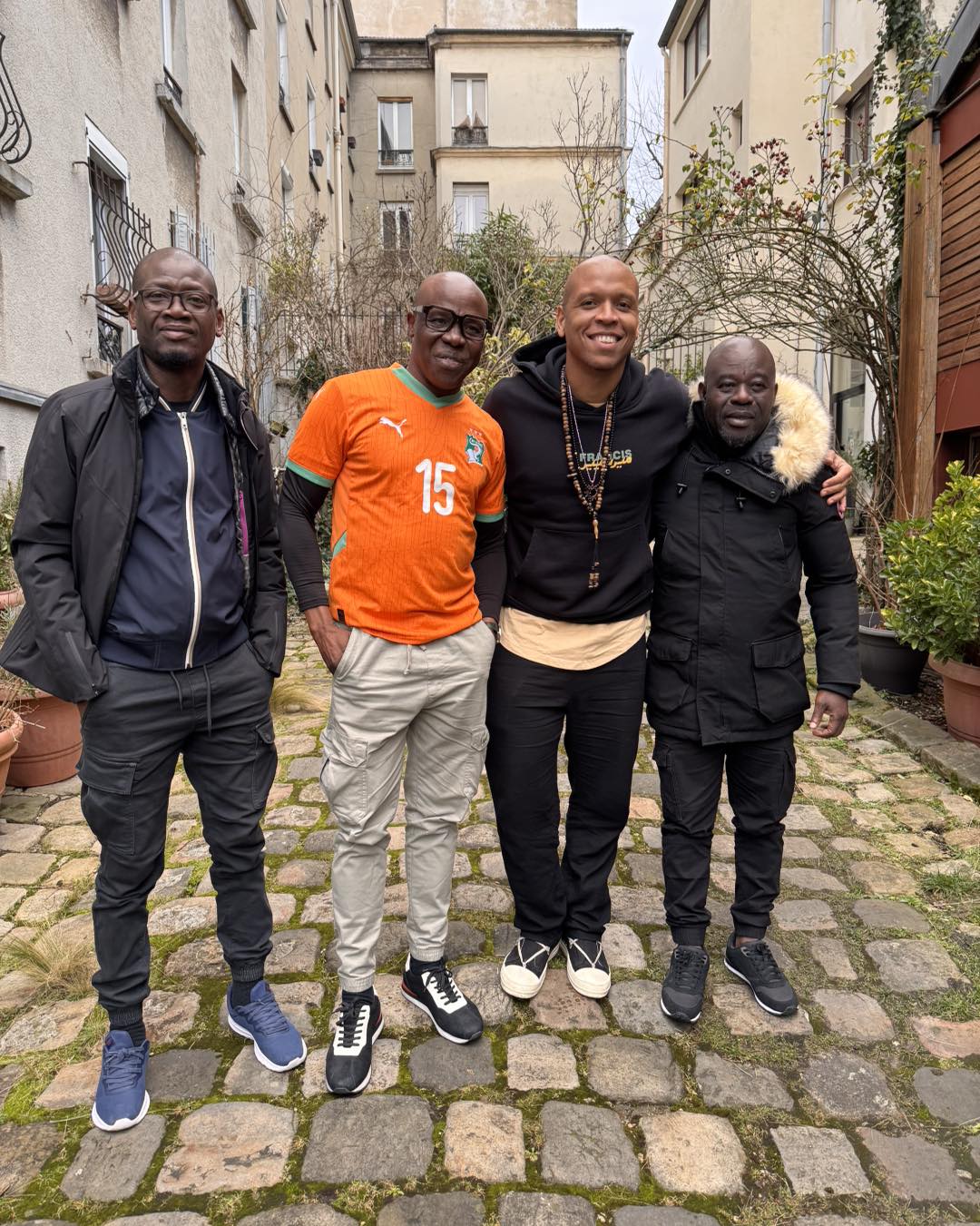
Francis Mercier and Magic System members, including lead singer A’salfo in an orange Ivory Coast jersey, posing together. Photo Credit: Magic System/Instagram
Do you remember that song from the late 90s that had absolutely everyone on their feet — children, adults, grandparents — dancing like their lives depended on it? Nobody fully understood the lyrics, but that melody did not care. “Premier Gaou†by Magic System was that song, and it has just gone Platinum in France.
And not just the original. The 2023 Afro-house remix by Haitian DJ and producer FrancisMercier and Nitefreak is the version that earned the plaque, and the celebration that followed is the kind of video you watch twice just to feel something good.
Francis Mercier shared the moment on social media — him and the members of Magic System, standing in the streets of Paris, holding the commemorative platinum plaque and singing “Premier Gaou†at full volume with zero apologies. They are laughing, swaying, pointing at the plaque mid-lyric, and the call-and-response between Mercier and the Magic System members is pure Zouglou spirit from start to finish, punctuated with shouts of “Affaire à suivre!†— to be continued.
Magic System first released “Premier Gaou†in 1999, and twenty-six years later the song is still finding new audiences, new charts and new milestones. Francis Mercier and Nitefreak gave it a new life in 2023, and that life has now gone Platinum in France.
Every week, OkayAfrica highlights the top African music releases — including the latest Afrobeats and amapiano hits — through our best music column, African Songs You Need to Hear This Week.
Read ahead for our round-up of the best new African music tracks and music videos that came across our desks this week.
Sarkodie – “Lavida Loca†feat. Lasmid
On his latest single, Sarkodie explores the pop rap path he’s done so well since the start of his career. He promises the good life on “Lavida Loca,†with the exquisite imagery and opulent flows to go with, but a winning element in its composition is the vibrant drums at the core and the atmospheric vocals of feature Lasmid. Known for his own soulfulness, he creates a truly memorable record with one of Africa’s most consistent rappers ever. A surefire bop. – Emmanuel Esomnofu
Dee Koala - “Hornsâ€
Dee Koala needs to be protected at all costs. The Cape Town-based emcee has the masses obsessed with her style and endless swagger. Her bars that borrow heavily from the Khayelitsha streets she calls home, from the slang to the inter-personal and communal relations; and her enigmatic stage presence and camaraderie that has seen her produce smash hits with the likes of Riky Rick, Maglera Doe Boy, Blxckie, and fellow Cape Town emcee, K.Keed. She has one album under her belt in 2019’s 4 the Kaltsha, and has waded the waves of fame with her head up, feet on the ground, and a mouth that knows how to put detractors in place. “Horns†is a triumphant, brass-heavy return to a form she never lost. She is sharp, incisive, assured, and fly as hell. “Andizanga ngalonto/ suka kude, deep kwi ntsokolo (I didn’t come here for nothing / I come from far, deep within struggle),†she raps, adding fuel to a fire that had been blazing from the first bar, which started with her declaring that she’s got no time to chit-chat after she gets off the stage. With Flowaboii delivering with a heavy hand on the boards, Dee Koala is left with no option but to cause total annihilation. - Tšeliso Monaheng
Asake & Tiakola “BADMAN GANGSTAâ€
Nigerian star Asakeconnects with buzzing French artist Tiakola for the new single and music video for “BADMAN GANGSTA.†The two artists trade verses in English, Yoruba, and French, as they celebrate all of their self-made successes. “‘BADMAN GANGSTA’ is a page from my real life. It’s about owning your space, your struggles, your blessings, all at once,†says Asake in a press statement. “Working with Tiakola brought a whole new flavor to the track. We come from different places but speak the same language when it comes to vibe, feeling, and ambition.†- EE
Gabzy – ‘It’s Not You, It’s Summer [EP]’
For years, Gabzy has embodied the Afrobeats sound with a subtle diasporan touch. Often taking from R&B, the blend has won him a unique spot in the scene, and with his new EP, the artist seems to be moving even closer to the roots of his sound. It’s Not You, It’s Summer is a tender collection of six songs, featuring Fireboy DML and Victony,who further enforce Gabzy’s unique vision. Replete with tales and interesting characters, it’s a showcase of an artist who’s kept in constant touch with their process. – EE
Voltz JT feat. Sane - “Cannabisâ€
Voltz JT is no stranger to Zimbabwe’s music scene. A pioneer of jecha trap, which is his homegrown blend of UK drill and Zim street grit, he’s built a solid reputation through consistency, carving his own lane one bass-heavy banger at a time. Following the explosive “Medzai Fridge,†he returns with “Cannabis,†a track many believe throws subliminal shots at fellow emcee Holy Ten. The tension between the two, fanned by online back-and-forths, now finds a new home on wax. Holy Ten’s political affiliations, particularly his vocal support of the ruling ZANU‑PF, have drawn ire, and Voltz TJ seems to channel that discomfort into his verses with sharp precision. Cannabis is used as a metaphor for escapism or compromised values, positioning Voltz JT and his clique as the real ones. Sane slides in with purpose, anchoring the track with a verse soaked in youthful recklessness, hunger, and street-wise determination. Shots have been fired. - TM
Kehne – “KILODEâ€
Nigerian singer-songwriter Kehne showcases impressive vulnerability on “KILODE.†The trappings of a toxic love situation is one that’s been massively courted by musicians, but Kehne makes the theme uniquely hers, reflecting the years of fine-wrought artistry. Over the string-awoken production, her perspective is urgent and sensitive, asking to be treated with the same assurance that the other person’s words hold. “No dey call me baby, cos I’m not your baby,†she cautions with an unguarded shade of weariness that renders even more complexity to the record. – EE
Jordan Moozy - “Kryptoniteâ€
Jordan Moozy is in a league of his own. He swaggers on songs like it's second nature, glides on beats like they’re his to slide on, and maintains a level of grit that usually gets lost when ambition overrides effort and hard work. “Kryptonite,†with Sun, is steeped in nostalgia, rich with imagination, and very much future-facing – a declaration that the homies are outside. Tatenda LXA draws from a deep well of house music, funk, amapiano, and more. The songwriting is magnetic and magnificent; “must be delirium, mass hysteria,†as your opening line is pure craft and attention to how the words move the soul, how rhythm injects meaning into life, how poetry becomes existence itself, made manifest through music. “‘Kryptonite’ is about a big comeback where you have your ops sitting on the edge of their seats, shaking in their boots. They don’t know what’s next and all you’re being is badder and better,†says the artist in a press release. - TM
Savara x Jay Melody – “Asali Mbichiâ€
Since deciding to release individual projects, Savara has shown a purposeful edge to his post-Sauti Sol days. Moving closer to a solo breakthrough with every release, his latest song “Asali Mbichi†has real potential in that regard. A subtle experimentation lies at its core, with log drums adapted in the realization of the East African rhythm. With emotive notes and the ever-beautiful singing of Savara and his guest Jay Melody, there’s obvious hit potential in the mellow beauty of this record. – EE
Phiwo - “Fallingâ€
South Africa’s R&B scene is in full bloom, and Phiwo is right at the forefront. The Durban-born, Johannesburg-based singer/songwriter has been steadily carving out her lane since 2021, delivering deeply felt, slow-burning gems like the evocative “In The Moment,†collaborating with Adrienne Foo on a joint EP, and lending her voice to DJ Clen’s All Is Fair, a street-certified showcase of the country’s rising R&B talent. Her latest offering, “Falling,†is a hazy, bouncy slow-jam with vocals that float effortlessly over woozy production. There’s vulnerability at its core: “I know the role I played, I know I made mistakes,†she confesses, mid-descent into love’s dizzying spiral. It’s introspective and intimate, the kind of R&B that sounds and feels like everything will be okay again. - TM
Tyla – ‘WWP [EP]’
Every move Tyla has made since the start of her career reveals a young woman who was ready for fame. With her sensuous, minimalist songs, she’s positioned herself as one of the leading acts of her generation and her new collection of songs reiterates that fact. A new feature verse from one of Afrobeats’ icons, Wizkid, props this new release considerably well, also with the duo of singles that have been shared prior. New Tyla is always welcome, so there’s little to say except to get into the vibe. – EE
Halo Yagami – ‘Ingubo Enamehlo [LP]’
The Johannesburg-based soul artist Halo Yagami has often reflected a high sense of artistry. Through his songs, which blend a variety of genres, he’s provided a quality counter-perspective to the hyper-realized nature of Africa’s pop music, and he again proves his mettle on his new project. Yagami’s fifth, Inugbo Enamehlo, is a stirring body of work that goes deeply into the traditional modes of song-making, with the artist infusing his own unique touches that makes it a rewarding listen. – EE
Wizkid and Tyla, two of the biggest African music stars in the world right now, join forces for an all-out banger of a collaboration on “DYNAMITE.â€
The new single, built on a bouncy bass line and syncopated drums, sees the Nigerian and South African music superstars blending their vocals perfectly as they trade sultry verses over the beat.
The new collaboration is sure to be a late contender for song of the summer, as we can see this one playing on dance floors on both sides of the Atlantic for months to come.
“DYNAMITE†features on WWP, a four-track bundle of songs Tyla has just dropped, which also features the previously released “IS IT†and “BLISS,†as well as another new track, “MR. MEDIA.â€
“When I thought of doing a mixtape called ‘WWP,’ I went back to all my old demos and I remembered the Wiz one,†Tyla had previously mentioned at one of her London concerts. “And it was still good, like, after three years! I just told him, ‘Let’s finish it because I want to drop it.’â€
So, “DYNAMITE†has been around for a minute, but it still plays like a fresh banger.
Listen to Wizkid and Tyla’s “DYNAMITE†and check out the full WWP bundle below.
Every week, OkayAfrica highlights the top African music releases — including the latest Afrobeats and amapiano hits — through our best music column, African Songs You Need to Hear This Week.
Read ahead for our round-up of the best new African music tracks and music videos that came across our desks this week.
Victony & Fridayy – “Glory IIâ€
Releasing a sequel to his latest single just some weeks after the original, Victony is flexing the reach of his artistry. Here he’s joined by Fridayy, who’s built up an impressive resume of collaborations with Afrobeats acts. The grass-to-grace narrative of the original is maintained, as Victony’s rap-informed flow is matched for intensity by his guest’s choir-reminiscent vocals. A fine blending of sensibilities, it’s a song that delivers beautifully on its role as an ode to God’s enduring grace. – Emmanuel Esomnofu
Kabza De Small - “Siyabongaâ€
Kabza De Small moves in his own lane. His long-awaited fifth album lays his heart bare, clarifies his intent, and reaffirms his status as the top don in the electronic music game. Not that he ever left; in the past year alone, his music was performed by an orchestra, he dropped one of 2024’s standout tracks in “Hayi Baba†(with Chronical Deep and LaTique), and laced bangers alongside Darque, DJMaphorisa, Xduppy, and Dlala Thukzin. He’s a man on a mission: to stretch the sonic spectrum, school our senses, and come out on top every time. “Siyabonga,†featuring Nontokozo Mkhize and Mthunzi, shows Kabza at his most tender, most curatorial. It leans into 3-Step, embraces you, cradles you. It’s a prayer – “asisabi lutho, isandla sakhe siphezu kwethu imihla yonke†(we fear nothing, His hand is upon us every day) – and everyone’s invited. - Tšeliso Monaheng.
Lojay – “Tennerâ€
After announcing the August release of his long-awaited debut album, Lojay has set the wheels rolling with a fiery song intended for the dance floors. Pairing his svelte vocals with hyper-vibrant pop beats is an artistic choice favored by the artist, and it continues to prove a winning formula, as he paints a riveting portrait of a lady he’s enamored by. Bold metaphors, swirling notes, and banging drums are ever-present throughout the song’s runtime, but the fusion doesn’t eclipse Lojay’s voice at the center of the fanfare. – EE
Adekunle Gold – “Coco Moneyâ€
Always one to reinvent himself, you’ll be hard-pressed to find Adekunle Gold in the same spot. On “Coco Money,†he returns to the indigenous throb that influenced his early music, pairing disco sensibilities with the unmissable drums of Juju music. It’s a quintessential fly talk song, an arena the artist particularly excels in. The vocals and the energy matching each other’s vivacity, it’s a renewed demonstration of the artist’s prowess as a songwriter. – EE
TOSS, Maglera Doe Boy, Young Stunna - “Hermanoâ€
“Hermano†is the rap Olympics – a relay of distinctive, heavyweight voices in African music. Themed around Black township life, with fashion nods to la sapeur, Black dandyism, and ukuswenka, the video brings the song to life in elegiac style. The back-and-forth between TOSS and Maglera Doe Boy deserves its own support hotline; there are simply too many quotables to catch in one go. Then comes Young Stunna on the chorus, a welcome breather from the lyrical warfare unfolding. Together, the three move like a league of their own: elite yet grounded, daunting but disarming, feisty and tender in equal measure. It’s an overload of excellence, so pace yourself. - TM.
Mr Eazi – “Cornyâ€
On his latest song, Mr Eazi shows why he’ll always be an interesting voice within Afrobeats. The chill number produced by P Priimeshowcases the artist’s expanding vision as a storyteller, as he reveals the intricacies of a romantic relationship. “No go do you cunny,†he sings atop the mid-tempo production, charting a seductive vibe that sways with the lyrics of the record. – EE
Blue Pappi - “G-Wagon†(feat. LaCabra)
Blue Pappi’s on a roll, and he’s only just getting started. The emcee, vocalist, and producer, who hails from Ladysmith in KwaZulu-Natal – home of the legendary Ladysmith Black Mambazo – follows up last week’s high-octane, Kane Keid-featuring “Dairy†with a mellow, left-of-centre tune that allows him and fellow Qwellers member LaCabra to exercise their rap muscles and cross uncharted flow territory. The cadences are impeccable, and the music, very stripped back, very lo-fi, allows them to swim with intention, playing lifeguard to your treasured eyes and ears. No word is wasted, and every moment of silence is as necessary as breathing itself. South African hip-hop is enjoying its moment in the sun, and these two are but part of a bubbling movement whose legend shall be spoken about in years to come. - TM.
Mlindo The Vocalist - “iMedi Yakho†(feat. Sir Trill)
Following the success of his breakout debut, Emakhaya, and the vulnerability of his self-titled sophomore album, Lindokuhle, Mlindo The Vocalist enters his third chapter with something deeper: perspective. It's a delicate balance of talent and emotional maturity that cuts above the clatter to go for the heart. Uhambo – The Journey is an album shaped by his own lived experience. It carries the weight of heartbreak, the beauty of healing, and the clarity that comes after navigating life’s highs and lows. On “iMedi Yakho,†a duet with Sir Trill, he repurposes the melody to Oliver Mtukudzi’s hit, “Neria,†and injects an Afro-pop swing to its step. The flavours ooze from the speakers straight to your soul. - TM.
Chrissy Spratt is no newcomer to the Afrobeats scene. Through her covers, the Canadian-based artist has curated a strong presence, even going on tour with Chike. Now, the Hi-Way 89 signee has released her latest song, a three-way collaboration with the talented singers Nonso Amadiand Serøtonin. As the line-up infers, it’s a vulnerable embrace that offers the love of a partner, with Spratt holding the thematic core through her piercing verse and vocals. It continues the purposeful run-up to a project expected in August, as she’s shown an impressive ability to handle several genres. – EE
The duo of Ikenna ‘IK’ Nwagboso and Camillo Doregos were seasoned music executives before coming together to start Hi-Way 89. They’d worked on label services and management, respectively, within the emPawa record label, positioning artists likeMr. Eazi andJoeboyfor the careers they'd later have. Individually, their clients make up a fine collective of established figures within the entertainment scene, making their alliance quite complementary.
“Once I was done with emPawa towards the end of last year, Doregos and I had that conversation that it's now time to come together and do something official," Ikenna recounts to OkayAfrica. "We both live in Canada, and we just saw the opportunity here and figured that it made sense.â€
For the duo, the large number of artists in Canada without a label structure made it essential for them to step into that space. “We [wanted to] provide our services and our expertise to develop acts and bring successful talents out of them,†Doregos explains to OkayAfrica.
It’s well-documented how African acts tend to favor the UK and US scenes when promoting internationally, with decades-long infrastructures influencing that decision. Making Canada an attractive destination for Black artists and brands is a long-term goal.
“Canada is still very pop, country music, and just like sprinkles of r&b,†Ikenna says about the market’s tastes. “So Black music is still very much lacking, and it’s something that we wanted to put our mark on. It just takes a company like ours to start things.â€
Doregos reiterates their competence. “For me and IK, being execs that’ve been able to navigate the key markets of the world and now finding ourselves in Canada, it’s just like starting again and doing what we know how to do best — break and develop talents,†he says. “We know that there’s a huge influx of the diaspora coming in, Black music, Black culture coming into Canada now, more talents coming into Canada, but fewer executives in the market that understand the music business and the scene. So we’re looking to position ourselves and develop and grow.â€
So far, Hi-Way 89 has commenced its undertaking of the cross-cultural vision. One of their flagship artists isChrissy Spratt, an artist whose roots are shared between Canada, Armenia, and Lebanon. “One of her strongest suits is just being able to dabble into different cultural sounds,†says Ikenna, “and she’s been able to understand how to do that within the Afrobeats space while maintaining her originality of pop and r&b.â€
They’ve also taken on the Nigerian actSiraheemand the Indian Canadian artistEnchantika, both of whom are joining Spratt as artists currently on the Hi-Way roster. “For us, it’s not just about the talent alone; we also look at people backing them on their side as well,†says Doregos. “Siraheem is a young kid, and people kind of doubt him. So he has a point to prove that he fits in the game. Even Davido said that when he started back then, people didn’t believe in him that much, thinking he’s from a rich background and the alte scene, but at the end of the day, he became an outlier.â€
These stories shape up the Hi-Way journey quite interestingly, and it is worth watching the process unfold. Last month’s “In Too Deep†showcases Spratt’s seamless ability to move between tonal registers, as she crafts a vulnerable tale of submission and seduction. Although her delivery incorporates the softness of R&B, the underlying drums have an Afro element. Siraheem’s “Bad B*tch Syndrome†pays homage to the Lagos rave culture while sampling one of P-Square’s most beloved classics.
The coming months promise to be eventful for Hi-Way 89, with Spratt set to release her debut EP in August. The release will build on the enthusiastic reception her covers have received from African music circles online. Her latest single, "Call On Me," features Serotonin andNonso Amadi, a Canada-based artist who has garnered significant attention. Additionally, the label is finalizing a release date for Enchantika, an eclectic act that blends Punjabi music with amapiano.
Given their diverse and promising roster, a reflection of their years of experience in the music industry, I was curious to hear Ikenna and Doregos' perspectives on what makes an artist marketable.
“It’s definitely not one thing,†says Ikenna, “but I would just say their tenacity, how willing they are to grow and develop their sound over time. With music, you can still be true to yourself; you do not have to conform to what you think the global scene wants from you. We see artists likeAsake,Burna Boy,Diamond Platnumz, doing well on a global stage, and they’re not compromising their sound, they’re really pushing their culture.â€
Doregos adds, “You have to understand that the African and Black diaspora is between 200 and 300 million people outside of Africa, in every city across the world. And being able to sell our music to our people in the diaspora means going global. Being able to have your song played, and that’s what is happening now. You release a song today in Nigeria, and within the next one to two days, or almost the same day, the song becomes a hit in London, France, the Netherlands, or Australia. That is what global means right now.â€
Samthing Soweto had just stepped out of his Uber when we connected online to talk about his new album, Touch Is A Move (Good Morning). It followshis 2020 EP, Danko!, and marks his first full-length releasesince Isphithiphithi redefined the game for him in 2019. Spanning seventeen tracks, the album is pure bliss, dotted with skits that feel like overheard conversations, and music that moves fluidly between the ephemeral and the ethereal. It draws from a broad palette: hip-hop, Afropop, Amapiano, Kwaito, and more.
"I think it's just luck and favour, and the audience deciding, okay, we're gonna keep you around. We like what you do, we're gonna keep you around," he says, responding to OkayAfrica's question about what it is that has sustained him for so long without releasing a full album. There were singles in between, however. "Amagents" arrived in 2022 as a cautionary tale to his daughter about the trappings of romantic love. "Ayafana amagents, ayafana amajimbozi," he sang, essentially letting her know that the game is rigged and that all men are the same – in how they set you up, in how they lie to you, in how they steal your heart.
"Songs are more valuable now than they were before. It used to be entire projects. If you have a really good song, you're good for at least six months," says the artist. "If you make music that people like, they'll remember you," he says.
There's a certain ease that comes with knowing, like knowing the sun will rise and set, as it has since time immemorial. Ease also comes in trusting that your favorite artist will deliver stunning work, no matter how long they take between projects. Samthing Soweto is one of those rare artists—a soothsayer of song, a titan, and a juggernaut who holds our hands through chaotic times. Since emerging with The Soil nearly two decades ago, he has left his mark on at least four distinct South African genres and done so as a singular, genre-defying force.
With The Soil, he helped popularise a cappella music for a new generation, infusing it with street-corner harmonies and township soul. He carried that melodic instinct into his early solo works – cult classics like This N That Without Tempo (2010) and Eb'suku (2014), which blended folk sensibilities with poetic introspection. As a member of the alt outfit The Fridge, he crafted sweet, searching love songs that defined the Johannesburg underground for a time. The Fridge was part of an ecosystem that included acts likeThe Brother Moves On, Impande Core, andBlk Jks – all of whom helped write the script for an alternative cool that still echoes through today's generation of bold, Black musicians.
Then came the turning point. Between late 2017 and early 2018, a collaboration withSun-El Musician changed the trajectory of both their careers. "Akanamali," which first appeared on SoundCloud, became a runaway summer anthem. What followed in 2019 was a string of hits – "Lotto," "AmaDM," and "Akulaleki" – all within the space of a few weeks. Isphithiphithi, which arrived in September of that year, cemented his place in the mainstream, proving him not just a genre chameleon but a pioneer. Samthing Soweto became one of Amapiano's most soulful and definitive voices. And that's not nearly it; he's done incredible work in hip-hop withStogie T, and also helped produce Makhafula Vilakazi's earlier poetry outings.
Isphithiphithi thrust him into popular consciousness, which was a welcome relief from all the years he'd spent toiling in the underground circuit.
"It's nice, because that was the point. I was always an artist," he admits. "Even before I made money, I was an artist. As an artist, I've always done art, and I do as much as I can. But when my daughter was born, I had to make money. Then I started being a commercial artist, someone who would make money from the art." He says the process has been "crazy humbling."
"It changed for the better in the sense that I was able to make ends meet. If it weren't for that, I would have stayed the artist that I was and played for whoever needed to hear me play. I was shy, and kept myself away from people's eyes," he says, and ends with a gratifying "I am happy."
The album recording process started in earnest in 2021, but it was a start-and-stop process that tested the limits of his artistic resolve. The arrival of "Amagents" signalled that an album was coming, but there were just too many false starts for that to materialise. Relationships were tested, but he still found himself back to the matter at hand: making another groundbreaking album that would shift the paradigm yet again, because that's just what he does. "I just kept on giving up. I probably gave up five times," he says.
He takes time, lets ideas percolate, re-visits, and edits until it feels right. Something he did before the album release was announced was to leak snippets online as a way to gauge public reception. "Deda," the second single, was first released in August 2023 and has garnered over two million viewson YouTube to date.
"I was trying to figure out what to do next. In 2021, I had the idea that this was the type of music I wanted to make. But I wasn't sure that people would like it," he says. So he read Ryan Holiday's book, Growth Hacker Marketing, about how multinationals grow their market share without using traditional marketing approaches. "When I read that book, it emphasised that instead of using big budgets, you can use what you have – from social media and stuff – to figure out what to do next. So you can ask your actual audience, and you'll find out exactly what they want based on the comments."
"This is all I have," he reveals amid our conversation, referring to the album. It's serious work to him, spirit work that requires him to reach within to pull out songs like the head-nodding kasi epic, "325", a reference to the BMW 3 Series 325i, otherwise known as a Gusheshe in South Africa. It's a song for the hood, for lovers, for those whose hearts haven't been made cold through contact with a harsh world.
"Ama Get Down," with Blxckie, is an instant hit. The harmonies at the beginning, Samthing Soweto's vocal inflections, more jazz than kwaito, are imbued with ancient spirits – the likes of Miriam Makeba, Victor Ntoni, and even Ladysmith Black Mambazo.
Production duties shift and blend seamlessly between a cast of three producers: Christer ("Ndandatho," "Ama Get Down," and "Don't Wanna Let Go"), J Smash ("325," "Yebo," and "Come Duze") and John Lundun, who produced "Deda."
"I kept on giving up. Every time I would have a setback, I'd just be like, It's fine, I'll find something else. But I had to go back to the music," he confesses. Time and space did help, but he'd always run into the same set of problems. "The last time was in March. I thought, 'Let me try one more time.' It came together, and I was like, okay, it's done now."
What he learned from this trial-and-error process was that life doesn't always happen the way we plan for it to. "But the point is to do it. You have to not stop, per se. You have to do what you need to do, and some of the solutions will find you as you do it. But you should not stop. It's one of those things where it's like, if you can't fly, you run; if you can't run, you walk; if you can't walk, you crawl; if you can't crawl, you roll. You do something," he emphasises. "I missed every deadline you can imagine. I didn't even think it was gonna be released. At this point, I'm just happy it's gonna come out."
For now, Samthing Soweto is happy that people outside his immediate circle are listening to his work. "For a very long time, just a few people and I knew it existed."
"I always love that moment when you identify a musical genre or a certain sound from a certain place that you didn't know anything about," Jannis Stürtz, founder of the Berlin-based indie labelHabibi Funk Records, tells OkayAfrica.
"Ya Ummi" by The White Bird Band marked Stürtz' starting point with Libyan reggae. It was one of the songs Stürtz came across at the abandoned TK7 factory in Sousse, Tunisia, many years ago. Owned by Tunisian guitarist and businessman Hechmi Miliani, the factory had closed after the collapse of the cassette tape industry in the early 2000s, but still housed tens of thousands of unsold tapes that Stürtz was fortunate to sift through.
"[Miliani] told me he hadn't been inside of it for ten years," he remembers. "There were skeletons of dead cats in the entrance halls." Out of the thousands of options, Stürtz chose everything Libyan he could find, paving the way for six Libyan releases in the following years.
The label today, July 4, releasedHabibi Funk 031: A Selection Of Music from Libyan Tapes, a collection of 15 songs dedicated to the cassette tape scene in Libya from the late 1980s to the early 2000s, featuring a range of genres from disco to reggae to pop. On a sunny Friday afternoon, Fatima Sabouni and Stürtz jump on a call with me from different ends of their Berlin office, telling me about Libya's love for reggae and the long-winded road the label took to bring this compilation to life.
Sabouni's official title at Habibi Funk Records is Product Manager, but amongst many other things, she co-wrote and edited a thoughtful and informative booklet of interviews with the artists that make up the Libya Compilation.
"'Ya Ummi' was the first track we licensed in 2019," says Stürtz. "In 90 percent of the cases, we license from the artist as opposed to old record labels. In this case, we had to make 15 deals, 15 people that needed to get paid, 15 people that we had to find before we actually could do any deal, 15 people who needed to get interviewed and their material digitized." It took six years.
None of the Habibi Funk team members could be on the ground in Libya. Their interlocutor, the man who made this compilation possible, was Yousef Alhoush, son of Najib Alhoush, the band leader ofThe Free Music. "[Alhoush] maintains this incredible network and found 90 percent of the musicians within 24 hours," says Stürtz.
Bringing this compilation together was a labor of love and patience that required overcoming unique logistical challenges. "The classic scenario would be that Yousef [Alhoush] finds someone who brings the master tape to Tunisia or Cairo, from where we find someone who can bring it to Germany. We get it digitized, and then it travels back the same route or one of the other routes," says Stürtz.
Sometimes Alhoush would go to the airport, hoping that he'd know someone in line for a flight, or that someone in the line would know his father and agree to deliver a master tape. Stürtz would await them at the airport with nothing but a picture. Payments were sent in a similar way.
"If I pay an artist via Western Union, they lose 50 percent of the advance," says Stürtz. "So then you've got to go to another money provider. Sometimes, I would visit a random logistics office in Cairo that has a partner company in Libya and give a random person a stack of money. I don't get a receipt or anything, and I just trust that this person then calls their colleague in Libya, and that colleague in Libya calls the musician we're working with to pay out the money."
Because North African cultures are highly interconnected and built around trust and keeping a good name, these informal ways were successful.
"Reggae became popular in Libya the year afterBob Marley passed away," says Sabouni. "Initially, artists would do covers, but there was a moment whereIbrahim Hesnawi, the father of Libyan reggae, was in the studio and someone told him, 'Why don't you just put a little twist on it and just make it a bit more Libyan.'"
The beat of Libyan shaabi rhythms is quite similar to reggae. Mixed, it became its own syncretic genre. Even today, there are Facebook groups with 60,000 members of different generations, solely dedicated to Libyan reggae. "I think there are a lot of reasons for that, besides the fact that reggae wasn't too far away from the average listener's ear sonically and filled a gap in the industry," says Sabouni.
During one of the interviews for the booklet, Libyan artist Ayed Belkhair, whose song "La Tgheeb Anni Wala Youm" closes out the compilation, explained to Sabouni why darker-skinned Libyans felt drawn to the genre.
"He said: 'When you're darker-skinned in Libya, it means that you have more African heritage in your family. And there was something about the African pride that came with listening to reggae that really resonated with people in Libya, specifically those with more African heritage. It gave us a seat at the table," she recalls.
Most of the compilation's musicians were unable to pursue full-time careers as musicians due to economic and political reasons, but they continue to write and play music to this day. "There was a lot of nostalgia from everyone I spoke to for a time that seemed to be very expansive creatively," says Sabouni. "When I asked if they still make music, they'd say 'yes, music never leaves you.'"
Habibi Funk Records' archive is a treasure trove of music many would not otherwise listen to. The label tends to gravitate towards musicians' earlier or overlooked releases, rather than their most successful albums.
"The longer you are part of the music scene and have success, the more you try to create something that will nurture the success," says Stürtz. "You try to adhere to certain sounds that are popular, follow certain songwriting and composition structures, and sometimes that means whatever you're putting out isn't as timeless anymore."
While all tracks on the compilation are timeless, Shahd's "Erhal Keef Alshams Tgheeb" is Sabouni's favorite. "It's such a great song and gets stuck in your head," she says with a smile. "It's really special that we were able to license a song by a woman."
After a chance encounter with Hesnawi, Shahd was encouraged to delve deeper into reggae and, under his mentorship, released her successful debut album Weinak in 2003. Five albums later, when Shahd's music was nationally recognized and played in shops and taxis, she remained anonymous. Sometimes, her friends recommended her own music to her.
Despite the many, albeit different, challenges these musicians faced, they created outstanding art that is worth re-release, as thoughtful and dedicated as Habibi Funk 031: A Selection Of Music from Libyan Tapes. In 15 tracks, it invites listeners into expansive worlds infused with reggae, funk, pop, disco, and, of course, beautiful Libyan Arabic.
Global music icon Angélique Kidjo has been selected to receive a star on the Hollywood Walk of Fame, making her the first African musician to be honored in this way. The Beninese singer, known for her powerful voice and commitment to social justice, was named as part of the Walk of Fame Class of 2026 under the ‘Recording’ category.
The announcement was made in Los Angeles by the Hollywood Chamber of Commerce. The organization, which oversees the Walk of Fame, confirmed that Kidjo joins a list of 2026 honorees that includes Bone Thugs-N-Harmony, Miley Cyrus, and Intocable.
Kidjo’s selection marks a major moment in music history. While artists from Africa have long shaped global culture, few have been acknowledged by institutions like the Walk of Fame. This inclusion, overdue as it may be, once again brings a strong voice from the African continent into focus.
"I may be the first African singer to get a star on the Hollywood Walk of Fame, but I am certain I won’t be the last," she tells OkayAfrica. "Many will follow, and it fills my heart with joy!"
Born in Ouidah, Benin, Kidjo began her career in West Africa before moving to France in the 1980s. She rose to fame through a unique blend of Afrobeat, funk, and pop. Her lyrics, sung in Fon, Yoruba, French, and English, explore themes such as identity and liberation.
She has released more than a dozen albums over the course of her career. Her projects have included reinterpretations of classic works, such as her reimagining of the Talking Heads’ Remain in Light, and tributes to women and African heritage on albums like Eve and Mother Nature. She has performed at major venues including Carnegie Hall and the Hollywood Bowl, and has collaborated with artists such as Alicia Keys, Burna Boy, Philip Glass, and Carlos Santana.
Beyond music, Kidjo is known for her humanitarian work. She is a UNICEF Goodwill Ambassador and the founder of the Batonga Foundation, which supports the education of girls across Africa. Her advocacy for women’s rights and cultural equity has earned her awards from the United Nations, Amnesty International, and the World Economic Forum.
The Hollywood Walk of Fame, which began in 1960, features over 2,700 stars along Hollywood Boulevard. Receiving a star is considered one of the highest honors in American popular culture. The Walk celebrates contributions to entertainment in categories such as film, television, radio, live theatre, and recordings.
With this recognition, Kidjo takes her place among the most celebrated performers of our time.
AfroFuture, the dynamic celebration of African culture, music, and innovation, is making its long-awaited U.S. debut in Detroit this August. In partnership with Bedrock, the festival has announced a two-week series of immersive, community-driven events leading up to the main event on August 16 - 17, 2025, at the Douglass Site.
Titled The Road to Detroit, the pre-festival programming aims to energize the city while connecting the African diaspora. Running from August 11 through August 28, these events will spotlight Detroit’s rich Black cultural landscape, combining culinary experiences, nightlife, tech innovation, cinema, and live performance.
Kicking things off is the AfroFuture Countdown Bar Crawl taking place from August 11 - 15. Here, festival-goers can sip custom cocktails at some of Detroit’s most iconic venues, such as the Hush Harbor, The Vinyl Society, and Paramita Sound, all while unlocking exclusive rewards like VIP passes and limited-edition merch.
Food lovers can indulge in Taste of Detroit Restaurant Week (August 11 - 18), which offers curated prix-fixe menus and chef demos at standout Black-owned restaurants such as Ivy Kitchen, Kola Lounge, and Salt + Ko.
Innovation takes center stage on August 13 with Diaspora Connect: Innovation For Global Black Futures, a pitch competition hosted by Black Tech Saturdays and Venture 313. Finalists will compete for up to $10,000 in equity-free funding in categories like digital culture, creative industries, and community development. The event will take place at TechThree in Midtown and is free to attend with an RSVP.
On August 14, poetry lovers can immerse themselves in poetry me, please – A Diasporic Spoken Word Experience at the historic Willis Show Bar. Featuring musicians and spoken word artists from across the diaspora, the night promises to be intimate and deeply moving.
Every Thursday throughout August, Afrocentric Movie Nights will take place at Lowkey Cinema, featuring screenings of films like Sun Ra’sSpace Is the Place, the Ethiopian post-apocalyptic sci-fi romance film, Crumb, and radical intersectional feminist Lizzie Borden’s dystopian docu-fiction drama, Born in Flames.
On August 15, the festival taps into Black music history with Samples n’ Friends X AfroFuture Experience, a communal celebration of samples, trivia, and karaoke spotlighting AfroFuture artists, Afrobeats, and Motown classics.
To round things off, a lineup of official pre- and after-parties will keep Detroit buzzing all weekend, with events like the Jerk x Jollof Pre-Party, Obi’s House, Toasted Life, and PVO.
“Bringing AfroFuture to Detroit isn’t just about launching a festival — it’s about building a cultural movement long before the first stage is set,” said Abdul Karim Abdullah, AfroFuture CEO & Co-Founder. “AfroFuture Detroit and its leadup events will honor the deep ties between the city and the African diaspora, amplify diverse voices, and foster and strengthen meaningful connections.”
Southern Africa's music scene is currently undergoing an exhilarating renaissance — a vibrant blend of history and boundary-pushing innovation. Across the region, artists are boldly redefining genres, merging the ancestral with the avant-garde, and crafting sounds that resonate far beyond their borders. From South Africa's pulsating electronic beats and razor-sharp lyricism to Lesotho's compelling storytelling and Zimbabwe's infectious dancehall rhythms, this collection of standout tracks reveals a region bursting with creative energy and artistic confidence.
Each artist featured here commands their own unique space, like Ciza's chart-climbing dancefloor anthem, which marries irresistible grooves with cinematic flair; Brotherkupa's fearless reimagining of jiggy rap with a rebellious edge; or Ntate Stunna's gripping narrative follow-up that pushes Lesotho's rap scene into new cinematic territory. The soulful introspection ofMoonchild Sanelly, the magnetic swagger ofNasty C, and the genre-defying sounds of Kharishma's Limpopo-rooted lekompo further highlight the rich diversity fueling this creative explosion.
This is a sonic landscape where tradition meets experimentation, where stories of resilience, love, and identity unfold over infectious beats and intricate flows. Collectively, these songs showcase the artistry, innovation, and cultural pride that define the music horizon of 2025.
Read ahead for the Best Southern African Songs of 2025 So Far.
Ciza - “Isaka (6AM)” feat. Jazzworx and Thukuthela (South Africa)
"Isaka" is an undisputed banger. Since its release in April, the song has climbed the charts, entered the hearts of dance music lovers, and given dance floors another reason to come alive. The Tarryn Tippens-directed video is a lavish display that mirrors the track's energy, allure, and infectious groove, securing its place within the lush and evolving terrain of South African electronic music.
This track is a bold statement from some of Lesotho's most potent artists. Led by Sannere, who is arguably the artist of the moment, "Ho Ba Monna" gathers a constellation of the country's sharpest talents to interrogate the myths and expectations of masculinity in a time that demands truth, vulnerability, and emotional depth. Each voice adds a distinct texture, offering not just musical range but layered perspectives. The result is a timely, resonant anthem that reflects Lesotho's evolving sound and places it squarely within the global conversation.
Jah Prayzah - "Kuno" (Zimbabwe)
Jah Prayzah has carved out many musical bags in the many years he's been active in music, and he can twist and turn at any point to reveal a different side of his artistry. "Kuno" was the first release from his new album, Ndini Mukudzeyi. He digs deep to sing his heart out about love, legacy, and the bonds that remain unbroken after life has ended. It's also an assurance to the one left behind that the ancestors see them and know them. Jah Prayzah is a formidable artist.
Oriiginelle - “Nguwe” feat. Jay Jody (Eswatini)
On "Change," Eswatini emcee Oriiginelle traded lavish bars with South Africa's Zulu Mecca and effectively marked the 'real rap' register with one of 2024's underrated releases. "Nguwe" carries the same jazzy, lo-fi feel and finds a vulnerable Oriiginelle singing her lungs out and stacking harmonies, with lines like "still got so much work, I'm ill-prepared" before busting meticulous raps using flows integrated into some form of a higher power. Jay Jody stays on topic and elevates the song to a super saiyan level, rapping: "But I ain't perfect, ke na le diphoso (I have my own flaws)." This is elegant rap music that will resonate now and forever.
Gabopatwe & Mpho Sebina - "Lerato" (Botswana)
"Lerato," a stirring duet by Botswana's Mpho Sebina and Gabopatwe, is as close as music comes to the sound of joy. Rooted in longing and desire, it's a moody, slow-burning love song that speaks to the sweet surrender that happens when love takes over completely. Sebina's featherlight vocals and razor-sharp pen glide effortlessly over Gabopatwe's delicate, expressive piano work as his fingers trace every emotional contour of the track. It's a luminous offering for lovers everywhere.
Taniâ - “Dioguito” (Angola)
Angolan artist Taniâ breathes fresh life into Bernardo Jorge Bangão's classic "Dioguito," transforming the semba staple into a dynamic dialogue between tradition and modernity. Her voice glides effortlessly over the track, weaving nostalgia and innovation, while Francisco Alexandre Pedro's vibrant production injects just the right bounce to keep heads nodding and feet moving. It's a seamless blend of past and present that honors the roots while pushing forward.
Dlala Thukzin, Kabza de Small, MK Productions - "Muthi" feat. Zeh McGeba, Masuda (South Africa)
About a month ago, a clip surfaced online featuringKabza De Small and Dlala Thukzin in the studio, cooking up what one can only imagine to be sizzling bangers. Some of the fruits from that collaboration are featured on 031 Studio Camp 2.0, a refreshing approach to electronic music rooted in a deep understanding of spirituality and a future-forward mindset unafraid to break new barriers. "Muthi" is sonic alchemy delivered in Dlala Thukzin's 3-Step grooves, Kabza De Small's unmistakable baselines, and Zeh McGeba's reassuring vocals. We might have another song for the summer with this one.
Kharishma - "Fly High Lekompo" (South Africa)
Kharishma is the moment. Her main occupation? Dishing out hits, which she does superbly. On "Fly High Lekompo," a melodic earworm rooted in South Africa's Limpopo province, she uses the infectious beat as a springboard to showcase the full range of her talent. The result is both catchy and commanding, a clear reminder that she's a force to be reckoned with.
Ntate Stunna - "Robari 2" (Lesotho)
With his debut offering, Sesotho Fashioneng, Ntate Stunna ushered a new age of Lesotho rappers, ones who drew from the innovations of both Famo musicians and rappers of an earlier time, such as Kommanda Obbs and Skebza D. The original "Robari," taken from that album, is a vivid tale of a robbery gone wrong. A series of unfortunate events leaves the protagonist at odds with himself, wondering how he'll escape a situation that now involves police officers. On the Flash Cortez-produced follow-up, Ntate Stunna disregards imminent danger and tries to negotiate with the hostages. "Toronko kapa mokhohlane/ ke re nka mpa ka baleha/ lebaka le nke keng ka tšoaroa, ke tsoile ka parole ene ha ke sa itlaleha, ("Jail or funeral/I'd rather run away/ I can't be arrested, I haven't been reporting for parole/")" he raps, as the cinematic soundscape elevates the song's impact. This is how you do a follow-up.
Shandesh & Mvzzle - "Sdudla or Slender" (South Africa)
Shandesh is a rising voice from Limpopo championing the lekompo sound — a genre defined by staccato percussion, synth-heavy production, and the signature use of auto-tune. Popularized by acts like Shebeshxt and Kharishma, lekompo gives voice to the everyday highs and lows of South Africa's youth. With "Sdudla or Slender," Shandesh adds another anthem to his growing catalog, building on the momentum of his 2024 breakout EP Versatile and further cementing his place in the genre's vanguard.
Brotherkupa - "Today Is A Good Day" (South Africa)
Brotherkupa's aura is currently unmatched. Alongside artists like Mfanatouchline and collectives like The Qwellers, he's ushering in a new era of jiggy raps and outlandish production that borders on disrespect in the best way possible. Here, samples are chopped, sped up, slowed down, reversed, and paired with buzzing 808s. It's an entire vibe. And the streets are responding: his fourth album, Before The Worst, shot to number one on streaming platforms upon release. Echoing the sunshine and glory of Ice Cube's 1992 hit. "Today Is A Good Day" is more than a statement — it's a lifestyle, a religion, and a way of life.
Killer T - "Magunje" (Zimbabwe)
In the animated video for "Magunje," Zimbabwean dancehall stalwart Killer T portrays an easy, carefree life. The song celebrates the finer things, luxuries, and pleasures that, while enjoyable, might still attract trouble with the authorities. Through a series of hilarious incidents, Killer T maintains an energetic flow that drives the song from start to finish, adding to its charm and playful defiance.
lordkez - "Aweh" (South Africa)
South African R&B is in a mighty healthy place right now, with new releases emerging left, right, and center across the burgeoning scene. Lordkez, a staple of this sonic wave, whose reign has blessed us with collaborations withMaglera Doe Boy,Bas, andShekhinah, shines on "Aweh," a colloquial term for "yo." The vibes are vibing; the choreography by the inimitable Tarryn Alberts is on point, and her command of the music elevates the track to another level.
Voltz JT - "Medzai Fridge" (Zimbabwe)
Every track the Zimbabwean emcee Voltz JT touches turns to gold. With a voice that echoes the gravitas of rap's greats and a mastery of flow that stretches words, flips meanings, and reassembles them into nuggets of inside jokes, prophetic wisdom, and unapologetic badassery, he carries an entire scene on his back. "Medzai Fridge" (Shona for "put it in the fridge") is bass-heavy, raw, unfiltered, and impossible to ignore. Beware of the funk.
Lowfeye - "Tango" feat. Usimamane (South Africa)
Lowfeye and Usimamane butt heads and unleash pure lyrical warfare. Lowfeye sets it up, leaving the slate clean for his counterpart to run wild on the beat. "This how it be, nobody's safe when I step out the house," he declares in the opening line. Usimamane wastes no time, making it clear that every rapper in the game is his offspring. He even slips in a shoutout to Riky Rick before passing the mic back to Lowfeye, who excavates words so jiggy they deserve their own dictionary.
On "Sheleni," Eswatini's Grixxly puts his own spin on the one thing that rules us all: money. Teaming up with Lyrikal Busta and Sarnilo, the fire-spitting emcee trades intensity for ease. The trio glides over the beat with effortless, laid-back flows that make the track feel timeless. It's a smooth, head-nodding anthem that reminds us that sometimes, the best flex is not stressing at all.
Tieho - “Mohuli” (Lesotho)
If distinctive melodic flows and heavyweight rap bars are your thing, then Lesotho emcee Tieho is about to re-arrange your worldview. His latest release rides a warm synth bed and a chopped vocal sample from Lihoba tsa Matšekha, unfolding into a fully-formed cautionary tale about the fleeting nature of material wealth. Tieho stretches syllables, bends language to his will, and locks into rhyme schemes with surgical precision, all delivered over Emjay Elphy's minimalist but striking production.
Nasty C - "Psychic" (South Africa)
Nasty C is the undisputed don of modern South African hip-hop. With a decade's worth of hits to go back on, the artist doesn't seem intent on resting on his laurels. "Psychic" is the rage-inspiring song of the season, a display of the skill that the emcee has mastered over the years. It's full of memorable lines ("I gotta pay, rent/ so don't be nervous baby, hit the link"), the beat is anthemic, with horns that sound like moments before the earth ends, and the vibe is generational, proof that Nasty C is not the one to mess with at any time.
Moonchild Sanelly - "Mntanami" (South Africa)
Moonchild Sanelly bares new layers on Full Moon, her most cohesive and emotionally resonant project to date. There's a striking honesty that pulses through the album — a kind of vulnerability that doesn't come overnight but is earned over years of living, breaking, and healing. On "Mntanami," she digs into old wounds, not for nostalgia's sake but to make peace with the past and move forward. The production feels cosmic, bold, experimental, and unmistakably hers. It's the sound of an artist in full bloom.
Cassper Nyovest - "Kusho Bani" [South Africa]
It's been over a decade sinceCassper Nyovest crashed into the mainstream with "Gusheshe," and in that time, he's remained one of South African music's most polarising figures. He's filled stadiums, launched a successful liquor brand, and undergone a spiritual transformation. Now, with "Kusho Bani," he returns to form, firing back at doubters and reminding the game of his staying power and knack for crafting hits. The song has introduced a new language to the cultural lexicon; "hosh kharamima," a phrase that appears in the song, is used by lovers across the board to express their admiration for their significant other.
Sjava - "Uyena" (South Africa)
Sjava's new EP Inkanyezi stands as a singular achievement in South African music. Recorded live during an intimate December 2024 performance, the project comprises entirely unreleased material. His command of the stage, his ability to hold space and guide emotion, is masterful. On "Uyena," he leads listeners through a gospel-tinged journey that blurs the line between concert and communion.
Internet Girl - "Treat" (South Africa)
Internet Girl's sound is an edgy mix of pop-rock, trap, and electronica fed through effect pedals, post-teenage angst, and the fleeting state of youth—all delivered through frontman TK's raw, unfiltered, and emotionally resonant lyrics. "Bhati Ntsika, where's your posi?/ they don't understand I got divorced parents/ and to my son I'd be the worst parent," he raps, his voice a fuzzy haze of broken childhood promises and the looming responsibilities of adulthood. Internet Girl is the sound of now.
Lesotho's saveHXPE wears his influences on his sleeve. Following up on "Real," released earlier this year, he channels a Kendrick Lamar-esque cadence to magnetic effect. Baby Daiz adds the extra seasoning, elevating an otherwise intimate affair into a rap banger with serious replay value.
From Nairobi to Kigali to Dar es Salaam, 2025 has been a year of quiet reinventions and loud declarations in East African music. Some of the region's biggest names returned to the spotlight with tracks that fused romance, rebellion, and cross-cultural flair, while others chose introspection or experimentation. The result? A genre-bending, emotionally rich soundtrack that reflects where we've been and hints at where we're going.
The year kicked off with a string of certified hits. Kenya's Matata dropped "Mpishi," an infectious anthem that quickly became the country's most popular song. Tanzania'sAbigail Chams rode the momentum of "Me Too," her single alongsideHarmonize, to a BET Awards nomination. Meanwhile, artists like Zuchu, King Saha, and Juma Jux delivered records that navigated personal transformation and public visibility with confidence.
But beyond the charts, it's the emotional depth and sonic boldness that have stood out to me most this year.Mereba's "Heart of a Child" offered a homecoming steeped in diasporic reflection.Joshua Baraka's "Wrong Places" andDyana Cods' "Get Busy" reminded us that growth isn't always loud. However, when it is, it had better have a melody worth moving to.
This list isn't just about what's trending. It's about the songs that have sparked conversation and moved bodies. From viral dance tracks to intimate confessionals, here are the East African songs that have defined 2025 so far.
Matata – “Mpishi” feat. Bien (Kenya)
"Mpishi" isn't just one of Kenya's biggest hits of the year; it's a pure shot of joy! After taking a year-long break, Matata stormed back with a track that's as infectious as it is celebratory. Teaming up withBien, the group cooked up a chart-topper that had me dancing from the first listen. There's something about the blend of Bien's smooth vocals, Matata's rhythmic swagger, and the song's playful energy that feels like a burst of sunshine. I was especially looking forward to catching the band live at Blankets and Wine before the show was canceled due to anti-government protests. But seeing them take the hit on tour with Bien in Europe softens the blow. Some songs just feel good in your body. "Mpishi" is that song for me.
I had the pleasure of interviewing Abigail Chams just as "Me Too" was climbing the charts, and it was clear even then that she was meant to be a star. It's been so rewarding to watch that potential unfold. "Me Too" is a flirty love song featuring Harmonize that has not only become a massive hit, racking up over 15 million views, but also confirmed Abigail's staying power. With a historic BET Awards nomination under her belt, Abigail is already defining her generation.
Joshua Baraka – "Wrong Places" (Uganda)
After lying low for much of the year,Joshua Baraka is back with "Wrong Places," a soulful, emotionally charged single that signals a new chapter for the Ugandan artist. This track leans into the raw, honest storytelling that's fast becoming his signature. With 1.8 million views and counting, "Wrong Places" might just be the first glimpse into the next phase of Baraka's artistry.
Marioo – "Nairobi" feat. Bien (Kenya/Tanzania)
Marioo's "Nairobi," featuring Kenya's Bien, has emerged as a standout anthem of 2025, amassing over 26 million views and igniting a wave of cross-cultural love across East Africa. With smooth Swahili lyrics, the song is a romantic ode to the women of Kenya's capital. Its viral success — fuelled by TikTok dance clips and lifestyle reels set to its chorus — has made it more than just a cultural moment. The song also marks a high point in a remarkable year for Marioo, who had another chart-topper with "Tete."
Jux – "God Design" feat. Phyno (Tanzania)
I love love. And even more than that, I love seeing a man declare his love loudly. Juma Jux is deep in his lover-boy era, and "God Design" is a celebration of that. Fresh off his headline-making wedding to Nigeria's Priscilla Ojo, Jux dropped this romantic banger with visuals pulled straight from the ceremony. The song radiates joy and devotion, and Phyno's verse adds just the right amount of edge to balance the sweetness. It's the crown jewel of Jux's EP A Day to Remember, which he calls a soundtrack to his love story.
Mereba – "Heart of a Child" (Ethiopia/USA)
This track is a personal pick. "Heart of a Child" is a soulful, introspective gem from Mereba's second studio album,The Breeze Grew a Fire. For me, the track feels like a quiet revelation as she traces her journey back to herself through sound and storytelling. Shot in Ethiopia by acclaimed videographer Maranata Tegegne, the music video beautifully captures the emotional weight of returning home. Mereba described the album as a process of reconnecting, asking, "What do I want to say to people now?" With "Heart of a Child," she answers that with vulnerability and a sound that hangs long after the last note.
Element Eleéeh – "Tombé" (Rwanda)
No East African roundup feels complete without Element Eleéeh. As both an artist and one of Rwanda's most influential producers, he continues to leave his mark on the country's music scene. His single, "Tombé," blends Afrobeats and kompa into a sultry love song that has racked up over 7.1 million views on YouTube and sparked a viral TikTok dance trend. Smooth, addictive, and expertly produced, "Tombé" is a reminder that Element is building momentum to take his music global.
Bien – “Safari” feat. Suldaan Seeraar (Kenya/Somalia)
Bien is amid a global takeover, and "Safari" is a standout moment in his ongoing evolution. Teaming up with Somali superstar Suldaan Seeraar, the track is a rare and powerful cross-border collaboration that bridges the musical landscapes of Kenya and Somalia. "Safari" is more than just the lead single from Bien's upcoming album; it is a statement of intent. Currently on tour across Europe and the U.S., Bien is showing that he's not only a solo powerhouse but also quietly building a case as Africa's king of features. His recent run of collaborations says it all: from the viral hit "Mpishi" with Matata and the pan-East African favorite "Nairobi" with Marioo (both featured on this list)to the house anthem "All I Need" with Brazil's Rammor and "Katam" with Diamond Platnumz.
Toxic Lyrikali – "Sick" (Kenya)
Kenya's Toxic Lyrikali kicked off 2025 with a bang through "Sick," a blend of gengetone, dancehall, and drill that is cementing his place as a leading voice in Nairobi's underground music scene. With aggressive flows and hard-hitting production, the track captures the raw energy and street sensibility that define his style. It set the tone for a strong year, followed by "Confirmation" in April featuring Mr Ree and a standout guest verse on Dyana Cods'"Get Busy." All of these moves signal that Toxic Lyrikali is not just riding the wave of Nairobi's street music; he is actively shaping it.
King Saha – “TikTok Life” (Uganda)
King Saha taps into the trials of modern life with "TikTok Life," a catchy song that captures the joy and exhaustion of living online. The song reflects the digital-age reality of constantly being on display, delivered with Saha's signature depth and finesse. The song has been steadily climbing the Ugandan charts, resonating with a generation caught between performance and authenticity. More than a decade into his career, King Saha proves he still has his finger on the pulse.
Dyana Codsis done playing it safe, but did she ever? In "Get Busy," she dives headfirst into steamy dancehall territory, teaming up with Toxic Lyrikali for a track that oozes confidence and raw appeal. The video, in which she stars as a seductive officer teasing her inmate, is a bold statement from an artist who has struggled to find her groove. A few months earlier, she dropped "Chude Genje" with Femi One. It's a gritty, high-energy banger that shows Cods is finding her groove following her 2024 hit "Set It." With each release, Dyana is sharpening her sound and proving that her spotlight is no fluke.
Zuchu – "Hujanizidi" feat. D Voice (Tanzania)
Zuchu has been keeping a low profile in 2025. But when she drops music, the impact is still loud. She kicked off the year with "Hujanizidi," a January release featuring D Voice, which has already garnered over 7.5 million views. The bongo flava track leans into their smooth chemistry, reminding listeners why Zuchu continues to command attention even without a constant spotlight. In May, she followed up with "Lollipop," a sultry collaboration withYemi Alade from her 2024 album Peace and Love. It's been a quieter year for the usually prolific star. But with each move, Zuchu proves she doesn't need the noise to stay on top.
Missed the best East African music of May 2025? Head to our article for all the March hits from Rwanda, Tanzania, Kenya, Uganda, and more.
Every week, OkayAfrica highlights the top African music releases — including the latest Afrobeats and amapiano hits — through our best music column, African Songs You Need to Hear This Week.
Read ahead for our round-up of the best new African music tracks and music videos that came across our desks this week.
Runtown – ‘Soundgod Fest IV [EP]’
Boasting one of the most credible portfolios in contemporary Afrobeats, the artistRuntownhas accrued a reputation as a recluse. Behind the needle-moving records is a man who just wants to stay disengaged from all the buzz, but he’s finally responding to calls for more music. Soundgod Fest IV continues his successful project series, a collection of six songs that ease into a chill vibe, with tales of love and life filtering out from the savant’s sweet tease. – Emmanuel Esomnofu
Kabza De Small - “Kabza Chant 2.0” (feat. Nkosazana Daughter, Nobuhle, Sykes)
How do you follow up greatness? You make greater moves. And who better than the undisputed king of amapiano,Kabza De Small, to show us how it’s done? On the sprawling “Kabza Chant,” the producer assembled some of the scene’s most vital voices, like Young Stunna, Murumba Pitch, and Nkosazana Daughter, for a praise song worthy of his throne. This second iteration, where Nkosazana Daughter returns, joined by Nobubhle and Sykes, is half the length yet just as potent, if not more. This is amapiano that has been performed with orchestras, heard in full houses, and felt in the spirit. It’s a shift in perception and a redefinition of legacy. It’s enchanting, exacting, and impenetrable. Kabza De Small is truly one of one. - Tšeliso Monaheng
Tekno – “Powerbank”
Nigerian starTeknoreinforces the currency of his hitmaker status over knocking Afropop drums. “Powerbank” is quintessential Tekno, boasting an astute flair for riding the beat, sounding as purposeful as ever in the recounting of a love story. When he vows that there’s “nothing I can’t do,” he sounds quite convincing, with him making quite the show of what those things might be. – EE
Yugen Blakrok - “Being Here”
With every album,Yugen Blakrok unlocks new chambers of rhythm. Her pen sharpens, her mind expands, and her worldview – always informed, never preachy – sketches parallel realms where beauty resists erasure. She moves like a magnetic field: gentle and affirming. Intentional in every breath, Yugen remains one of the best rappers doing it right now. “Being Here” deepens her already rich visual canon while her bars climb heights few dare. Sample this: “There’s times where sinners become the preachers/ Claim that they’re believers ’til you challenge their beliefs,” she raps, every bar a carefully curated slice of a bigger picture. Proceed with caution. This is real rap: unbothered, unfiltered, undeniable. - TM
Gabzy – “So Much Sense” feat. Fireboy DML
For years now, Gabzy has steered a unique vision for his R&B-influenced sound. Here, he’s joined by a similar stylist inFireboy DML, creating a bop that evokes all the feels. With a laid-back beat evoking the promise of cool evenings, both musicians paint vivid images of chilling with their love interest, inferring that this would make so much sense. – EE
Zoë Modiga - “Uyakhazimula”
WhenZoë Modiga speaks, the room listens. On record or in person, her presence demands stillness. On “Uyakhazimula,” she returns to eMbali in Pietermaritzburg, the place that raised her. The song feels like soul food, vintage couches, coal-heated stoves, and warm bread fresh from the oven. Just as the world outside threatens to fall apart, it wraps you in memory, in comfort, in beauty. This is definitive art: lush harmonies, emotional abundance, and spiritual glow. Zoë Modiga is a prime artist, and she radiates light. - TM
Da Capo – ‘Indigo Child II: Love & Frequency [LP]’
South African producer Da Capo’s establishment in the Afro-house genre is no fluke. He’s proven himself a fine creator and curator, assembling some of the most forward-thinking artists on his stellar production, and the follow-up to his last project, Indigo Child II, is no different. Featuring artists likeBongeziwe Mabandla,Elaine, and others, it is an impressive body of work with great potential to become a classic. – EE
Eli Mary - “PIECES’
On the emblematic “Pieces,” Johannesburg artist Eli Mary doesn’t just sing; she conveys feeling, using the microphone as a tool for expression. Her voice is a balm. Serene yet stirring, it drifts like smoke and lands like scripture. The beat shapeshifts beneath her, combusting in waves that mirror her emotional range. With each iteration, she peels back a new layer of self, revealing an artist who speaks as much as she soothes. This is heart music – gentle yet galvanizing. -TM
ODUMODUBLVCK – “PITY THIS BOY” feat. Victony
Released earlier this year,Odumodublvck’s “PITY THIS BOY” has all the markings of an enduring record. Between the bright strings orchestrated byNiphkeysand the harmony both Odumodu andVictony bring, it’s a delightful song to listen to. Its new video follows the opulent overtones of the song, casting the artists in scenes rich with color and activity, further extending the song’s appeal. Check out “PITY THIS BOY” and the other songs on OkayAfrica’s Best Afrobeats Songs of 2025 So Far list. – EE
Beatmochini and Towdeemac - “Eventually” (feat. Priddy Ugly, Maglera Doe Boy, Kaygizm)
The last timePriddy Ugly andMaglera Doe Boy linked up, we got a generational banger in “Ntjaka.” Now they’re back – this time on a more subdued, soulful tip – and are joined by two-thirds of the legendary Morafe: Towdeemac and Kaygizm. It hits differently, like a gentle nudge that nevertheless leaves lasting imprints on your spirit. With Beatmochini on production, this is a cross-generational link-up we didn’t know we needed but absolutely do. It’s a quiet storm of legacy, precision, and poetics. Towdeemac, once again, proves he’s not the one to front on. His bars don’t just rhyme; they ripple. Sentences run on, fold into themselves, and re-emerge as something entirely new. Who else can rap: “Cava ntja, how I inspired … to flex in their mother tongue / bona nou bafana ba kajeko ba matha joang / on another level, Joe, ba nkgopotsa nako tsa ka,” and make it sound effortless? Listen to "Eventually" here. - TM
Each year, amapiano brings fresh hits, innovative trends, and new sounds to get fascinated by. The music's range seems endless as it delicately embraces different aspects of the human experience.
Six months into the year, amapiano remains the cultural lifeblood of South Africa's music scene – and increasingly, the world's. It's a genre that doesn't just soundtrack the moment but shapes the very fabric of how we move through it. From sold-out orchestral concerts to social media storms, every month has brought with it a unique blend of groove and growing pains.
This year began with a reminder of amapiano's position as language, movement, attitude, and community. From grassroots platforms like Sniper Zone to polished YouTube hubs like Piano City, the genre has shown its ecosystem is as layered as its thumping log drums. February brought standout tracks from both titans and newcomers, with DJ Maphorisa and Lesotho's Ntate Stunna offering just a glimpse of the genre's pan-African and cross-generational appeal.
March came with mourning. The tragic passing of Yallunder, a singular vocalist who lent soul to amapiano's depths, rippled across the community. Her powerful and poignant voice lives on in tracks with Kelvin Momo, De Mthuda, and others. But alongside the grief, there was movement: "Biri Marung" dominated YouTube, Sir Trill made a triumphant return, and dance crews were already plotting the next viral routine.
Then came April, a month packed with fireworks. PCee's livestream calling out industry exploitation (and, allegedly,Uncle Waffles) reminded us of the tensions simmering beneath amapiano's high gloss. The back-and-forth highlighted ongoing questions around power, gatekeeping, and recognition. Still, the music didn't stop.Davido's emphatic shout-out to South Africa as the rightful home of amapiano on The Breakfast Club felt like a much-needed affirmation. Kelvin Momo's Red Bull Symphonic headliner status further proved that the genre is not only global but also elite.
May carried momentum and messiness. DJ Speedsta and Nadia Nakai's critiques of amapiano's dominance drew ire from the masses and reopened old wounds in SA's music discourse. Meanwhile, Scotts Maphuma's public apology didn't land as intended, igniting conversations about fan respect, accountability, and what it means to be "made" in a genre that thrives on community co-signs.
Yet, despite the drama, amapiano's global grip tightened. Uncle Waffles' Canadian tour visuals reinforced her as an icon in motion. The release cycle was unrelenting: Kelvin Momo's "Thato Ya Modimo," Daliwonga and Mas Musiq's"Bas'tholile," Sfarzo Rtee's"Sechaba," and De Mthuda's resurgent "Mthuthuzeli," as well as Sam Deep, Stixx, and Nvcho's "Kings of Kwapi Vol. 1," all made strong cases for Piano's sonic elasticity and spiritual core.
Amapiano is multiplying its forms, reach, and resonance. If the first half of 2025 is anything to go by, the second promises even more fireworks.
Read ahead for the best amapiano songs of 2025 so far.
DJ Maphorisa's undeniable presence in the amapiano scene remains unchallenged with "Ngibolekeni," a track that feels like the festive season refused to end in the best possible way. From the moment the beat drops, there's an unmistakable sense of familiarity: log drums that hit just right, infectious chants, and a groove tailored for dancefloors and street corners alike. It's the kind of song that sounds like December, even in June. Far from a solo flex, "Ngibolekeni" brings together a cast of some of the most sought-after voices in the game right now.Blxckie delivers slick, melodic bars that ride the beat with ease; Scotts Maphuma adds raw, streetwise charisma; LeeMcKrazy, with his rising star status, brings the spark; and PCee, known for his viral hooks, locks it all in with a chant-ready refrain.
TeepeeMassoxs and Kelvin Momo - "Opera"
"Opera" is a nostalgic nod to early amapiano, tapping into the amapiano's jazz-rooted foundations with warm keys, lush pads, and a deep, pulsating bassline that lingers long after the beat fades. It's the kind of track that doesn't demand your attention with high-energy drops. It instead pulls you in slowly, with finesse and atmosphere. On this standout cut from his debut album, The Beginning, TeepeeMassoxs teams up with Kelvin Momo, one of the architects of the "private school piano" sound. Their collaboration yields a moody, meditative groove that evokes the sensation of a late-night drive through Johannesburg's quieter corners or a 3 AM moment of clarity on a dance floor somewhere deep in the city.
Trappybeats - "Gululu"
Malawi's Trappybeats follows up his breakout hit "Cardio" with "Gululu" — a high-octane, club-ready banger that reinforces his position as one of the most exciting figures in the burgeoning Nyasa-piano movement. Amapiano's global reach continues to expand, and Trappybeats brings a distinct Malawian flavor to the sound, blending local rhythm sensibilities with the genre's signature log drums and deep grooves. "Gululu" wastes no time establishing its energy. It opens with a propulsive beat, layered vocals, and percussive flair that keeps things moving at a pace slightly quicker than a typical amapiano. But it's around the two-minute mark where Trappybeats pulls a masterstroke: weaving in elements of Bacardi house, the Pretoria-born subgenre known for its gritty percussion and minimal loops. The transition is seamless, injecting the track with fresh momentum and nodding to the cross-regional dialogue currently shaping the African dance music landscape.
Anything touched by Mellow & Sleazy tends to turn to gold. Their production is unmistakable: gritty, inventive, and full of bounce. Add Focalistic to the mix, and you've got a certified banger in the making. This particular track may have gotten lost in the December release flood, but it's worth revisiting. The song is a masterclass in how far amapiano's sonic boundaries have stretched. Mellow & Sleazy's beat leans into the unconventional. It's the kind of track that hits just as hard in a packed tavern as it does in a headphones-only, late-night listen. Reece Madlisa brings his signature charisma and streetwise flair, riding the beat with a swagger that feels playful and sharp.
On his first release of the year, Mr. JazziQ calls in the cavalry, linking up with fellow amapiano giants Vigro Deep and Mellow & Sleazy, alongside rising stars Cowboii and Xduppy, for a heavy-hitting posse cut titled "Majozi." It's the kind of all-star link-up that only happens occasionally. Still, when it does, it reminds us why amapiano remains one of the most dynamic and collaborative genres on the continent. What makes "Majozi" even more special is that it marks a first for Mr. JazziQ. The release is accompanied by a music video, which also adds new dimensions to his growing catalog and star power. "The song was created late last year in conjunction with my strikers, Mellow & Sleazy, Vigro, Duppy, Cowboii, and Scotts Maphuma," JazziQ shared. "I remember the exact night that the beat was created. We all wouldn't stop dancing to the arrangement we had just put together, and obviously, everyone in the studio was dressed in NIKE that night."
Ntate Stunna - "Moya" feat. DJ Ngwazi, Lowly
Ntate Stunna has carved out a unique space for himself, one where versatility is also a calling card. He can drop fierce battle tracks with punchline precision one day, then pivot to something deeply personal and spiritually resonant the next. "Moya" is the latter: a powerful anthem about endurance and self-belief. Built on a stirring instrumental that blends emotional piano chords with gospel-tinged harmonies, the track is a testimony and tribute that finds Ntate Stunna reflecting on the challenges he's faced, from the early struggles of trying to break into the industry to the triumph of his 2020 breakthrough, a moment that changed everything.
Odeal - "Blame U" feat. DJ Maphorisa and Xduppy
Straight out of South East London, Odeal has built a reputation as a multi-genre artist seamlessly blending Afrobeats and R&B with an unmistakable electronic edge. On "Blame U," he dives deeper into his passion for electronic music, reimagining a standout track from his Lustropolis album with the help of amapiano heavyweights DJ Maphorisa and Xduppy. The result is a sultry, sophisticated makeover that pushes amapiano's boundaries into more sensual territory.
Sir Trill, B33Kay SA & DJ 2K - “iMpumelelo” (feat. Msongi, Tumisho, De Soul)
Like many amapiano artists, Sir Trill began his musical journey rooted in hip-hop, honing his skills in a genre known for its lyrical dexterity and storytelling. Since then, he has seamlessly transitioned into amapiano, lending his distinct voice and style to tracks that have become genre-defining anthems. Hits like "John Wick" alongside De Mthuda and Da Muziqal Chef and "Isingisi" with Semi Tee and MDU aka TRP cemented his status as a key player in the scene. With "iMpumelelo," Sir Trill breathes fresh life into the music's evolving soundscape and firmly re-inscribes his lane.
Shakes & Les have firmly established themselves as trusted purveyors of amapiano, skillfully navigating the genre's diverse sonic terrain. Their catalog balances instrumental-heavy, groove-driven cuts like "Funk 66" with more vocal-centric tracks, such as "Funk 99," featuring Lee McKrazy's smooth delivery. This versatility has earned them a dedicated following that appreciates their production prowess and their unchallenged ability to collaborate with artists who craft memorable hooks. Their latest offering, "Hamba Nabo," continues this tradition with a sleek, polished sound that had already gained significant traction on social media in the lead-up to its official release earlier this year. Deep basslines ripple through the mix, creating a hypnotic effect that simultaneously disorients and engages listeners.
DJ Maphorisa, Xduppy & Enny Man Da Guitar - "Dlala Ka Yona" (feat. Focalistic, Ricky Lenyora, Uncool MC
In a conversation with OkayAfrica, Xduppy opened up about the breakthrough moment his 2023 hit "Bhebha" brought him: catching the attention of none other than DJ Maphorisa. The connection sparked a creative partnership that quickly flourished, with the duo working closely until they amassed enough material for a double album. Out of this prolific collaboration came standout tracks like "Ngomoya" and "Rough Dance," both of which showcase their seamless chemistry and knack for crafting amapiano bangers. Among these, "Dlala Ka Yona" stands out as a reminder of just how electrifying Focalistic can be when he locks into the groove. Riding a Bacardi-flavoured beat that bubbles with raw energy and infectious rhythm, the rapper delivers his verses with abandon, leaving nothing on the floor. His sharp flow and magnetic presence are further amplified by Ricky Lenyora and Uncool MC, who bring an extra dose of intensity and flair, pushing the track to the edge of a full-blown club anthem.
Skyla Tylaa - "Bombshell (Cheza) (feat. Diamond Platnumz, Tyler ICU, Khalil Harrison & DJ Exit)
Amapiano meets Afropop in "Bombshell (Cheza)," a high-voltage collaboration fromSkyla Tylaa,Diamond Platnumz,Tyler ICU, Khalil Harrison, and DJ Exit. Blending the sounds of South Africa, Tanzania, and the UK, this genre-bending anthem has already begun making waves, with unreleased teasers racking thousands of videos and millions of views on TikTok alone. The London-born Skyla Tylaa marks her first official foray into production with a track that lives up to its name. "Bombshell (Cheza)" takes the stabby synths and rumbling basslines reminiscent of gqom, flips and filters them through an explosive, club-ready amapiano template, and laces them with Diamond Platnumz's commanding vocals alongside regular Tyler ICU collaborator Khalil Harrison.
Beyond dance music, amapiano is a keeper of memory. On "Ghana Ghana," the artists adopt a cadence reminiscent of Oskido's "Tsa Mandebele," which features Candy. This one will force people to leave whatever they're doing, flood the dancefloor, and request multiple rewinds. The alchemy of all of these artists on one song, from DBN Gogo to Soul Jam, Massive95K to Ego Slimflow, results in an exceptional jam that won't leave your mind.
Sfarzo Rtee, Jazzworx, and Thuthukhela - "Asiyeni" feat. DBN Gogo
Current 3-step darlings Jazzworx team up with Sfarzo Rtee for a wild yet soulful ride through the lush, expansive terrain of amapiano. Known for their ability to balance rhythmic precision with melodic richness, Jazzworx continues to carve out a sound that's both forward-looking and emotionally resonant. At the heart of this sonic escapade is Thukuthela, whose voice floats, soars, and heals. His performance is featherlight yet full of presence, gliding effortlessly over a four-on-the-floor groove that's as dazzling as it is deeply soothing. The beat pulses with the hypnotic swing of 3-step, while lush chords and atmospheric layers create a dreamy, almost cinematic mood.
De Mthuda - “Gijima” feat. Zawadi Yamungu and Sipho Magudulela
Zawadi Yamungu draws from a vocal tradition as ancient as time. Her voice echoes the spirit of matriarchs like Princess Magogo, the Zulu poet and musician whose compositions were rooted in oral tradition, and sonic visionaries like Busi Mhlongo, who channeled ancestral memory through genre-bending expression. With this rich lineage behind her, Zawadi brings something far deeper than just vocals to "Gijima." She brings an invocation. Over De Mthuda's masterful instrumentation, she doesn't merely sing; she conjures. The log drums and layered textures serve as the rhythmic bones of the track, but it's Zawadi's voice that imbues it with soul. Sipho Magudulela's warm saxophone melodies further anchor the track in feeling, threading intimacy and breath into its already rich sonic palette.
Mas Musiq, Daliwonga & DJ Maphorisa - “As’galavante”
Mas Musiq is no stranger to amapiano. While the hard lockdown was driving us crazy, he emerged from the chaos with Auti' eSharp, a bona fide classic featuring the likes of Young Stunna and longtime collaborator Aymos. Now, linking up with Daliwonga – hitmaker behind anthems like "AboMvelo" and "Gangnam Style" – Mas Musiq taps into a frequency that resonates deep in the bones. The music and mood are hypnotic, emotive, and unmistakably homegrown. Together, they craft music that feels both intimate and immense, a soundtrack for late-night cruises and early-morning reflections alike.
Missed our May 2025 amapiano hits? Catch up on the hottest amapiano tracks from De Mthuda, Kelvin Momo, Sfarzo Rtee, and more.
Afrobeats veteran Olamide assembles an all-star cast on “99,” a banger released ahead of his forthcoming self-titled album. From Young Jonn to Asake and Seyi Vibez, the Nigerian contingent supplies the colorful hedonism that’s been at the center of its pulsating music culture, and with his riveting verse, Zimbabwean Daelcolm polishes off the guest performances. It’s a fine celebration of the African sound, with disco flourishes that should make it bang in the U.S. – Emmanuel Esomnofu
K.O. - “Supernova” feat. Cassper Nyovest
K.O stands as a towering figure in South African pop culture. From his pioneering days with Teargas to a genre-defining solo career, he’s long mastered the art of hitmaking. On “Supernova,” a standout from his latest album Pharacity, K.O offers a sleek, retro-futuristic reimagining of Lebo Mathosa’s “I Love Music,” reintroducing the late icon’s classic to a new generation. Joined by Cassper Nyovest, the rapper delivers cryptic, staccato bars that only he could make land. This serves as a reminder of his enduring command of style and cultural resonance. - Tšeliso Monaheng
Diamond Platnumz – “Katam” feat. Bien
A sweet tease of a record, “Katam” has guitar licks and soft drums that will set your heart rolling. There’s that inimitable East African flavor that Diamond Platnumzhas perfected throughout his career. But now we hear even more soul and less activity, a touch that is amplified by the feature Bien. The ex-Sauti Sol man has a voice and tone that’s impossible to miss, and he relishes this beat, going over and over with Diamond as they toast East African ladies. With a video to follow, this has strong potential to become a hit song, no less, considering the profiles of the musicians. – EE
June Freedom – “Spiritual”
In what sounds like a tribute to Fela Kuti, the production on “Spiritual” plucks colorful drums and an effervescent note that never goes away. June Freedom’s ever-alert vocals find just the perfect spirit for it, floating with the enchanting allure of a ballet dancer across the record’s sonic space. “Spiritual” is a song about desire and all that goes in between; every performance here delivers on its simple but evocative premise. – EE
Mlindo The Vocalist - “Izinkomo Zika Baba” feat. Cowboii, DJ Maphoris & Madumane
Mlindo The Vocalist crept into the scene unannounced and never quite left. “Inkomo Zika Baba,” a striking amapiano cut from his forthcoming album (due in July), sees him team up with Cowboii and DJ Maphorisa. It’s the sound of summer in the heart of winter, a tender, groove-laced confession from a man lost in the heat of love. - TM
ZerryDL – “My Amigo”
For those paying attention, ZerryDL is one of the more inventive storytellers around. Between himself and his siblings, Shallipopi and Famous Pluto, the family contributed to the rise of an interesting subgenre that strongly entrenches southern Nigeria’s narratives on the country’s sprawling street pop culture. “My Amigo” carries a theme you’ve heard before—fake love among friends—but Zerry’s language and cadence make all the delivery, grooving assuredly over Busy Pluto’s thumping club-ready production. — EE
Maleek Berry – ‘If Only Love Was Enough [LP]’
For an artist who’s been part of the Afrobeats story for over a decade, it feels a little strange that Maleek Berryis only releasing his debut album now. But Berry has largely operated on his own time and with his own style, shunning popular choices for what has felt true to him. Holding such a dramatic premise, the title of the project prompts a lot of thought, and through its 15 songs, the artist charts an expansive storyline over taut sonic choices that mostly revolve around Afropop and R&B, with features coming from assured voices such as Wizkid, Tiwa Savage, and Zlatan. Read our exclusive new interview with Maleek Berry. – EE
Banda Banda - “Sombhuluka” feat. Fatoumata Diawara & Muneyi
While he may be best known for his work with Zoë Modiga, composer and producer Banda Banda’s footprint on South African live music is both deep and expansive. He operates on a frequency entirely his own– one that, as “Sombhuluka” reveals, resonates far beyond local borders. Featuring the masterful voices of Muneyi and Fatoumata Diawara, the track vocalizes the things we often dare not say. “Sombhuluka” is love personified: a feeling that travels through language and spirit, completely unbound by geography. - TM
Ric Hassani – ‘Lagos Lover Boy [LP]’
Through this sprawling journey that centers Lagos and its infamous love narratives, the artistic Ric Hassanihits another incredible milestone. It’s a setting and story that has attracted many artists, and yet for those who are attuned to their impulses, it’s a rich field. Hassani certainly makes the journey varied, even including several interludes that ease the album through its different soundscapes and concepts. – EE
Nasty C - “Soft” feat. Usimamane
It seems Nasty C has only grown more powerful since embracing his independence. He’s already delivered “Psycho” and “Nobody,” so there’s no real reason he needs to go this hard. But he does. As the title suggests, this track offers a gentler landing than his usual high-octane fare, revealing a more measured but no less lethal side of the rapper. TM
Mayorkun – “Blessings On Blessings (B.O.B)” feat. Davido
Off his Still The Mayor album comes this great union, the mentor and his mentee. Mayorkun definitely has a lot to be thankful for, recently announcing his deal with Sony Music Africa, which he attributed to Davido’s help. Indeed, their collaboration has that groove and movement about it, with bouncy percussion that leans towards Mayorkun’s tendency for upbeat production. “Follow who know road,” in this context, is quite clear considering the duo’s relationship, a history that consistently translates on wax. – EE
Every week, OkayAfrica highlights the top Afrobeats and African music releases through our best music column, Songs You Need to Hear This Week.
Read ahead for our round-up of the best new African music tracks and music videos that came across our desks this week.
BNXN – “Cutesy”
Cool flame best describes "Cutesy," the new record fromBNXN. Known for flexing his lyrical abilities, on this one, the artist goes for the atmospheric, utilizing the half-realized pomp of drill-esque drums to croon about his intentions for his lover. It's an affectionate performance made even more tender by BNXN's unfazed delivery, taking the theme in good stride even as the production infuses a strong dramatic quality. Sounding like a new era, we're all ears for what the artist has lined up. - Emmanuel Esomnofu
saveHXPE - "80s Baby" (feat. Baby Diaz)
Lesotho's saveHXPE wears his influences on his sleeve. On the follow-up to "Real", released earlier this year, he utilizes a Kendrick Lamar-esque cadence to magnetic effect. Baby Daiz is the extra seasoning, and levels up an otherwise intimate affair into a rap banger with multiple replay value. - Tšeliso Monaheng
Anendlessocean – "ZA"
Known for blurring the lines between contemporary gospel and the mainstream,Anendlessocean has delivered another record of stunning quality. "ZA" is an affirmative number elevated by its stirring, stripped soundscape and the artist's lucid lyrics, wherein he boasts of the assurance of living in the spirit. As always, it's a fine feat of musicality that is made even more beautiful through its resounding message. - EE
Veteran producer ID Cabasa has been orchestrating a series of reimagined songs, giving fresh life to some of the most transcendental records of the 2000s. On his latest, he flips the aspirational hues of 9ice's "Anytime," collaborating with a trio of artists who made their name from similar stories. A fine mix of lyrical sensibilities, the voices are in sync as well, making this undoubtedly one of the best songs from the project yet. - EE
Ishuu Industry & Ntate Stunna - "Ndeya Ndeya" (feat. 2wofresh)
On "Ndeya Ndeya", Ishuu Industry and Ntate Stunna create a party anthem for the ages. With 2wofresh in the mix, the song becomes more than just a jam; it's a statement of intent, never to stop loving the good times. - TM
Rowlene & Christer – "Don't Give Up On Me"
One of the most impressive voices in the scene, there's a vulnerability that is uniquely expressed in everyRowlene song. Her adeptness in the R&B style heightens her feeling for the mundane; even the most ordinary experiences are magnified when she sings about them. "Don't Give Up On Me" thrives on these influences. It emphasizes that while human flaws are inevitable, it's important for lovers to remain in awe of one another. With an exhilarating delivery that soars until the last second, it's one of the most emotive songs you've heard recently. – EE
B4bonah & Samsney – "Active"
Produced by Samsney, this record showcases a vulnerability in its arrangement. It explores the familiar Afropop theme of striving to build a better life, but its unique appeal comes from the infectious beat and B4bonah's spirited performance. Ultimately, it's a song reiterating the energy Ghanaian artists bring to the scene, and as always, it's active. – EE
The Cavemen - "Dancing Shoes"
Siblings Kingsley Okorie and Benjamin James are The Cavemen, a duo whose potent highlife songs have gained a sizeable following over the years. They have spent time with Lady Donli,KDDO, Busketmouth, and other shining lights in the Nigerian music scene. "Dancing Shoes" is a party manual, guiding you gently towards requisites on the dance floor. The aim, however, isn't to sweat, but to live in the music and never leave its magnetic field. - TM
Kwesta - “Joy” (feat. Nkosazana Daughter)
One of the most decorated rappers in South African hip-hop,Kwesta's range extends beyond the template he operates within. He has had bangers across genres and remains as sharp and relevant to the scene as ever, a testament to his staying power. On "Joy", he calls upon Nkosazana Daughter, whose silky voice is the sonic embodiment of easy living. In his usual, raspy voice, Kwesta spit lyrics steeped in slang so complex, it sounds like he invented the words for this song specifically. - TM
The nominees for the 25th annual BET Awards have officially landed, and African artists are making their presence felt. From Lagos to Johannesburg, Dar es Salaam to Accra, a diverse slate of continental talent has secured nominations across major categories, underlining the global rise and influence of African music.
This year, Nigerian pop powerhouse Ayra Starr leads the African contingent with three nods – Best Female R&B/Pop Artist, Best New Artist, and Best International Act. It's a significant moment for the 21-year-old, whose debut album, The Year I Turned 21, has positioned her as a standout voice in the Afro-pop landscape. Ayra's nomination haul cements her arrival as a local chart-topper and a fully-fledged global star.
Another Nigerian trailblazer, Tems, earned double nominations in the BET Her category for “Burning” and “Hold On,” both from her critically acclaimed debut Born In The Wild. Known for her introspective writing and haunting vocals, Tems continues to expand the boundaries of soul and R&B, infusing them with the spirit of Lagos while resonating with audiences worldwide.
Across the Best New International Act category, the spotlight turns to a new class of African talent defining the moment: Nigeria’s Shallipopi, UK-based Nigerian artist Odeal, South Africa’s Maglera Doe Boy, Tanzania’s Abigail Chams, and Durban’s genre-bending producer Dlala Thukzin all made the cut. It’s a testament to the explosive creativity bubbling from African scenes that increasingly set the pace for pop music at large.
Speaking on this year’s nominations, Senior Vice President & Co-General Manager at Paramount Africa and Lead at BET International, Monde Twala, reflected on the significance of this moment: “The 2025 nominations reflect the incredible creativity, influence, and impact of African artists who are shaping culture and pushing boundaries. These talents represent the diversity and heartbeat of a new generation, and the global resonance of our sounds.”
The awards continue to spotlight excellence across Black entertainment. US rapper Kendrick Lamar leads all nominees with ten nods, including Album of the Year for GNX and Video of the Year for “Not Like Us.” Rising star Doechii, with her genre-bending debut Alligator Bites Never Heal, earned six nominations, tying with Drake, Future, and GloRilla. Meanwhile, SZA and The Weeknd both earned four nominations each.
Celebrating its 25th anniversary this year, the BET Awards, dubbed “Culture’s Biggest Night”, returns to the Peacock Theater in Los Angeles on Tuesday, 10 June, broadcasting live on BET (DStv Channel 129 and GOtv Channel 21) at 01:00 WAT. The milestone event will also include the free 2-day BETX Fan Fest, co-produced by Live Nation Urban, with concerts, panel discussions, and community activations.
As African artists continue to break borders and redefine genre, their growing visibility at institutions like the BET Awards marks more than just individual wins; it’s a reflection of how the global cultural map is being redrawn.
In this month's Best West African Songs list, OkayAfrica travels through Côte d'Ivoire, where coupé-décalé is still ruling the scene, Ghana, where artists like Lali x Lola experiment with Afropop-influenced sounds, and Nigeria, where legends make triumphant comebacks.
Tiwa Savage "You4Me" (Nigeria)
The Queen of Afrobeats,Tiwa Savage, is entering a new era. Here, she returns to her R&B roots, ditching percussion for guitars and tender lyrics. After releasing the reggae-infused "Forgiveness" last year, "You4Me" plays like an earnest, feel-good contemporary R&B track that still carries her subversive touch. The track samples Tamia's "So Into You," drawing clear connections between the influences Savage is drawing from for her upcoming project and the sounds she is looking to create. As is familiar with Savage's work, the writing is tightly constructed, and well-placed riffs anchor the vocals.
Serge Beynaud “Taper Dedans” (Côte d’Ivoire)
One of the prominent champions of coupé-decalé and loko loko, Serge Beynaud's new track "Taper Dedans" is instantly infectious and club-ready. The track is enlivened by a playful call-and-response, repetitive hooks that stick to the brain, and an explosive beat that would make a perfect soundtrack to an end-of-year music festival. With over a decade of working in the Ivorian music industry, Beynaud is one of the ardent voices that have continued to embody the communal and transformative essence of coupé-decalé while adding a modern spin.
Reekado Banks “Mukutu” (Nigeria)
In "Mukutu,"Reekado Banks keeps things seductively simple. Singing over a bouncy yet stripped-down beat, Banks offers a splashy, beach-ready track for the summer. More than a decade since his debut, it's clear that Banks still knows what it takes to make a hit song.
Dayo Lamar “Woody” (Côte d'Ivoire)
Dayo Lamar's "Woody" lends itself to classic hip-hop and EDM sensibilities. Executed as if in one breath, Lamar raps over a thumping beat, clearing his mind and getting his thoughts out without an interlude or chorus. "Woody" is a short, well-defined, and brilliantly executed confessional that places sufficient trust in the sharpness of Lamar's rap flows, the slimness of the beat, and the precision with which he delivers his message.
Team Paiya “Révolté” feat. Le Grand Homme (Côte d'Ivoire)
In many ways, Team Paiya's music carries an urgency that's difficult to explain yet essential to their impressive discography. Even though they were formed in 2022 and haven't been around for long in the star-studded music scene in Côte d'Ivoire, their energetic, blended approach to music has made them a crucial part of the current success of Ivorian music. In "Révolté," their latest track, the crew blends coupé décalé, rap, and boucan in a signature sound they call "maimouna 2.0." Like their previous hits, "Révolté" has an explosive, thrilling essence that, yet again, proves how attentive Team Paiya is to the sounds and messages that move the youth.
Joyce Olong "WWYD" (Nigeria)
Nigerian indie artist Joyce Olong created much of her latest, full-length project, Soseo, in Ghana. Tucked away in a serene and spiritually charged space, Olong became a channel through which several ethereal, otherworldly songs were birthed. "WWYD," a groovy, bewitching track, is one of them. Starting with short, sharp chants and an echoey, trance-like beat, "WWYD" quickly segues into a gentle pep before Olong's soothing voice enters, asking questions and beseeching a love interest. Known for languid sounds that inspire reflection and easy living, Olong takes these qualities (her most powerful artistic qualities) and throws them into a highly experimental pot, where everything feels light, honest, and aggressively beautiful.
Lali X Lola "Unstable" feat. Oiza x Meyi (Ghana/Nigeria)
Fast-rising Ghanaian musical duo Lali X Lola share much in common with their Nigerian counterparts, Oiza x Meyi. They're both identical twins, and their music sits at the fringe of the mainstream, often melding R&B with indie and exploring Afropop and folk. In their first and fitting collaboration, both duos bring their well-oiled charm, playful but sensitive lyrics, and experimental musicality to a lively track. "Unstable" explores classic themes of self-preservation, ultimately recognizing misdeeds and reaffirming one's strength amidst a chaotic relationship. Both groups share the same concerns regarding matters of the heart, and because they're both excellent documentarians of the state of modern romance, they're compelling to listen to.
Demmi "Still Rolling" (Ghana)
Ghanaian artist and producer Demmi (McDonald Otubuah) is an ardent student of modern Afropop. Thanks to his producer background, Demmi collects references from well-known and obscure sounds, which he then simmers into groovy yet deeply personal Afropop tracks. In his latest drop, "Still Rolling," that formula comes into play excellently. His lyricism is personal and anecdotal, the beat experimental but club-ready. For Demmi, "Still Rolling" is an alluring tease of something big to come.
Melissa "Tattoo" feat. Blaqbonez (Ghana)
Ghanaian R&B star Melissa teams up with Nigerian rapper and singer Blaqbonez for a sultry, emotion-heavy number on "Tattoo." Covering the plains of desire and tease, "Tattoo" evokes a blurry image of a sweaty dance floor filled with willing love interests. Blaqbonez's raspy tone and playfully brash lyrics complement Melissa's airy, fluttering voice. Ultimately, "Tattoo" blends the softness of R&B with the subtle bounce of Afropop into a song that would sound magical after a dip in the pool on a hot summer day.
It is common knowledge in the Arab world that Egyptians tend to overstate their cultural achievements. They successfully exported their films and music to the rest of the region, asserting themselves as an artistic hub for decades (and sometimes forgetting that they are not the only ones creating good art).
Growing up with Ramadanmosalsalat, other Arabic speakers usually switch to the Egyptian dialect when talking with an Egyptian because most Egyptians only understand their own dialect. As a result, there is a certain resentment when Egyptians dominate cultural spheres.
This is to say that I am aware of how controversially Egyptian April’s list of best North African songs is. But denying that the catchiest, most interesting music came out of Egypt this month would be a lie. So, at the risk of being part of the Egypt-centric problem, here are this month’s song recommendations.
Carly Gibert, Lella Fadda - “Everything new [remix]” (Egypt, Spain)
Egypt’s most-streamed female rapper Lella Fadda jumps on a remix of Spanish singer Carly Gibert’s “Everything New,” rapping in Arabic and Italian over the track’s industrial beat. With its ethereal back vocals and harp-like synths, “Everything New” is at once a hopeful spring song and a badass rap collaboration.
Nadah El Shazly - “Kaabi Aali” (Egypt)
“Kaabi Aali” teases the upcoming second album of Egyptian-born, Montreal-based producer, vocalist, and composer Nadah El Shazly, titled Laini Tani, set for release on June 6. As with her previous offerings, El Shazly creates a hypnotic, multi-layered soundscape, fusing experimental electronics and Egyptian rhythms over which she delivers haunting vocals. “This song takes place amidst Cairo’s neon green city lights and should definitely be listened to at high volume in the car,”says El Shazly.
Wegz, Tayc - “Girlfriend” (Egypt, France, Cameroon)
Rapper Wegz teams up with French Cameroonian R&B singer Tayc for Afro-R&B track “Girlfriend,” demonstrating Wegz’ versatility; the single dropped only a few days after a nostalgic return to his 2019 trap roots on “ElWa3d.” While the track is an interesting, unusual conversation between artists from different worlds, I would have loved Wegz to do a dance scene like Tayc for real revolutionary appeal.
Mazin Hamid, Eiman Yousif - “Ya Jamal Alneel” (Sudan)
Sudanese musician and actorEiman Yousif, best known for her role inGoodbye Julia, collaborates with Mazin Hamid for “Ya Jamal Alneel,” an ode to the beauty of the River Nile. Over simple guitar and melodica chords, this heartfelt duet remembers Khartoum as the place where the White and the Blue Nile converge, invoking memories of joyful afternoons at the riverbank before the outbreak of war.
Dallo - “Ghara (Remastered)” (Egypt)
Cairo-born electronic music producer Dallo returns with “Ghara (Remastered),” a hypnotic journey that links sufi chants with electronic experimentation and plays with the voice as a soundscape.
Warchieff, Freek, Ma-Beyn, The Hws, TUFF - “Mahzla” (Egypt, Saudi Arabia, Somalia, Syria, Palestine)
On “Mahzla,” Saudi producer Warchieff brings together a powerful group of up-and-coming rappers from North Africa and the Levant. The track features Freek, Ma-Beyn, The Hws, and TUFF, blending their high-energy bars and various Arabic dialects with hard-hitting trap beats and an experimental soundscape built on an unsettling bassline.
DJ Habibeats, Felukah - “Hayati” (Egypt, Palestine, US)
Taking us back to the early 2000s, Palestinian American DJ Habibeats and Egyptian rapper and singer Felukah throw a garage party on “Hayati,” a dance track that makes me yearn for summer. Over Habibeats’ trap rhythms and R&B textures, Felukah delivers bilingual Arabic and English vocals that explore diasporic identity, a theme relevant to both US-based artists. The mood switch halfway through the track makes me want to hit repeat every time it ends.
Marwan Moussa - “Bosakber” (Egypt)
Egyptian German rapper Marwan Moussa, the country’s third most streamed rapper, is preparing to release his most personal album. The album is split into five parts, each section tracing the stages of grief—denial, anger, bargaining, depression, and acceptance—after the loss of his mother. “Bosakber” is the second preview single, a fusion of hip-hop beats, sufi elements, oud arrangements, and shaabi that narrates the experience of heartbreak, trust issues, and spiraling mental chaos. The music video is a testament to Moussa’s love for film, which he studied in Rome.
Obie - “AS7a” (Sudan)
Obie is a Sudanese teenager with a promising flow. On his latest track, “AS7A,” he reintroduces himself to the scene after releasing his Supernova EP last year, and I am intrigued. Mixing fast, playful beats inspired by Afrobeats and Amapiano, paired with his effortless, assertive bars, Obie sounds older than he really is.
Femi Kuti sits in a modest room, cool and calm. On this Zoom call with OkayAfrica, the 62-year-old afrobeat legend speaks with the agility of a man assured in his craft. In a few days, he will release his eleventh body of work,Journey Through Life. As we begin our conversation, we first explore Kuti's intent behind the album title.
"I just thought it was important to talk about things that have guided me throughout my life," says Kuti, "that's why it's called 'Journey Through Life.' Just before the recording, my daughter had an operation and everywhere was just so … we were all very confused, everywhere was so emotional, and her bravery was part of the inspiration. The family was so tight and together in this period, and I thought it was important to sing about these virtues."
If you listen closely, you can hear the communal energy that flows through the 10 songs on the album. Vibrant percussion blends with bright guitar work on the titular track, "Journey Through Life," in which Kuti sings about the personal and familial ideals he speaks passionately about. "Keep all your loved ones by your side," he sings in his unshakable voice, a sweet salvo that soars with fiery purpose when required.
That energy often emerges when Kuti tackles the corruption of the Nigerian political class, as he does in "Chop And Run" and "Politics Don Expose Them," where he highlights the wrongdoings of politicians. Like a watchman from his tower, Kuti stands for the conscience of society.
"We're the ones that make up Nigeria," Kuti affirms. "All our issues, our joy, everything works hand in hand. I think I've understood long ago that this problem won't be solved in my lifetime. You see, when you're talking about not just Nigeria's problem but Africa's problem, you're talking about 400 years of slavery, a hundred years of bad, corrupt, evil African government, Western influence, greed, so it's not going to end in 50 years. It's not possible."
Highlighting the motives of pan-African leaders such as Patrice Lumumba and Malcolm X, he says that anyone who wanted Africa to grow was eliminated.
So why sing at all? The veteran knows it's impossible to change the world, so he has recently turned to more personal matters. "I think I would be quite stupid to think I can solve Africa's problem with my music," he scoffs. "But if you listen to the tracks, you'll see a record called 'Work On Myself.' The way I look at life is: 'Why do we like to superimpose our ideas on other people?' We need to superimpose those ideas on ourselves to make ourselves better. Probably that's the objective of life."
Journey Through Life is a compilation of Kuti's ideals. His political thoughts might occupy the frontline, but they stand visibly beside his musical mastery. Whether it's his early recordings after forming the Positive Force band in 1986 oralmost breaking the Guinness World Record for the longest saxophone note in 2017, it's remarkable that Kuti has always continued making music. Nearly stoic in his dedication, he tells us it's a fight against monotony.
"It's very important for an artist not to remain stagnant or monotonous," he says. "Every project of mine, I try to do something different, or else it would be boring. Age and practice help you grow, so I still practice. I still do a lot of work, and hopefully, my sound will mature with age as time goes by. You see, music is like a flower. You have to nurture it; you have to give it water and sunlight, or else it will die. Your music will die off."
On "Corruption na Stealing," he moves beyond his famous baritone vocals, singing in a near-falsetto that shows just how impressive a singer he is. Amidst the grungy Afrobeat groove, which instantly situates listeners in Lagos' Afrikan Shrine, the musician brings to life one of the transcendent problems of African society. In the second verse, his phrasing takes after contemporary styling, as he upholds that "when money thief, we must find the thief to call am thief," however recognizing that the same rules are bypassed for the rich and influential, with the advantage of "big English to add to the thing."
During our conversation, Kuti goes into long analyses of the social world, all of which tie back to his life’s journey. Education, he infers, used to mean more than just certificates — it had to do with virtues.
"Nowadays, we have a lot of lousy professionals," he says. "In a classroom of twenty students, if one child fails, everyone fails. Maybe that guy who came last, or doesn't know it, probably would have become a surgeon if we had taught him well. He would probably treat one of us in the future, but we're making fun of him and bringing him down. For me, the teacher is wrong, and everyone in that classroom is wrong, for that child to fail. What kind of education is that? The African community is old. We grow together. Everybody has the potential to be successful; everybody is important in society. Everybody has a problem to solve."
Creating such a thematically and sonically rich work four decades into one's career is quite rare in music; furthermore, in the Nigerian music scene, where legacy is often attributed to the old, the dying, or the dead. For the Anikulapo-Kuti family, who have commandeered one of the strongest cultural legacies in the world, it seems fitting that an artist and personality like Femi Kuti would release this project now, four years after a joint project with his son,Made Kuti.
Our conversation ends with me asking about the importance of these familial connections. "I think legacy is important in that sense," he says. "But you don't force people to do what they don't want to do. Made did. He's playing music because he wants to. I have seven children. He's the only one ... Okay, one of the girls is showing interest, I don't know if she'll show it at the latter stage of her life. All of them have studied music, but the rest don't want to play music."
"To play music, you really have to be sure," he says. "It's not a bed of roses. You have to find your passion; when you discover what you love, even during tough times, your dedication will make time fly. You won’t even realize where the last 20 years have gone because you’re so engaged in your work. And if you even become successful, you'll see it in a different light. It's not about material things. In my family, success is never weighed by wealth; rather, it’s about your commitment to your work and the perseverance you demonstrate over time. This is how I see my life, and this is how Fela lived his life."
On a warm evening in early April, more than 500 people lined up outside a Los Angeles warehouse for what had quickly become one of the city's must-attend parties.
The door team greeted each guest with warmth and style, setting the tone for what lay inside. Thick with hookah smoke and heavy bass, the air pulsed as the DJ spun a soundscape rooted in East African mixes.
Beautiful Black faces filled the room while conversations buzzed. Old friends reunited, and strangers quickly became kin. At the bar, honey wine flowed steadily. Mereba was the guest host.
Whether guests came to dance, unwind, or simply take it all in, one thing was clear: this wasn't just a party.Motherland Sounds is a cultural event and movement redefining how East African culture is celebrated in the diaspora.
"It's a very come-as-you-are type of environment," Addis Daniel, co-founder and artistic director of Motherland Sounds, tells OkayAfrica. "You walk in and immediately feel like you're seen. People are stylish, and the energy is up but grounded. It's not about exclusivity; it's about belonging."
What began in 2023 as a casual launch for a honey wine brand has since evolved into one of LA's most intentional cultural platforms. Founded by five creatives — Daniel, Miriam Haregot, Tamé Bezabeh, Yonas Michael, and Denkinesh Argaw —their mission was to create a contemporary space that amplifies East African identity, particularly that of Ethiopians and Eritreans, through sound, visuals, and community.
The Roots of a Movement
Long before Motherland Sounds officially came together, its foundation was being laid during the pandemic. Daniel says that it was a collaborative time among East African artists and creatives in Los Angeles. They organized conversations and informal gatherings focused on Ethiopia and Eritrea, particularly in response to the political conflicts that had started back home.
These early efforts were as much about community as they were about activism. The group explored how diaspora artists, many of whom are first- or second-generation, could utilize their creativity and cultural capital to raise awareness and express solidarity. How do you stay connected to home while building something meaningful abroad?
"We asked how we can utilize our art and our cultural capital to bring attention to what's happening, and then also to bring attention to what we have going on," Daniel says.
Motherland Sounds is also an effort to shift the spotlight to East Africa, at a time when music and aesthetics from West and South Africa dominate the global stage. While Ethiopia and Eritrea are recognized for their ancient histories and cuisine, their cultures remain underrepresented in modern diaspora narratives. This gap is especially striking in Los Angeles — home to America's entertainment industry — where Ethiopians and Eritreans have long been present. Their community is centered along Fairfax Avenue, in the officially designated "Little Ethiopia," yet public cultural expressions have mostly been limited to weddings, church events, or family gatherings.
For first and second-generation Habesha youth, Motherland Sounds offers a new cultural space. "This is something people can share with non-East African friends," says Daniel. "It's a source of pride. And for people outside the community, it's a door that's been burst open. It's a space to connect."
So it's not surprising that Motherland Sounds also echoes the legacy of Nipsey Hussle, the late rapper and entrepreneur of Eritrean descent who built his movement in South LA. Hussle was always proud of his roots. As a result, his spirit is a guiding presence for the collective, which honored him in an event on his birthday in 2024. "Nipsey proved you can hold space for your community and still think globally," Daniel says.
Music Takes Centre Stage
Music is the heart of the Motherland Sounds experience. It's curated with a deep understanding of "the assignment," the team's shorthand for their commitment to authentically representing East Africa and beyond. The DJs selected are chosen based on their ability to curate a diverse range of African sounds, not just their popularity.
"It's about championing those eclectic sounds from the continent," Daniel says. "And if all you know how to do is play whatever the latest amapiano hit is, then Burna Boy and Wizkid, and that's your whole Afrobeats set — no shade — but I don't know if you can really stick to the assignment."
DJArkie Tadesse, a regular at the events, is known for delivering what they call an "Arkie set." It's a selection-focused African mix, from Salif Keita to Amadou & Mariam and vintage Sudanese funk. DJ Chinua and Tana Yonas are also regulars who understand the assignment.
As attendance grows, Daniel acknowledges the challenge of maintaining intimacy from the event's early days while expanding the vision. The team is exploring smaller, members-only gatherings and spacing out their flagship events to preserve the original spirit.
"It's important that our day-one people still feel seen," she says.
Funding, too, remains a hurdle. The community powers the events, but Daniel admits it can be hard. "Nobody talks about how much support, financial and otherwise, you need to do something like this." But there are discussions about taking the event around the country and maybe even to Africa. But for now, Daniel says Motherland Sounds continues to be curated by and for a new generation of diasporans reclaiming their narrative.
"We've always been here. Now, we've got a space that says it out loud."

 Connexion